


Blended Vegetable Oil refers to a mixture of two or more vegetable oils formulated to achieve specific characteristics such as cooking performance, flavour, consistency, melting behaviour and oxidative stability.
Common vegetable oil blends may contain Palm Oil, Palm Olein, Soybean Oil, Sunflower Oil, Canola Oil or other edible vegetable oils, depending on the formulation and intended application.
At Mars Oleochemicals Sdn. Bhd., Malaysia, we support international buyers seeking palm-based raw materials, edible vegetable oils and relevant oleochemical products.
Understanding the appropriate Blended Vegetable Oil HS Code is essential for international customs documentation and trade compliance.
Blended Vegetable Oil is produced by combining different vegetable oils in controlled proportions to obtain particular functional and commercial characteristics.
The blending process allows manufacturers to adjust the fatty acid profile, physical properties and performance of an oil mixture for specific uses.
Palm oil and palm olein are commonly used in vegetable oil blends because of their availability, versatile characteristics and suitability for various food manufacturing processes.
Depending on the selected oils and formulation, blended vegetable oils may be suitable for household cooking, food processing, bakery production and selected industrial applications.
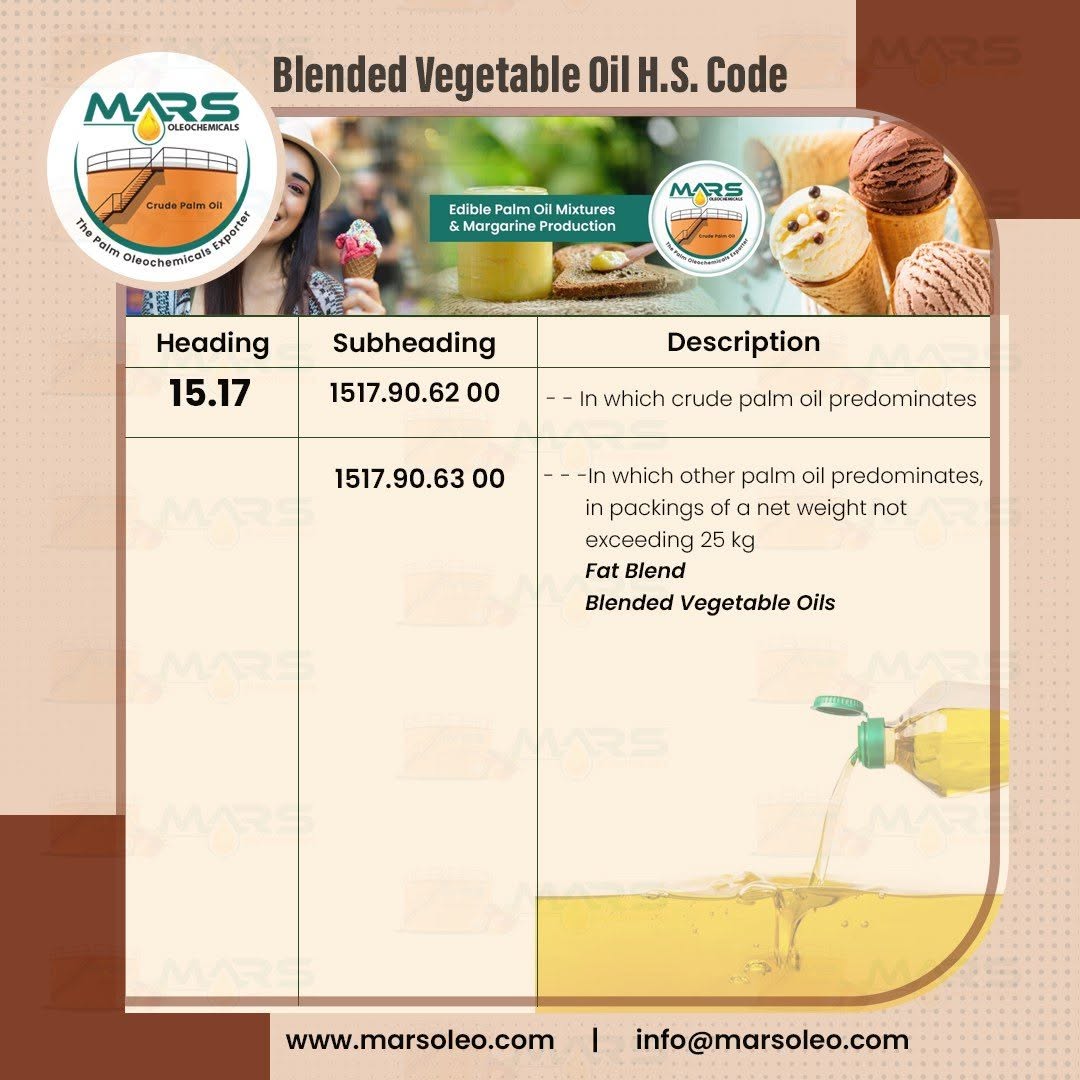
Blended vegetable oil mixtures may be classified under HS Heading 15.17, which covers margarine and edible mixtures or preparations of vegetable or animal fats and oils.
Relevant Malaysian tariff codes include:
HS Code 1517.90.62 00 - Crude Palm Oil Predominates
This classification applies to qualifying liquid vegetable fat or oil mixtures in which crude palm oil predominates.
HS Code 1517.90.63 00 - Other Palm Oil Predominates
This classification applies to qualifying liquid vegetable fat or oil mixtures in which palm oil other than crude palm oil predominates, packed in containers with a net weight not exceeding 25 kg.
For relevant mixtures packed in containers exceeding 25 kg net weight, HS Code 1517.90.64 00 should also be considered.
The appropriate tariff classification depends on the actual ingredients, proportions, processing and packaging of the finished product.

Blended Vegetable Oil HS Codes including palm oil-based fat blends, edible vegetable oil mixtures, commercial applications and Malaysian.
Vegetable oil blends can be manufactured using different combinations of oils to achieve desired functional characteristics.
Examples include:
The proportions and technical specifications vary according to product requirements.
Palm-based vegetable oil blends provide manufacturers with flexibility in developing cooking oils and edible fat systems.
Combining oils with different fatty acid profiles can help achieve suitable melting behaviour, flavour, texture and processing characteristics.
Selected blends can provide useful oxidative stability for cooking and frying applications, although performance depends on the individual oils and manufacturing conditions.
Vegetable oil blending can also assist manufacturers in balancing raw material availability, functional requirements and production costs.
Blended vegetable oils are used in food processing because they offer flexibility in formulation and processing.
For frying applications, appropriate oil blends may provide the desired thermal and oxidative characteristics.
In bakery manufacturing, oil and fat mixtures can contribute to product tenderness, texture and overall eating quality.
In margarine and shortening manufacturing, suitable fat blends help establish specific physical and melting properties.
Food manufacturers must select formulations according to their intended processing conditions, product requirements and applicable food standards.
Suitable vegetable oil blends can be incorporated into selected cosmetics, skincare and personal care formulations.
Depending on the formulation, these oils may function as emollients, conditioning ingredients or components of oil-based products.
Applications can include creams, lotions, body oils, balms and certain soap formulations.
Cosmetic suitability depends on the oil composition, purity, oxidation characteristics and finished-product requirements.
Selected vegetable oil blends may also serve as feedstocks for industrial processing.
Potential applications include biodiesel production, oleochemical processing, specialty lubricant formulations and related chemical manufacturing.
Industrial suitability depends on the specific formulation and technical characteristics.
Important technical specifications may include:
Industrial and food manufacturers should review the supplier's Technical Data Sheet (TDS), Certificate of Analysis (COA) and relevant supporting documentation.
Mars Oleochemicals Sdn. Bhd. is an MPOB-licensed Malaysian palm oil and oleochemical exporter supporting international trade in palm-based products.
Our product knowledge covers crude palm oil, refined palm oil products, palm kernel oil and various oleochemical derivatives.
We welcome commercial inquiries concerning edible vegetable oil blends, product specifications, packaging and international shipment requirements.
Visit our website at www.marsoleo.com For product requirements, technical documentation, commercial information and international export inquiries, please email us at info@marsoleo.com.










Home :: Products :: Enquiry :: Contact Us :: Site Map
Copyright All Rights Reserved © 2025. Mars Oleochemicals :: Disclaimer :: Privacy Policy


