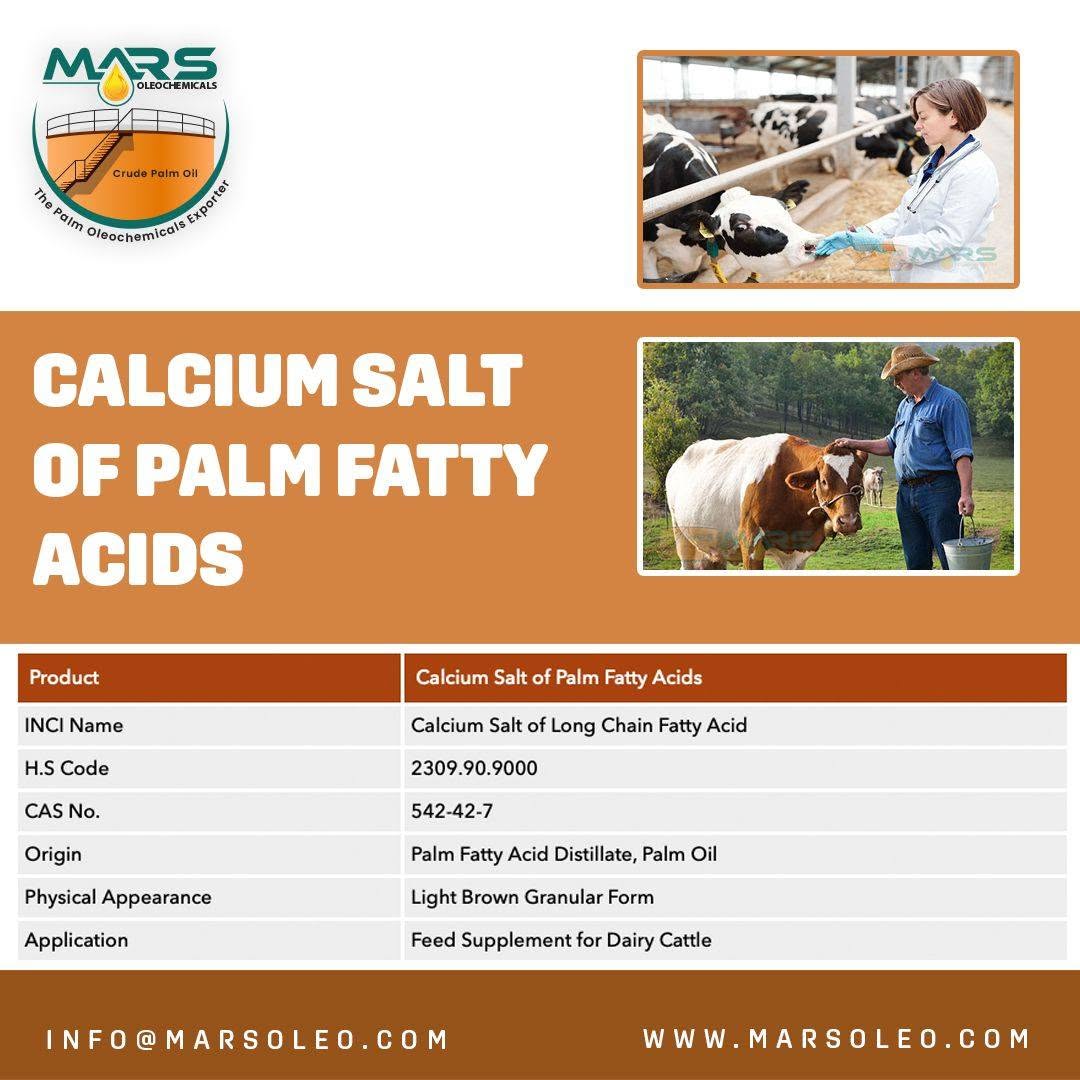
Calcium Salts of Palm Fatty Acids are produced by reacting palm-derived long-chain fatty acids with a calcium source such as calcium hydroxide. The resulting calcium soaps contain several fatty acids rather than only palmitic acid. Mars currently publishes a profile containing palmitic, stearic, oleic and linoleic acids, with C16:0 palmitic acid specified at 45% minimum.
Calcium Salts of Palm Fatty Acids dietary oils can interact with rumen microorganisms and fibre digestion when supplied at excessive levels. Converting long-chain fatty acids to calcium salts makes the supplemental fat relatively less available in the rumen under suitable conditions. The fatty acids can subsequently become available for digestion, providing a concentrated source of energy to the animal. Rumen conditions and product composition still influence performance, so “protected” should not be interpreted as complete rumen bypass.

Calcium Salts of Palm Fatty Acids for Dairy Nutrition and Rumen-Protected Energy from Malaysia Worldwide.
Calcium salts of long-chain fatty acids can help increase dietary energy density and may support milk yield, milk-fat output, feed efficiency or maintenance of body energy reserves under appropriate nutritional conditions. However, controlled studies have produced different responses depending on diet composition, inclusion level and production conditions. They should therefore be treated as a ration ingredient rather than as a guaranteed milk-production or fertility enhancer.
Mars Oleochemicals supplies Calcium Salts of Palm Fatty Acids for dairy and ruminant feed applications. Its current published grade contains 82.5–85% crude fat, 8.5–10.5% calcium and maximum 5% moisture and is supplied in light-brown granular form. Buyers should review the current specification, SDS, TDS, COA, fatty-acid profile, feed-safety documentation and certifications before commercial approval.
1. What are Calcium Salts of Palm Fatty Acids? Calcium Salts of Palm Fatty Acids are palm-derived long-chain fatty acids reacted with calcium to produce a relatively rumen-inert fat ingredient used to increase dietary energy density in ruminant feed.
2. Are Calcium Salts of Palm Fatty Acids the same as Calcium Palmitate? Not exactly. Calcium palmitate is the calcium salt of pure palmitic acid, while commercial Calcium Salts of Palm Fatty Acids contain calcium salts of several fatty acids including palmitic, stearic, oleic and linoleic acids.
3. What does CAS number 542-42-7 represent? CAS number 542-42-7 identifies calcium palmitate. For a commercial mixture of calcium salts of palm fatty acids, the actual manufacturer's current SDS should be used to determine the appropriate chemical identifiers.
4. Does Calcium Salt of Palm Fatty Acids have a molecular formula? The commercial product does not have one molecular formula because it contains calcium salts of several fatty acids. Pure calcium palmitate has the formula C32H62CaO4.
5. What is the HS code for Calcium Salts of Palm Fatty Acids? When supplied as an animal-feed preparation, the product is commonly classified within HS 2309.90. The complete national tariff extension should be confirmed with the relevant customs authority.
6. Why are Calcium Salts of Palm Fatty Acids used in dairy cattle diets? They provide a concentrated source of dietary fat and energy while being relatively inert in the rumen, helping nutritionists increase ration energy density without relying entirely on additional fermentable carbohydrates.
7. Do Calcium Salts of Palm Fatty Acids increase milk production? They may support milk yield, milk-fat production or feed efficiency under suitable dietary conditions, but responses vary with diet, inclusion level, fatty-acid composition, lactation stage and individual herd conditions.
8. What fatty acids are present in the Mars product? The published Mars specification includes palmitic, stearic, oleic and linoleic acids, with palmitic acid specified at a minimum of 45 percent of the fatty-acid profile.
9. Which quality parameters should buyers review? Buyers should review crude fat, calcium, moisture, ash, free fatty acids, fatty-acid composition, physical appearance, contaminants, feed-safety documentation and the current Certificate of Analysis.
10. Where can buyers source Calcium Salts of Palm Fatty Acids from Malaysia? International buyers can contact Mars Oleochemicals Sdn. Bhd. for specifications, packing options, feed-safety documentation, current certifications, availability and export quotations.











Home :: Products :: Enquiry :: Contact Us :: Site Map
Copyright All Rights Reserved © 2025. Mars Oleochemicals :: Disclaimer :: Privacy Policy