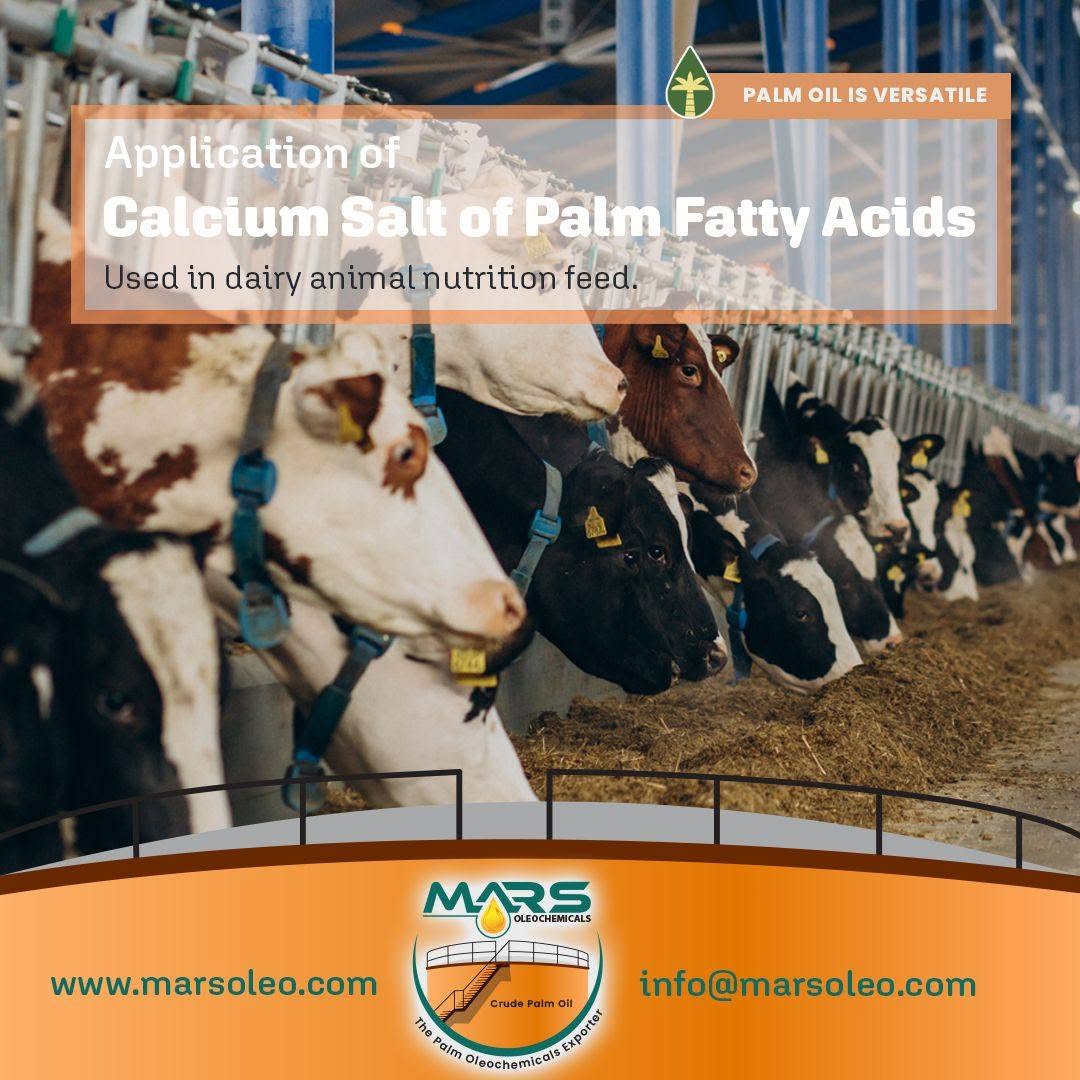
Calcium salts of palm fatty acids are produced by reacting palm-derived long-chain fatty acids with a calcium source. The resulting granular feed ingredient is often called calcium soap, calcium palmitate, bypass fat or rumen-protected fat. Commercial products contain calcium combined with fatty acids such as palmitic, stearic, oleic and linoleic acids.
Calcium salts are formulated to remain relatively stable at the pH normally found in a healthy rumen. This reduces direct contact between free fatty acids and rumen microorganisms. After the material passes into more acidic digestive conditions, the salts can dissociate, allowing the fatty acids to be digested and absorbed farther along the gastrointestinal tract. The protection is relative rather than absolute.

Calcium Salt of Palm Fatty Acids for Dairy Nutrition, Energy and Global Supply from Malaysia.
Calcium salts increase the energy concentration of dairy rations without requiring an equivalent increase in starch. A published meta-analysis found average increases in milk, milk-fat and fat-corrected-milk yields, as well as improved feed efficiency, although it also found small reductions in dry-matter intake and milk-protein concentration. Results therefore depend on the product, inclusion rate, production stage and overall ration.
Mars Oleochemicals supplies Calcium Salt of Palm Fatty Acids 85 for dairy-cattle feed applications. Its published specification includes 82.5-85% crude fat, 8.5-10.5% calcium, maximum 5% moisture and at least 45% palmitic acid. Buyers can request current specifications, certificates, packing options, availability and export quotations from Malaysia.
1. What are calcium salts of palm fatty acids? Calcium salts of palm fatty acids are feed-fat ingredients produced by reacting palm-derived long-chain fatty acids with calcium. They are commonly used as rumen-protected or bypass-fat supplements for dairy cattle.
2. Why are calcium salts used in dairy-cow feed? Calcium salts are used to increase the energy density of dairy-cow diets while reducing the disruptive effects that excessive unprotected oils may have on rumen microorganisms and fibre digestion.
3. Are calcium salts completely inert in the rumen? No. Calcium salts are designed to be relatively stable under normal rumen conditions, but their degree of dissociation depends on rumen pH, fatty-acid composition, product quality and the complete diet.
4. Where are the fatty acids digested and absorbed? After leaving the rumen, calcium salts dissociate under more acidic digestive conditions. Their fatty acids can then be digested and absorbed mainly through the small intestine.
5. Can calcium salts improve milk production? Research indicates that calcium salts of palm fatty acids may increase milk yield, milk-fat yield, fat-corrected milk and feed efficiency in some diets. Responses vary with feeding rate, lactation stage and ration composition.
6. What fatty acids are present in calcium salts of palm fatty acids? Commercial products may contain palmitic, stearic, oleic and linoleic acids. Mars Oleochemicals specifies at least 45 percent palmitic acid for its Calcium Salt of Palm Fatty Acids 85 grade.
7. When are rumen-protected fats commonly fed? They are commonly considered for transition, early-lactation and high-producing dairy cows when dietary energy demand is high. The feeding programme should be established by a qualified animal nutritionist.
8. What quality parameters should buyers review? Buyers should review crude fat, calcium, moisture, ash, free fatty acid, fatty-acid composition, physical form, odour, feed-safety certification, shelf life and compatibility with the intended ration. Mars Oleochemicals publishes these analytical parameters for its Calcium Salt of Palm Fatty Acids 85 grade.
9. Where can buyers source calcium salts of palm fatty acids from Malaysia? International buyers can contact Mars Oleochemicals Sdn. Bhd. for Calcium Salt of Palm Fatty Acids 85 specifications, packing options, documentation, availability and export quotations from Malaysia.












Home :: Products :: Enquiry :: Contact Us :: Site Map
Copyright All Rights Reserved © 2025. Mars Oleochemicals :: Disclaimer :: Privacy Policy