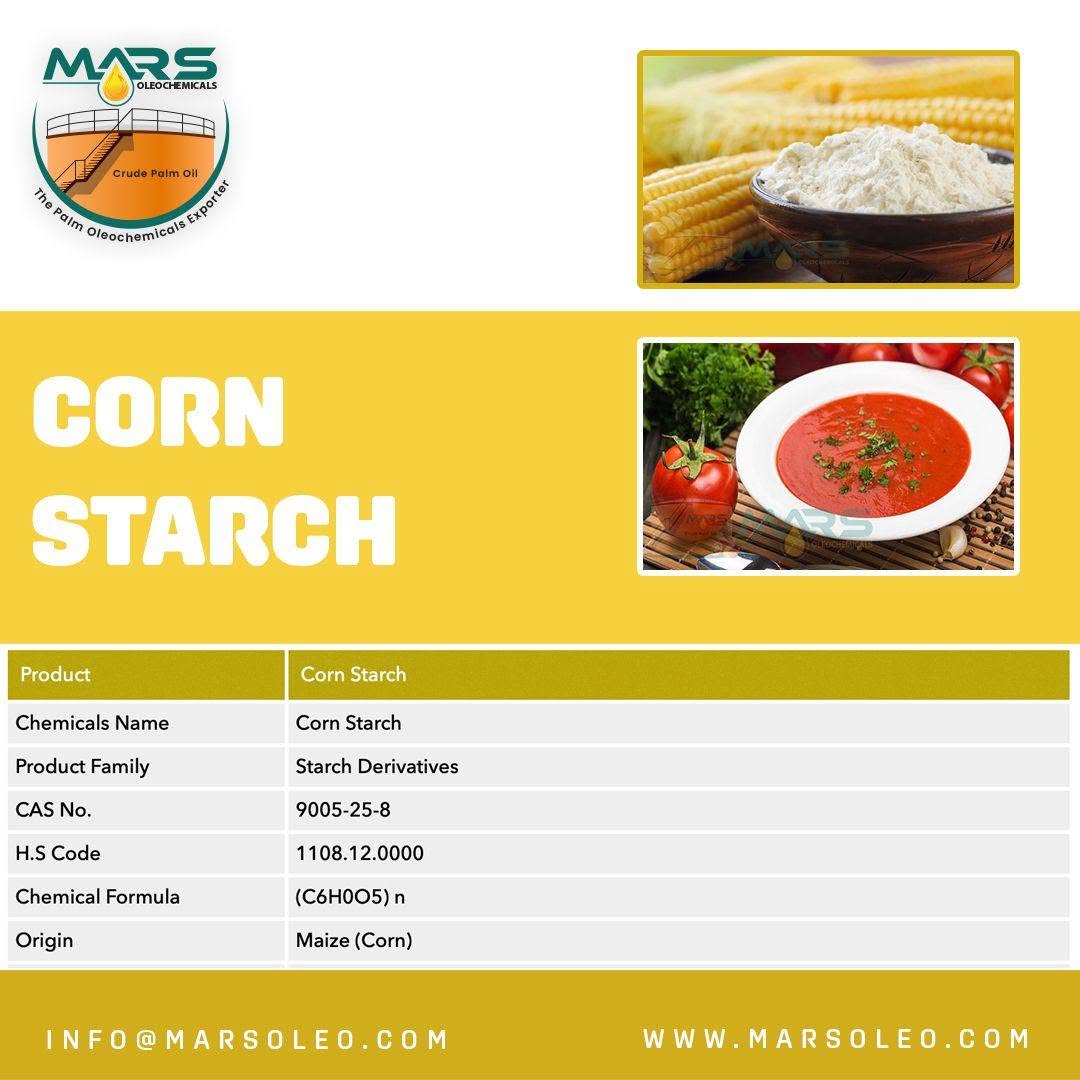
Corn Starch, also known as Maize Starch, is a natural carbohydrate polymer separated mainly from the endosperm of corn kernels during wet milling. It consists principally of the glucose polymers amylose and amylopectin and is supplied as a fine white powder. Codex classifies native starch as a naturally occurring granular glucose polymer separated from plant materials such as corn.
Native corn starch develops viscosity when its granules are dispersed in water and heated. As temperature increases, the granules absorb water, swell and undergo gelatinization, creating a thicker continuous phase. This functionality makes corn starch valuable in sauces, soups, gravies, puddings, fillings and many processed-food formulations where controlled texture and consistency are required.

Corn Starch Food Grade for Thickening, Bakery, Sauces, Confectionery and Industrial Applications from Malaysia Worldwide.
Beyond food processing, corn starch is used in paper manufacturing, corrugated board, textile sizing, adhesive systems, pharmaceuticals, cosmetics and personal-care formulations. In cosmetics, Zea Mays Starch can function as an absorbent, anticaking ingredient and viscosity regulator. Mars also publishes paper, textile, adhesive and pharmaceutical applications for its maize-starch product.
Mars Oleochemicals supplies Corn Starch for food and industrial applications and currently publishes a specification including 98% minimum starch content, 12.5% maximum moisture and white-powder appearance. Commercial buyers should review the current TDS, SDS, COA, microbiological parameters, origin documents and applicable food-safety certifications before approving a shipment.
1. What is Corn Starch? Corn Starch, also called Maize Starch, is a native carbohydrate polymer extracted primarily from the endosperm of maize kernels through wet milling. It is supplied as a fine white powder.
2. What is the correct chemical formula for Corn Starch? The general repeating formula for starch is (C6H10O5)n. Because starch contains high-molecular-weight amylose and amylopectin polymers of varying chain lengths, it does not have one fixed molecular weight.
3. What are the CAS and EC numbers for Corn Starch? Starch commonly uses CAS number 9005-25-8 and EC or EINECS number 232-679-6.
4. What is the HS code for Corn Starch? The international six-digit HS subheading for maize starch is 1108.12. Longer national tariff codes, including 1108.12.0000, should be confirmed with the relevant customs authority.
5. What is the cosmetic INCI name for Corn Starch? The recognised cosmetic INCI name for corn starch is Zea Mays Starch. In cosmetic formulations it can function as an absorbent, anticaking agent, skin protectant and viscosity-control ingredient.
6. What is Corn Starch used for in food? Corn Starch is commonly used to thicken sauces, soups and gravies and to provide texture, viscosity, binding and bulk in bakery products, confectionery, snacks, desserts and processed foods.
7. How does Corn Starch thicken food? When corn starch is heated with sufficient water, its starch granules absorb water, swell and gelatinize. This increases viscosity and creates the thickened texture used in sauces, soups and fillings.
8. Is Corn Starch the same as Corn Flour? The terminology depends on the market. Maize Starch is the most precise international term. In some countries corn flour means corn starch, while in others it means finely milled whole corn.
9. What industrial applications use Corn Starch? Corn Starch is used in paper and corrugated board, textile sizing, adhesives, pharmaceuticals, personal care, biodegradable materials and other industrial formulations requiring binding, viscosity or absorbency.
10. Where can buyers source Corn Starch from Malaysia? International buyers can contact Mars Oleochemicals Sdn. Bhd. for Corn Starch specifications, packing options, quality documentation, current certifications, availability and export quotations.










Home :: Products :: Enquiry :: Contact Us :: Site Map
Copyright All Rights Reserved © 2025. Mars Oleochemicals :: Disclaimer :: Privacy Policy