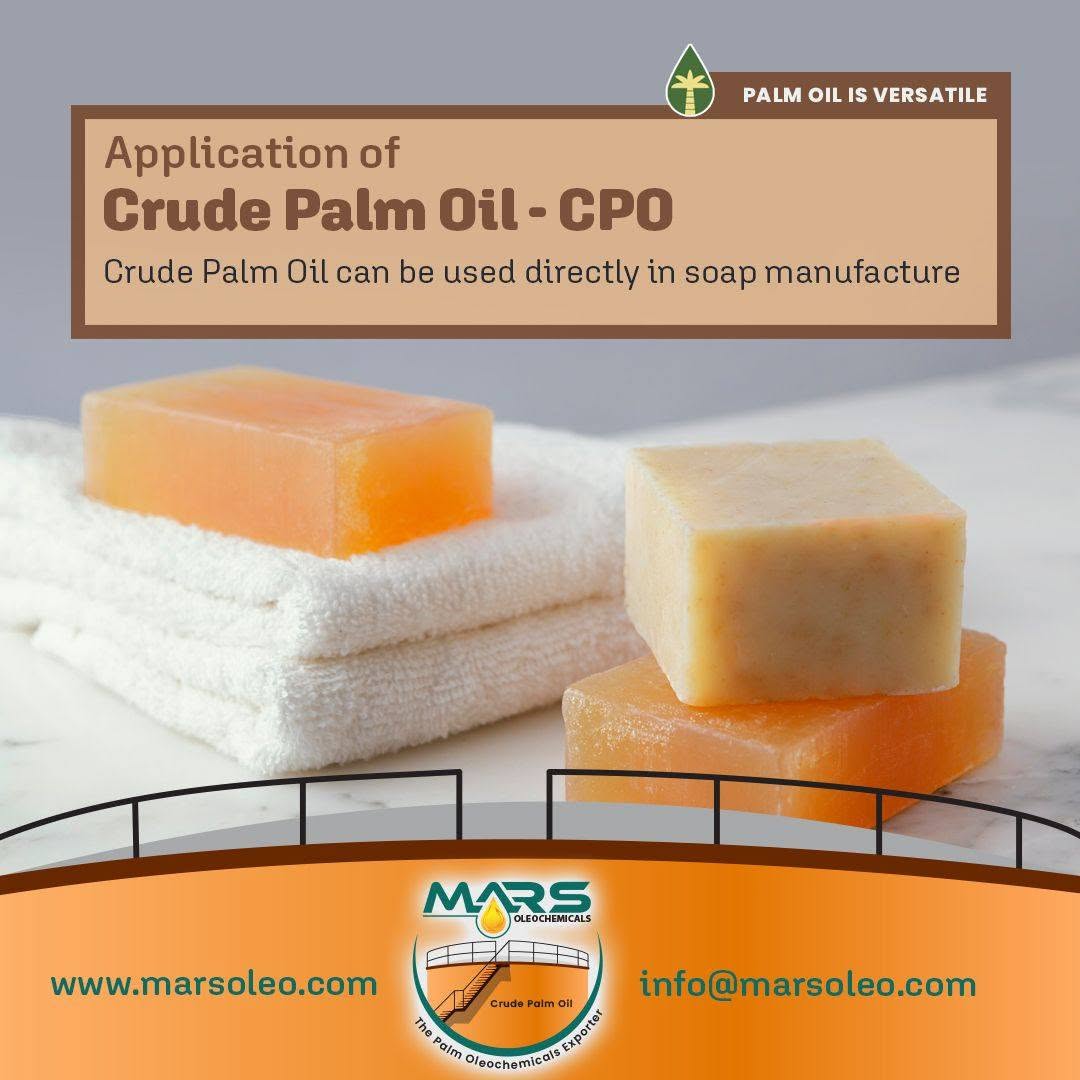
Crude Palm Oil is an unrefined vegetable oil extracted from the fleshy mesocarp of oil-palm fruit. It contains triglycerides together with naturally occurring carotenoids, tocopherols, tocotrienols and other minor components. Its carotenoids give CPO a characteristic orange-red appearance before refining, bleaching and deodorising.
Crude Palm Oil CPO can be introduced as the oil feedstock in soap production and reacted with sodium hydroxide or potassium hydroxide. This saponification process converts the oil's triglycerides into fatty-acid salts and glycerol. Palm-derived soap is produced from a renewable vegetable-oil source and can be manufactured through established batch or continuous processing systems.

Crude Palm Oil CPO for Soap Manufacturing Oleochemicals and Reliable Global Supply from Malaysia Worldwide.
Crude Palm Oil contains mainly palmitic and oleic fatty acids, which can contribute structure, hardness, conditioning and balanced bar characteristics. Because palm oil contains relatively little of the C12-C14 fatty acids associated with stronger detergency and lather, it is commonly blended with palm kernel or coconut oil to achieve the required cleansing and foam profile.
Mars Oleochemicals supplies Malaysian Crude Palm Oil to international soap manufacturers, oleochemical processors, importers and distributors. Buyers can request the current specification, origin, free-fatty-acid level, moisture and impurities, packing or bulk-shipment options, quality documentation, availability and export quotation.
1. What is Crude Palm Oil? Crude Palm Oil, commonly called CPO, is unrefined palm oil extracted from the fleshy mesocarp of oil-palm fruit. It contains triglycerides, natural pigments and other minor components before refining.
2. Can Crude Palm Oil be used directly in soap manufacturing? Yes. Crude Palm Oil can be used directly as the vegetable-oil feedstock, but it must undergo saponification with an alkali to become soap. It is not added unchanged as the finished cleansing agent.
3. How is Crude Palm Oil converted into soap? During saponification, Crude Palm Oil triglycerides react with sodium hydroxide or potassium hydroxide to form fatty-acid salts and glycerol. Sodium soaps are generally firmer, while potassium soaps are usually softer or liquid.
4. What properties does palm oil contribute to soap? Palm oil's palmitic- and oleic-acid profile can contribute bar structure, hardness, conditioning and stable soap properties. Final performance depends on the oil blend, alkali level, additives and manufacturing process.
5. Why is palm oil blended with palm kernel oil in soap? Palm kernel oil contains more C12-C14 fatty acids, which can increase detergency and lather. Combining palm oil and palm kernel oil in appropriate proportions helps manufacturers balance bar hardness, cleansing and foam.
6. Can Crude Palm Oil affect the colour and odour of soap? Yes. Natural carotenoids give Crude Palm Oil its orange-red colour, and crude components may influence finished-soap colour and odour. Bleaching or refining may be selected for lighter-coloured or more neutral soap products.
7. Is Crude Palm Oil the same as RBD Palm Oil? No. Crude Palm Oil is the unrefined oil obtained from the fruit mesocarp. RBD Palm Oil has undergone refining, bleaching and deodorising to reduce impurities, colour and unwanted odours.
8. Which quality parameters should CPO buyers review? Buyers should review free fatty acid, moisture and impurities, iodine value, saponification value, peroxide value, colour, DOBI, storage conditions, origin, certifications and compatibility with the intended manufacturing process. DOBI is specifically used by the palm-oil industry as a quality-control indicator for CPO bleachability.
9. Where can buyers source Malaysian Crude Palm Oil? International buyers can contact Mars Oleochemicals Sdn. Bhd. for Malaysian Crude Palm Oil specifications, packing options, quality documentation, product availability and export quotations.










Home :: Products :: Enquiry :: Contact Us :: Site Map
Copyright All Rights Reserved © 2025. Mars Oleochemicals :: Disclaimer :: Privacy Policy