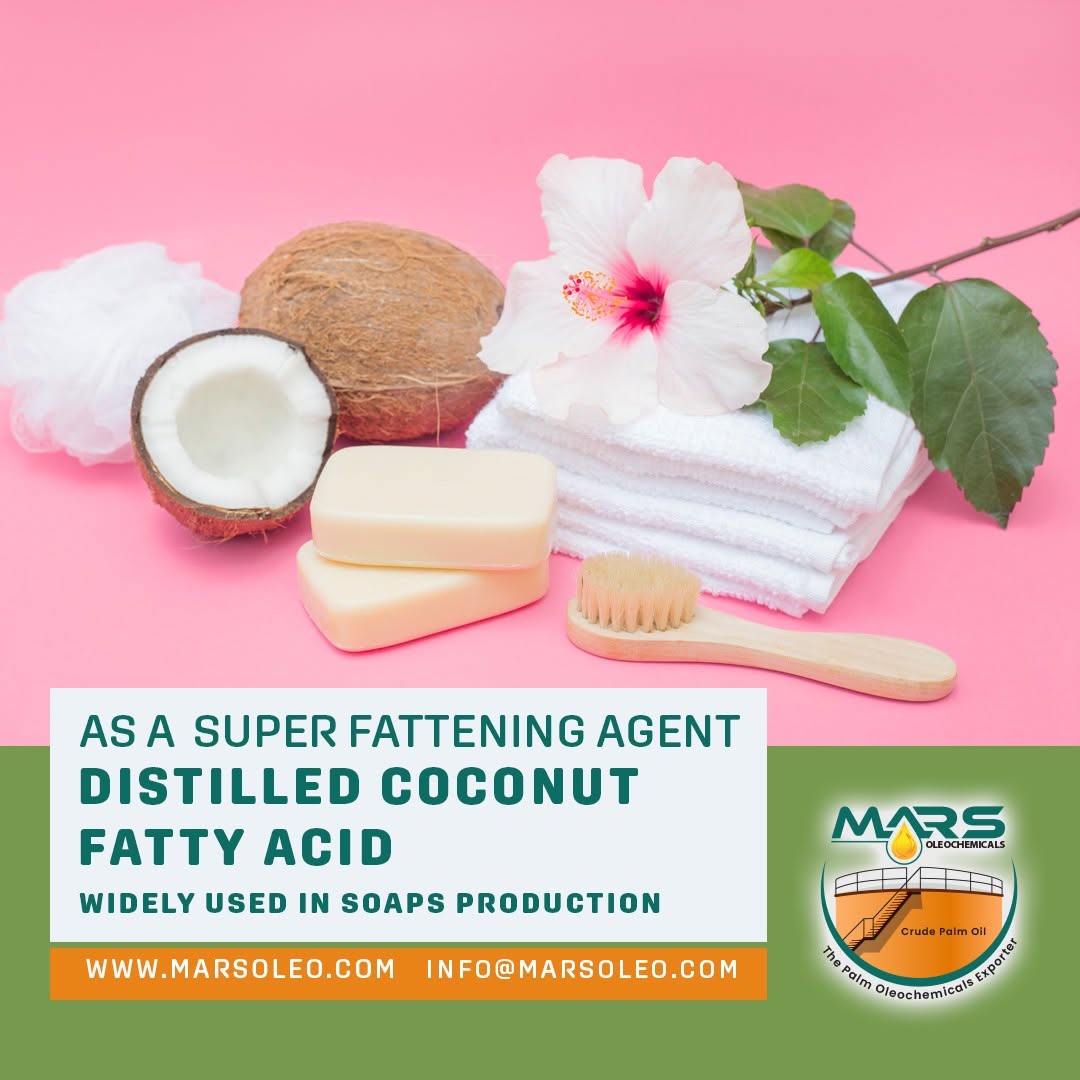
Distilled Coconut Fatty Acid, commonly abbreviated DCFA, is produced from coconut-derived fatty acids that are purified through distillation. Commercial DCFA typically contains a mixture of medium- and long-chain fatty acids, with lauric and myristic acids forming important portions of the composition. These characteristics make coconut fatty acids useful as raw materials in soap and detergent manufacturing. Wilmar's current DCFA specification, for example, lists C12 as the largest individual fatty-acid fraction.
In soap production, fatty acids react with an alkali during saponification or neutralization to form fatty-acid salts that function as soap. The chain distribution of coconut fatty acids contributes to the performance profile of the finished cleansing system. Because DCFA contains significant shorter and medium-chain fatty acids compared with many other vegetable fatty-acid cuts, formulators can use it in soaps and cleansers requiring effective cleansing and lather characteristics. Commercial oleochemical suppliers specifically list distilled coconut fatty acids for soap and detergent applications.

Distilled coconut fatty acid soap making through cleansing, lather, structuring, and formulation flexibility.
Distilled Coconut Fatty Acid as a “super fattening agent” widely used in soap production. That positioning can apply when a formulation deliberately leaves or adds fatty material beyond the quantity completely neutralized by alkali. The resulting free fatty components can alter the feel and characteristics of the finished cleansing product. However, the effect depends on the fatty-acid level, neutralization degree and overall soap formulation rather than DCFA automatically functioning as a moisturizer in every application.
coconut fatty acids can serve as raw materials or chemical building blocks for surfactants, esters and other oleochemical derivatives. Mars Oleochemicals coconut acid grades with emollient, emulsifying and surfactant/cleansing functionality across skin care, hair care and toiletries, while Wilmar identifies fatty acids as feedstocks for soaps, metallic soaps, esters and other derivatives.
What is Distilled Coconut Fatty Acid? Distilled Coconut Fatty Acid is a purified mixture of fatty acids derived from coconut-based feedstock and used in soaps, detergents, personal care and oleochemical manufacturing.
What does DCFA stand for? DCFA commonly stands for Distilled Coconut Fatty Acid.
Is DCFA used in soap manufacturing? Yes. Distilled Coconut Fatty Acid is commercially used as a fatty-acid raw material for soap and related products.
Is DCFA a superfatting agent? DCFA can be used to support superfatting in appropriately designed formulations, but the actual superfatting effect depends on how much fatty material remains unneutralized.
Does DCFA produce lather? Its fatty-acid profile, particularly the substantial lauric fraction found in typical coconut fatty acids, can contribute to the lather characteristics of resulting soap formulations.
Does DCFA moisturize skin? The finished soap's skin feel depends on the total formulation. DCFA should not automatically be marketed as guaranteeing moisturization.
Is DCFA used in personal-care products? Yes. Coconut fatty-acid grades are used across toiletries, skin care and other personal-care formulations and as feedstocks for derivatives.
Is DCFA the same as Lauric Acid? No. DCFA is a mixture of multiple fatty acids. Lauric Acid, or C12, is typically one of its major components.
What is the difference between DCFA and topped coconut fatty acid? Topped coconut fatty acid has some lighter fatty-acid fractions removed, giving it a different composition and technical profile.
Is hardened coconut fatty acid the same as regular DCFA? No. A hardened grade has undergone hydrogenation, which reduces unsaturation and changes properties such as iodine value.
Does Mars Oleochemicals supply Distilled Coconut Fatty Acid? Yes. Mars Oleochemicals supplies Distilled Coconut Fatty Acid K8-18 for international commercial requirements.
How can buyers request DCFA? Buyers can provide the required grade, fatty-acid composition, specification, quantity, packaging, intended application and destination to info@marsoleo.com.





Home :: Products :: Enquiry :: Contact Us :: Site Map
Copyright All Rights Reserved © 2025. Mars Oleochemicals :: Disclaimer :: Privacy Policy