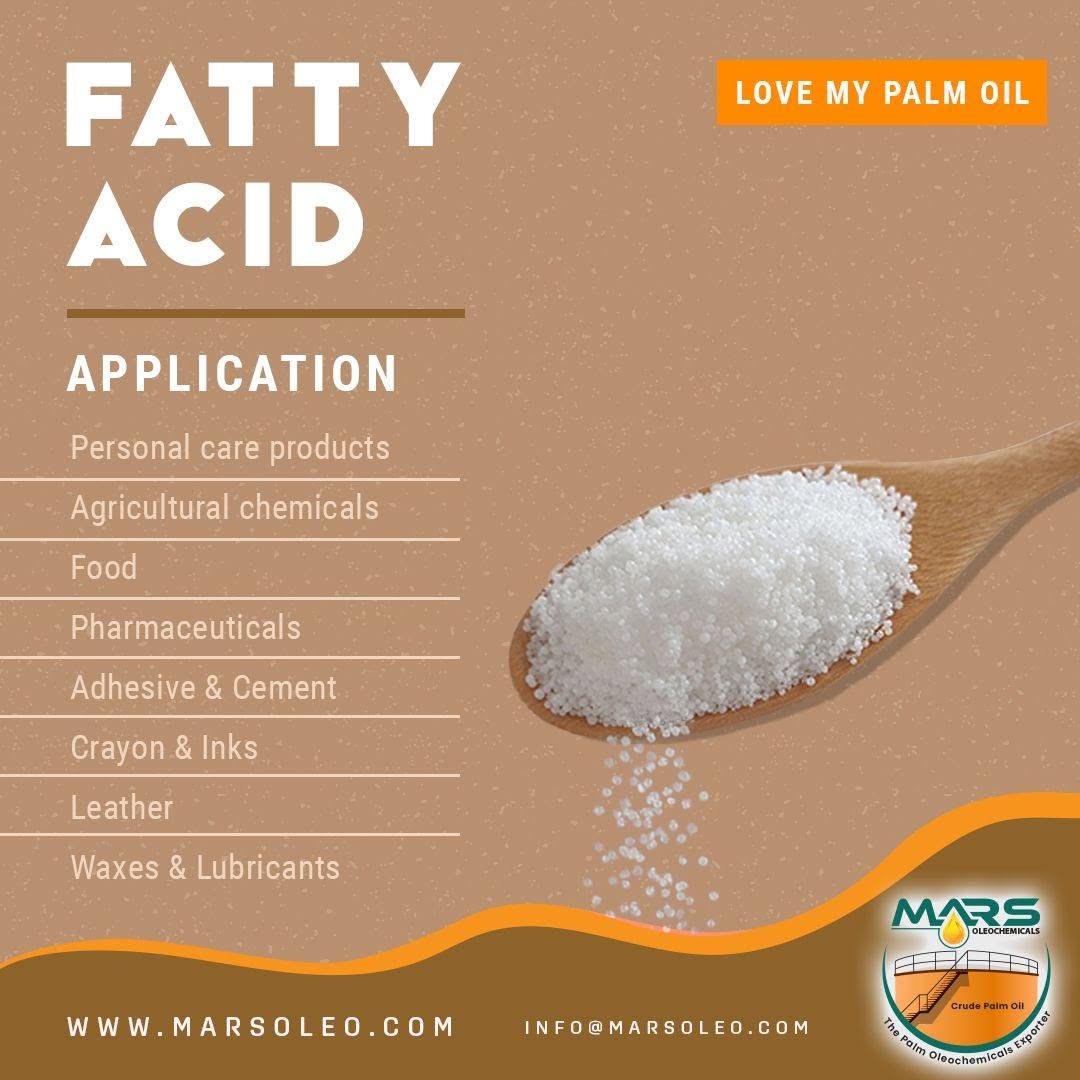
Palm-based fatty acids are oleochemical raw materials produced from vegetable-oil feedstocks such as palm oil and palm-kernel oil. Commercial fatty-acid families include Stearic Acid, Oleic Acid, Palmitic Acid, Lauric Acid and Myristic Acid, with different carbon-chain distributions and purity levels selected according to manufacturing requirements. Mars currently supplies these different grades for a wide range of downstream applications.
Appropriate fatty-acid grades are widely used in soaps, cleansers, creams, lotions, shampoos and other personal-care products. Depending on the acid and formulation, they can contribute to structure, cleansing systems, emulsification support or serve as raw materials for surfactants, esters and other functional derivatives.

Fatty Acids Support Personal Care, Food, Pharmaceutical and Industrial Manufacturing Applications Worldwide.
Selected fatty acids are used in agricultural chemicals, adhesives, crayons, cement-related formulations, coatings, printing inks, leather processing, waxes, lubricants, rubber, plastics and textiles. Mars Oleochemicals Sdn Bhd specifically lists these applications for selected palmitic, stearic and oleic acid grades, while industrial fatty-acid derivatives are also used in coatings, adhesives and lubricant systems.
Not every fatty acid is suitable for every application. Chain length, saturation, purity, composition, melting behaviour and regulatory grade determine how a fatty acid performs in a formulation. Food and pharmaceutical applications especially require appropriate specifications and regulatory suitability Mars Oleochemicals Sdn Bhd that only certain fatty-acid grades within its range are manufactured for these applications.
What are palm-based fatty acids used for? Palm-based fatty acids are used in personal care, soaps, detergents, food, pharmaceuticals, coatings, adhesives, lubricants, rubber, plastics, textiles and other industrial formulations. Mars and other established oleochemical producers document this broad range of applications.
Which fatty acids are commonly supplied for industrial applications? Common commercial fatty acids include Stearic Acid, Oleic Acid, Palmitic Acid, Lauric Acid, Myristic Acid and blended or distilled fatty-acid grades. Mars currently lists these among its Malaysian fatty-acid portfolio.
Are fatty acids used in personal care products? Yes. Appropriate cosmetic-grade fatty acids are used in soaps, creams, lotions, cleansers, shampoos and other personal-care formulations.
Can fatty acids be used in food and pharmaceutical applications? Yes, selected fatty acids can be used in food and pharmaceutical applications when the specific grade, purity, specification and regulatory requirements are suitable for the intended use.
How are fatty acids used in adhesives, coatings and inks? Selected fatty acids and their derivatives serve as chemical intermediates and functional raw materials in adhesive, resin, coating, pigment and printing-ink systems. Dimer fatty acids, for example, are commercially used in hot-melt adhesives, coatings and printing inks.
Are fatty acids used in lubricants? Yes. Selected fatty acids and fatty-acid derivatives are used for lubricity, ester production, metalworking fluids and other industrial lubricant formulations.
Does every fatty acid work for every application? No. Performance and suitability depend on fatty-acid chain length, composition, purity, physical form, grade, formulation requirements and applicable regulations.
Where can buyers source palm-based fatty acids from Malaysia? International buyers can contact Mars Oleochemicals Sdn. Bhd. for fatty-acid specifications, available grades, packing options, technical documentation, availability and export quotations. Mars currently lists Stearic, Oleic, Palmitic, Lauric, Myristic and other fatty-acid grade.






Home :: Products :: Enquiry :: Contact Us :: Site Map
Copyright All Rights Reserved © 2025. Mars Oleochemicals :: Disclaimer :: Privacy Policy