


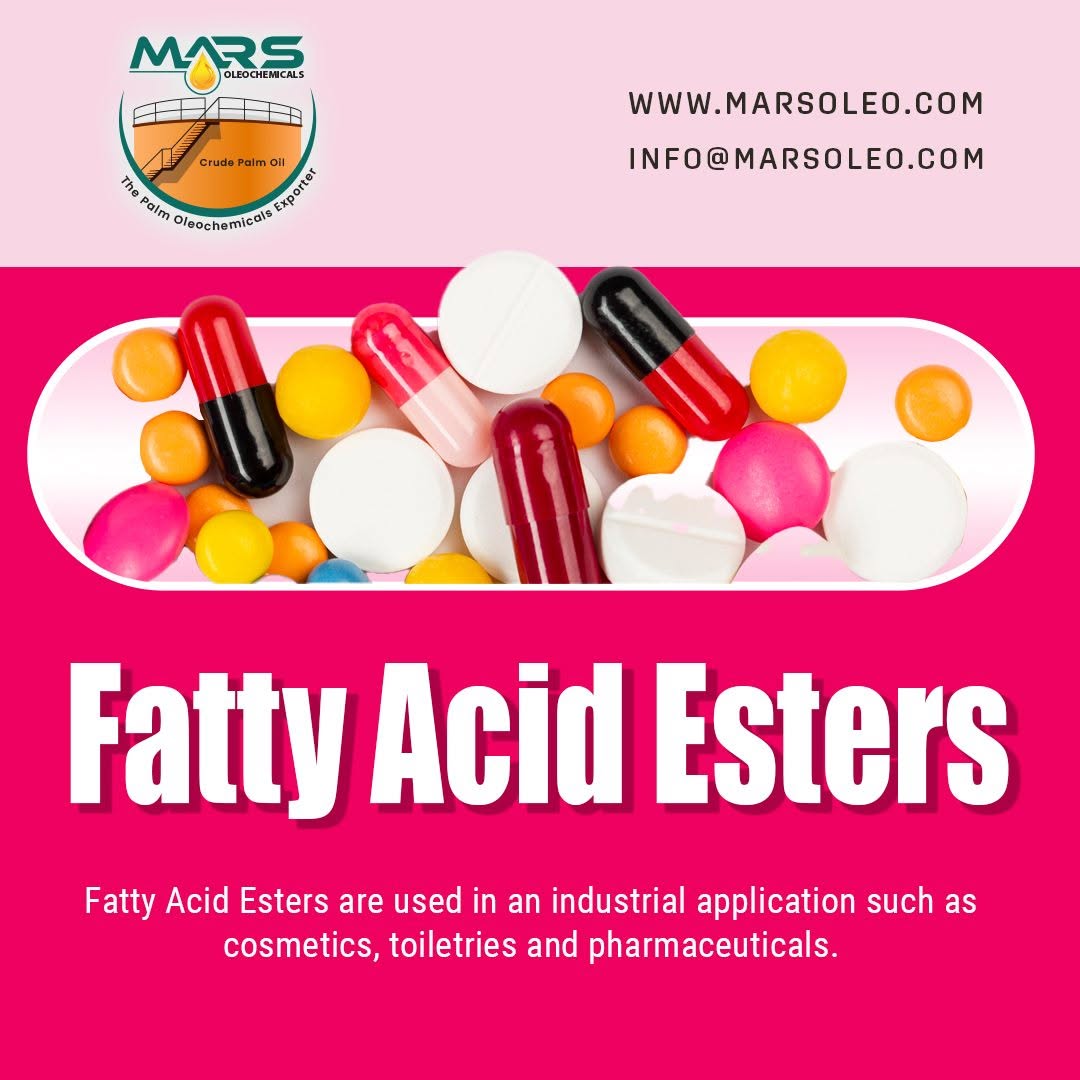
Fatty Acid Esters are versatile oleochemical derivatives created by reacting fatty acids with alcohols or other hydroxyl-containing compounds. Their properties vary according to molecular structure, making them useful across cosmetics, personal care, pharmaceutical, food and industrial applications.
Isopropyl Palmitate and Isopropyl Myristate are widely associated with cosmetic and personal-care formulations where they can provide emolliency, spreading, slip and texture modification. Although related, IPP and IPM have different fatty-acid chain structures and should be selected according to formulation requirements.

Fatty acid esters provide emolliency, texture, lubrication and formulation functionality across industries worldwide.
Glyceryl Monostearate is another important Fatty Acid Ester family. Depending on grade, GMS can function as an emulsifier, structuring ingredient or texture modifier in food, cosmetics, personal care and other suitable formulations.
Buyers should specify the ester name, grade, purity, technical specification, application, quantity, packaging and destination. COA, TDS and SDS documents should be reviewed to confirm technical suitability, while food or pharmaceutical applications may require additional grade-specific compliance.
What are Fatty Acid Esters? Fatty Acid Esters are compounds formed when Fatty Acids react with alcohols or other hydroxyl-containing compounds.
What are Fatty Acid Esters used for? They are used in cosmetics, personal care, pharmaceutical formulations, food systems, lubricants and other specialty applications depending on grade.
What is Isopropyl Palmitate? Isopropyl Palmitate is an ester of Palmitic Acid and isopropyl alcohol commonly used in cosmetic and personal-care formulations.
What is Isopropyl Myristate? Isopropyl Myristate is the ester of Myristic Acid and isopropyl alcohol and is widely used in cosmetic and personal-care formulations.
What is Glyceryl Monostearate? Glyceryl Monostearate is a glycerol Fatty Acid Ester used for emulsification, texture, consistency and formulation support.
What is the difference between IPP and IPM? IPP is based on Palmitic Acid while IPM is based on Myristic Acid, giving them different molecular structures and formulation characteristics.
Are Fatty Acid Esters used in cosmetics? Yes. Many ester grades are widely used as emollients, spreading agents, texture modifiers and formulation components.
Are Fatty Acid Esters used in pharmaceuticals? Certain suitable ester grades may be used in pharmaceutical or topical formulations, but the required pharmaceutical-grade specification and compliance must be confirmed.
How can buyers contact Mars Oleochemicals? Commercial enquiries can be sent to info@marsoleo.com.










Home :: Products :: Enquiry :: Contact Us :: Site Map
Copyright All Rights Reserved © 2025. Mars Oleochemicals :: Disclaimer :: Privacy Policy


