


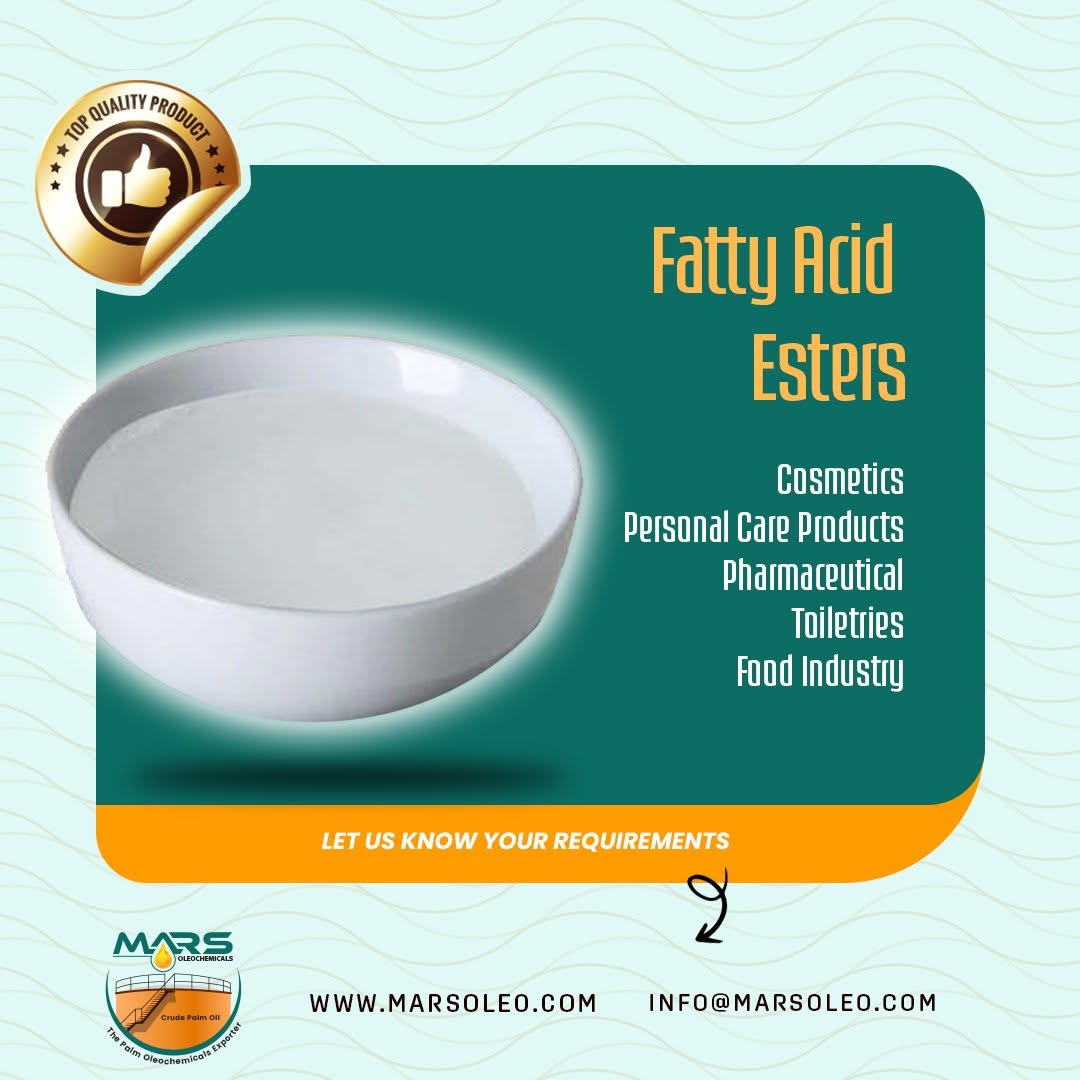
Fatty Acid Esters are produced by reacting fatty acids with suitable alcohols to create compounds with useful emollient, sensory, emulsifying and lubricating properties. By varying the fatty acid and alcohol components, manufacturers can produce esters with different physical and functional characteristics.
Cosmetic and personal-care manufacturers widely use Fatty Acid Esters to improve spreadability, skin feel, texture and formulation performance. Products such as Isopropyl Palmitate and Isopropyl Myristate are well-known emollients used in creams, lotions, skin care, makeup and other personal-care formulations.

Fatty acid esters provide emollient, texture, emulsifying, lubricating and formulation benefits across consumer industries worldwide.
Different esters serve different formulation requirements. Isopropyl Palmitate and Isopropyl Myristate are primarily valued for emollient and sensory functionality, while Glyceryl Monostearate is widely used for emulsification, structuring and consistency modification in suitable formulations.
Buyers should evaluate chemical identity, ester purity, acid value, saponification value, moisture, appearance and other product-specific characteristics. The correct grade must also be selected for cosmetic, pharmaceutical, food or industrial use according to applicable specifications and regulations.
What are Fatty Acid Esters? Fatty Acid Esters are compounds typically produced by reacting fatty acids with alcohols and are widely used in cosmetic, personal-care and industrial formulations.
What are Fatty Acid Esters used for? They are used as emollients, texture modifiers, emulsifiers, carriers, lubricants and functional formulation ingredients depending on the specific ester.
Are Fatty Acid Esters used in cosmetics? Yes. Fatty Acid Esters are widely used in cosmetics to provide emolliency, texture modification, spreadability and desirable sensory characteristics.
What is Isopropyl Palmitate? Isopropyl Palmitate, or IPP, is a fatty-acid ester widely used as an emollient and texture-enhancing ingredient in cosmetics and personal care.
What is Isopropyl Myristate? Isopropyl Myristate, or IPM, is a cosmetic ester commonly used for emolliency, spreading and sensory modification.
What is Glyceryl Monostearate? Glyceryl Monostearate, or GMS, is an ester of glycerol and stearic-rich fatty acids used as an emulsifier, structuring agent and consistency modifier.
Are Fatty Acid Esters used in pharmaceuticals? Suitable pharmaceutical-grade Fatty Acid Esters may be used as excipients, carriers, emollients or formulation aids depending on the product.
Can Fatty Acid Esters be used in food? Only suitable food-grade esters approved for the intended application should be used in food products.
Are Fatty Acid Esters the same as Fatty Acids? No. Fatty Acid Esters are produced by reacting fatty acids with alcohols and have different physical and functional properties.
What should buyers check when sourcing Fatty Acid Esters? Buyers should check chemical identity, purity, acid value, saponification value, moisture, appearance, physical properties and application-specific compliance.










Home :: Products :: Enquiry :: Contact Us :: Site Map
Copyright All Rights Reserved © 2025. Mars Oleochemicals :: Disclaimer :: Privacy Policy


