


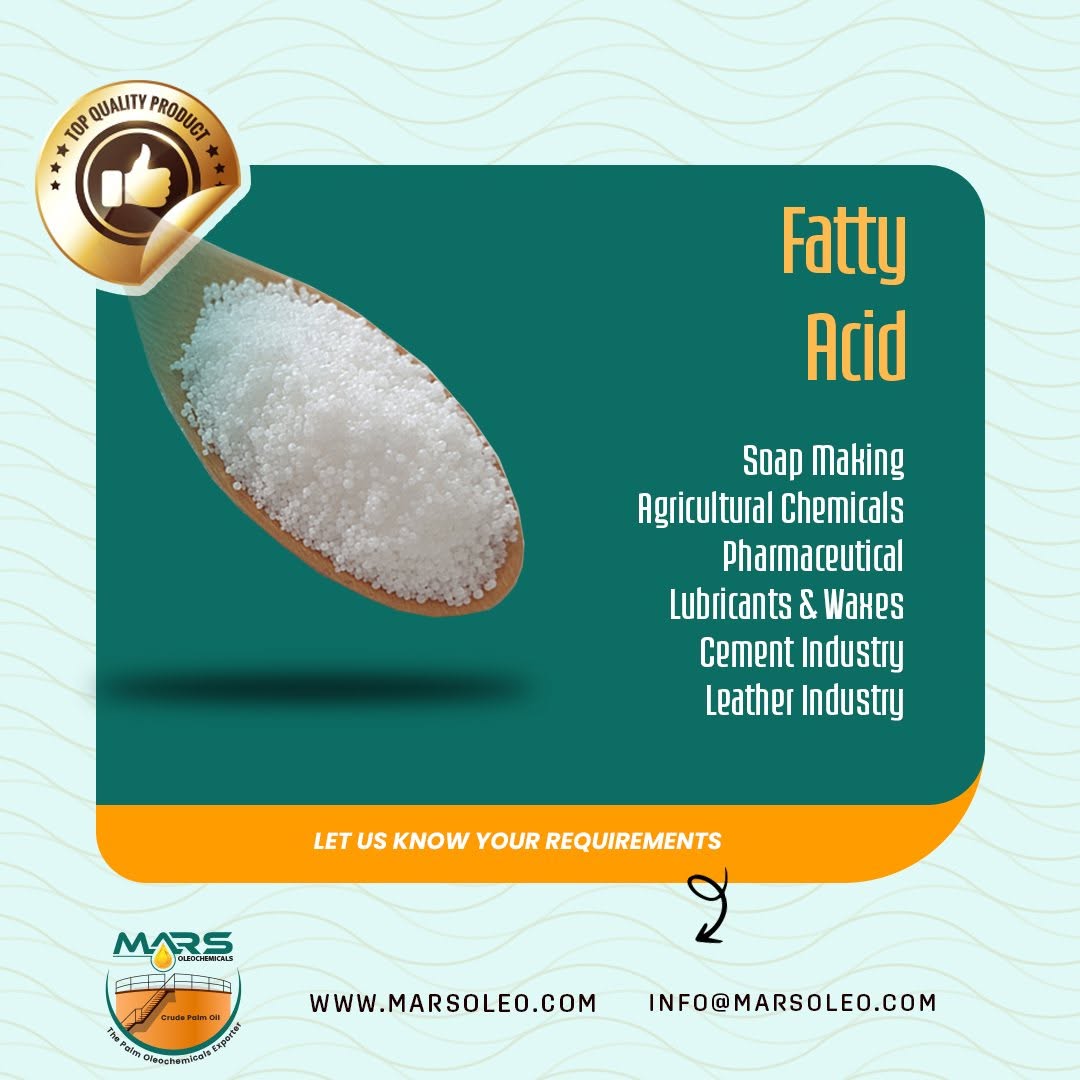
Fatty acids are fundamental raw materials used throughout the oleochemical and chemical industries. Derived from vegetable-oil feedstocks such as palm oil and palm kernel oil, they are available in different carbon-chain lengths and compositions that provide distinct physical and chemical properties.
Fatty acids are extensively used in soap manufacturing, while selected grades and derivatives are also important in lubricants, cosmetics and personal-care products. Lauric, Myristic, Palmitic, Stearic and Oleic Acids each offer different characteristics that allow manufacturers to select a suitable raw material for their formulation.

Fatty acids serve as versatile raw materials for soaps, lubricants, pharmaceuticals, agriculture, leather and industry.
fatty acids and their derivatives are used in rubber, plastics, leather chemicals, agricultural formulations, wax systems, construction chemicals and specialty industrial processes. They are also valuable intermediates for producing esters, metallic soaps, surfactants and other downstream products.
Industrial buyers should evaluate fatty-acid composition, carbon-chain distribution, acid value, iodine value, saponification value, color and physical form when choosing a product. Providing the intended application and technical specification helps identify the most appropriate fatty-acid grade.
What are Fatty Acids? Fatty acids are organic carboxylic acids with hydrocarbon chains and are important raw materials in oleochemical and industrial manufacturing.
What are Fatty Acids used for? Fatty acids are used in soaps, detergents, lubricants, cosmetics, pharmaceuticals, agriculture, leather, rubber, plastics and numerous chemical applications.
Are Fatty Acids derived from Palm Oil? Many commercial fatty acids are produced from palm oil, palm kernel oil and other vegetable-oil feedstocks.
What are the main types of Palm-Based Fatty Acids? Important commercial products include Lauric Acid, Myristic Acid, Palmitic Acid, Stearic Acid and Oleic Acid.
What is Lauric Acid? Lauric Acid is a saturated C12 fatty acid widely used in soap, detergent, surfactant and personal-care applications.
What is Palmitic Acid? Palmitic Acid is a saturated C16 fatty acid used across soap, cosmetic, industrial and specialty applications.
What is Stearic Acid? Stearic Acid is a saturated C18 fatty acid widely used in cosmetics, soap, candles, rubber, plastics and industrial formulations.
What is Oleic Acid? Oleic Acid is a monounsaturated C18 fatty acid used in lubricants, leather processing, cosmetics, esters and specialty chemicals.
Why are Fatty Acids used in soap making? Fatty acids react with alkalis to form fatty-acid salts, which form the fundamental cleansing material in many soap systems.
What specifications should Fatty Acid buyers check? Buyers should evaluate fatty-acid composition, chain distribution, acid value, iodine value, saponification value, moisture, color and physical form.








Home :: Products :: Enquiry :: Contact Us :: Site Map
Copyright All Rights Reserved © 2025. Mars Oleochemicals :: Disclaimer :: Privacy Policy


