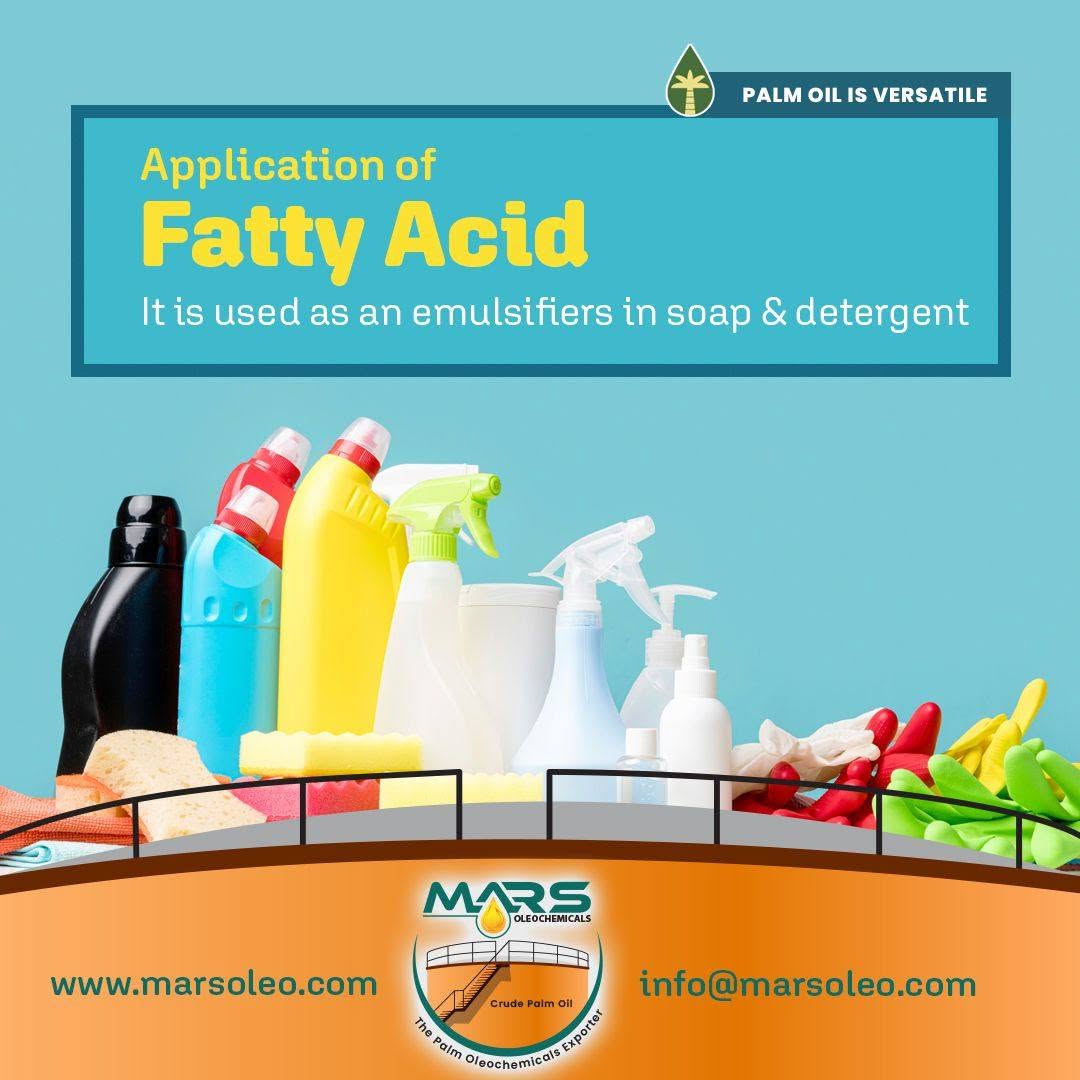
Fatty acids are organic materials obtained from natural fats and oils, including palm oil and palm-kernel oil. Industrial oleochemical processing separates these oils into fatty acids and glycerol, after which the fatty acids may be distilled or fractionated into broad cuts or purified grades for different manufacturing requirements.
Soap is produced when fatty acids are neutralised with an alkaline material to form fatty-acid salts. The resulting salts provide surface activity that helps water interact with oils and soils. Fatty-acid composition influences the finished soap’s hardness, solubility, lather and cleansing characteristics, so manufacturers normally use carefully selected blends.

Household cleaning bottles, gloves and sponges representing fatty acid applications in soap and detergent production.
Fatty acids can be used directly as formulation ingredients or converted into salts, esters, alcohols, amines and other surfactant intermediates. Some fatty-acid substances are reported for surface-active or emulsifier use, but performance depends on chain length, neutralisation, derivatisation, concentration and the complete formulation.
Mars Oleochemicals Sdn. Bhd. supplies Malaysian palm oil and palm-kernel-based fatty acids to soap manufacturers, detergent formulators, importers, distributors and industrial buyers worldwide. Available products include stearic, lauric, myristic, palmitic, oleic, lauric-myristic and distilled coconut fatty-acid grades.
1. What are fatty acids used for in soap and detergent manufacturing? Fatty acids are used as raw materials for manufacturing soaps, surfactants, detergent ingredients, emulsifier systems and other cleaning-product intermediates.
2. Are fatty acids emulsifiers? Some fatty acids may contribute to emulsifier systems, but fatty acids should not all be described as universal emulsifiers. Their salts, esters and other derivatives frequently provide surfactant or emulsifying functions.
3. How are fatty acids converted into soap? Fatty acids react with an alkali such as sodium hydroxide or potassium hydroxide to form fatty-acid salts. Sodium salts are commonly used in solid soaps, while potassium salts are frequently used in softer or liquid soap systems.
4. Which fatty acids are commonly used in soap production? Common soap-making fatty acids include lauric acid, myristic acid, palmitic acid, stearic acid, oleic acid and blended palm, palm-kernel or coconut fatty acids.
5. What is the difference between a fatty acid and a fatty-acid salt? A fatty acid is the original carboxylic-acid material. A fatty-acid salt is formed when the acid is neutralised with an alkali, producing a soap or surfactant material such as sodium palmitate. PubChem identifies sodium palmitate as both a surfactant and an emulsifier.
6. How do different fatty acids affect soap performance? The fatty-acid profile influences soap hardness, solubility, lather, cleansing performance and conditioning characteristics. The final result depends on the complete blend, processing method and formulation. Stearic acid is used to harden soaps, while lauric-acid materials are associated with cleansing and foaming applications.
7. How should manufacturers select a fatty acid grade? Manufacturers should evaluate carbon-chain distribution, acid value, iodine value, titre, colour, moisture, purity, physical form and compatibility with the intended soap or detergent formulation.
8. Where can buyers source Malaysian fatty acids? International buyers can contact Mars Oleochemicals Sdn. Bhd. for Malaysian fatty-acid grades, specifications, packing options, documentation, availability and export quotations.







Home :: Products :: Enquiry :: Contact Us :: Site Map
Copyright All Rights Reserved © 2025. Mars Oleochemicals :: Disclaimer :: Privacy Policy