


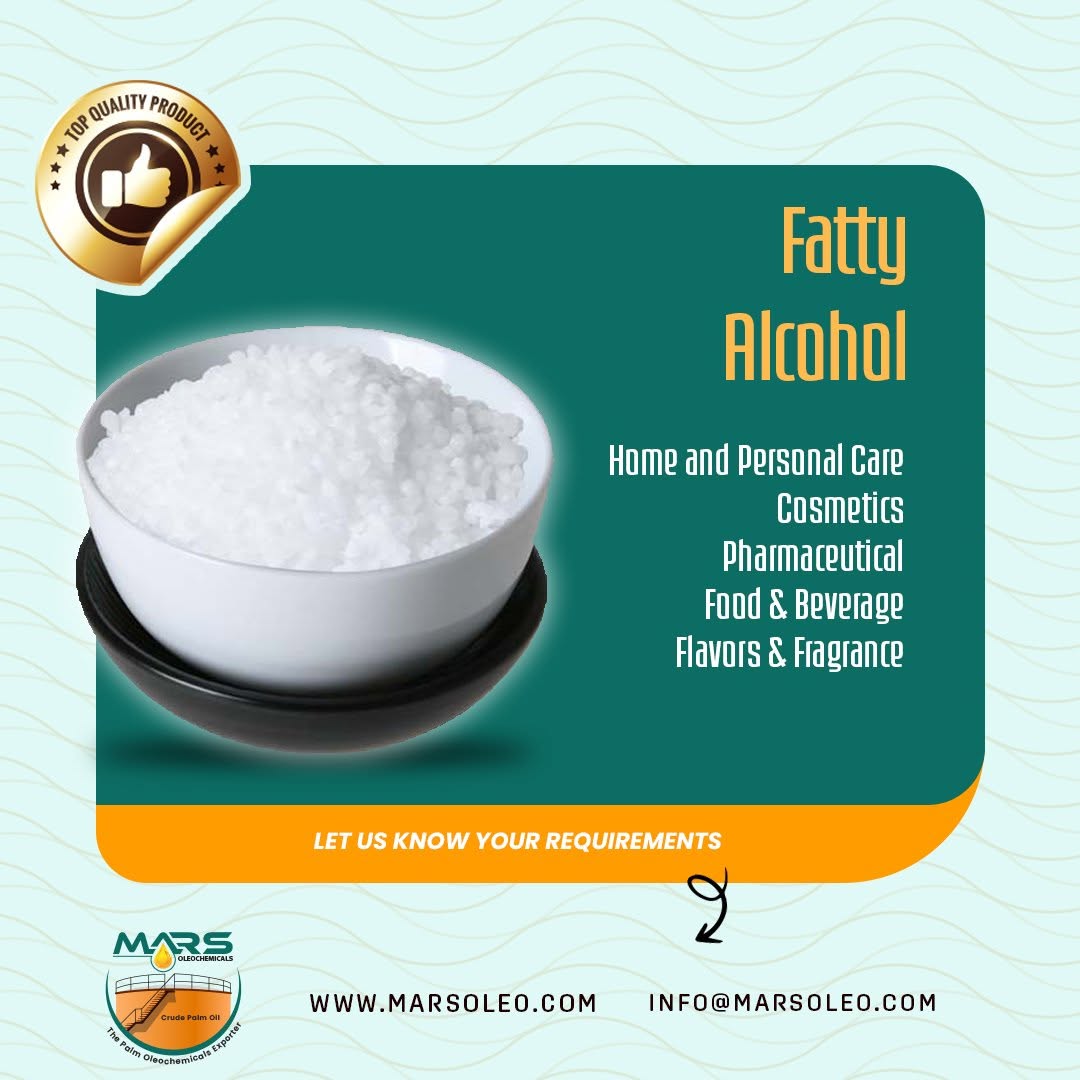
Natural Fatty Alcohols are important oleochemical raw materials derived from renewable vegetable-oil feedstocks. Commercial grades range from shorter-chain Lauryl and Myristyl Alcohols to longer-chain Cetyl, Stearyl and Cetearyl Alcohols, each offering different physical and functional properties.
Fatty Alcohols such as Cetyl Alcohol and Stearyl Alcohol are widely used in creams, lotions, conditioners and other personal-care formulations. Depending on the grade and formulation, they can provide emolliency, viscosity, structure and support for stable emulsions.

Natural palm-based Fatty Alcohols for personal care, cosmetics, surfactants, detergents and specialty industrial formulations.
C12 and C12-14 Fatty Alcohols are important intermediates for surfactant manufacturing. Through downstream reactions such as ethoxylation and sulfation, they can be converted into ingredients used across detergents, household cleaners, personal care and industrial cleaning products.
Industrial buyers should evaluate carbon-chain distribution, purity, hydroxyl value, acid value, physical form and other relevant parameters before selecting a Fatty Alcohol. Sharing the intended application and technical specification helps identify the most appropriate grade.
What are Fatty Alcohols? Fatty Alcohols are long-chain alcohols used as functional ingredients and chemical intermediates in personal care, surfactants, detergents and industrial formulations.
Are Fatty Alcohols the same as ethanol? No. Long-chain Fatty Alcohols such as Cetyl and Stearyl Alcohol are chemically and functionally different from short-chain alcohols such as ethanol.
What are Natural Fatty Alcohols made from? Natural Fatty Alcohols can be produced from vegetable-oil-derived fatty acids or methyl esters, including palm and palm-kernel-based feedstocks.
What are Fatty Alcohols used for? They are used in cosmetics, personal care, hair care, home care, surfactants, detergents, pharmaceuticals and specialty industrial formulations.
What is Cetyl Alcohol? Cetyl Alcohol is a C16 Fatty Alcohol widely used as an emollient, thickener and structuring ingredient in creams, lotions and conditioners.
What is Stearyl Alcohol? Stearyl Alcohol is a C18 Fatty Alcohol used as a structuring, thickening and emollient ingredient in personal-care and pharmaceutical formulations.
What is Cetearyl Alcohol? Cetearyl Alcohol is a mixture primarily consisting of Cetyl Alcohol and Stearyl Alcohol and is widely used in cosmetics, creams, lotions and conditioners.
Are Fatty Alcohols used to make surfactants? Yes. Fatty Alcohols are important raw materials for Fatty Alcohol Ethoxylates, alcohol sulfates and alcohol ether sulfates.
What is the difference between Fatty Alcohol and Fatty Acid? Fatty Alcohols contain an alcohol functional group, while Fatty Acids contain a carboxylic-acid functional group.
What specifications should Fatty Alcohol buyers check? Buyers should review carbon-chain distribution, alcohol purity, hydroxyl value, acid value, iodine value, moisture, color and physical form.






Home :: Products :: Enquiry :: Contact Us :: Site Map
Copyright All Rights Reserved © 2025. Mars Oleochemicals :: Disclaimer :: Privacy Policy


