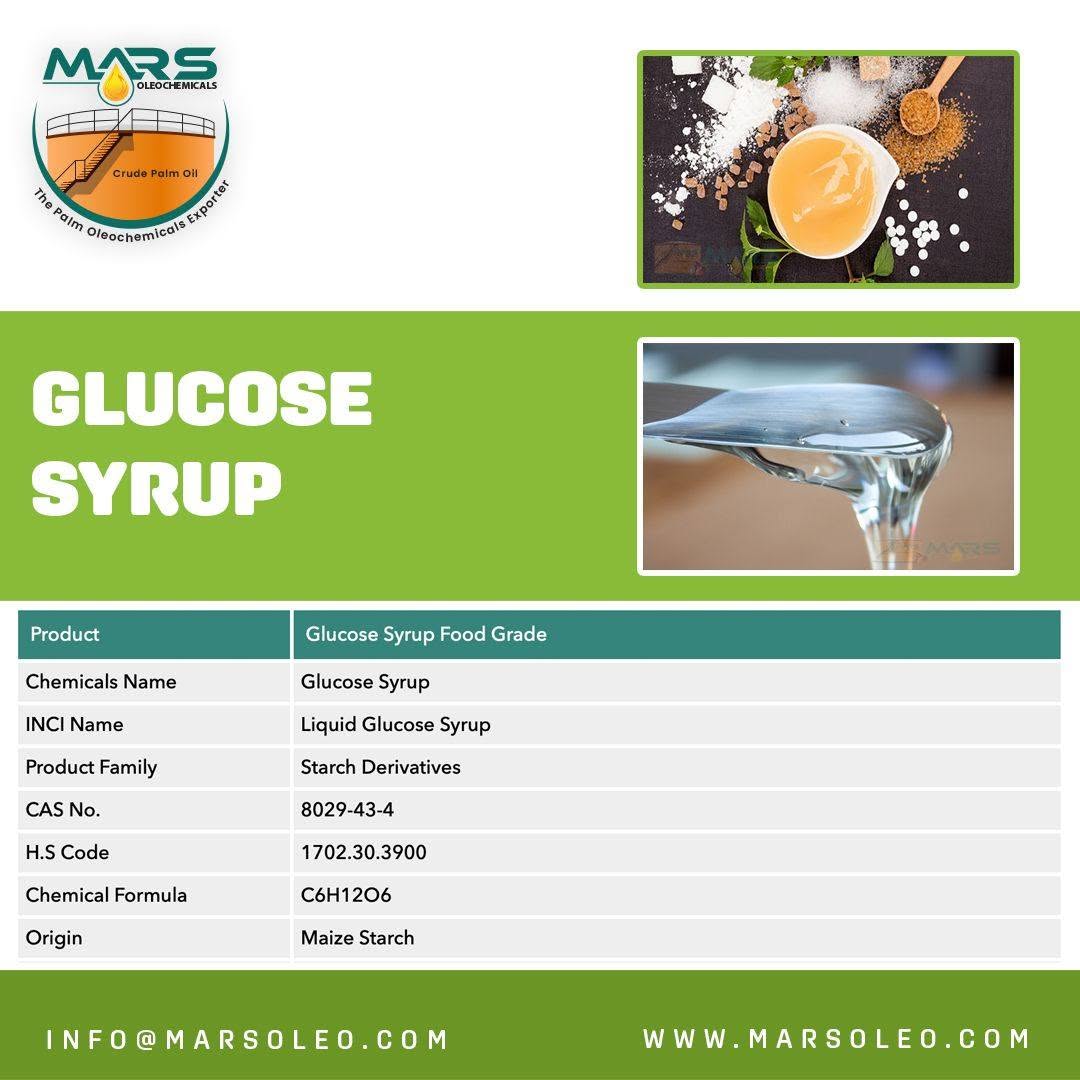
Glucose Syrup Food Grade is a concentrated aqueous mixture of sugars produced by partially hydrolysing edible starch. When maize starch is used, the product may also be described as corn syrup. Unlike pure glucose, commercial syrup contains varying proportions of glucose, maltose and higher saccharides, with composition influenced by the degree and method of hydrolysis.
Dextrose Equivalent, commonly abbreviated DE, expresses the reducing-sugar content of a starch hydrolysate as D-glucose on a dry basis. It also provides a practical measure of how extensively the starch has been hydrolysed. Mars Oleochemicals currently publishes a DE range of 38-44 and approximately 85% dry solids for its Glucose Syrup Food Grade.

Glucose Syrup Food Grade for Confectionery, Bakery, Beverages and Global Manufacturing Supply from Malaysia Worldwide.
Glucose syrup is used as a sweetening, bulking, humectant and texturizing ingredient across confectionery, bakery, frozen desserts, jams, jellies and other processed foods. It contributes viscosity and body and can help control sugar crystallization in confectionery systems. FDA recognises corn syrup as an ingredient obtained through partial hydrolysis of corn starch.
Mars Oleochemicals supplies Glucose Syrup Food Grade derived from maize starch. Published packing formats include HDPE drums, IBCs, flexibags and bulk arrangements. Buyers should review the current DE, dry solids, pH, ash, SO₂, microbiological parameters, Certificate of Analysis, TDS, SDS and applicable food-safety documentation before commercial approval.
1. What is Glucose Syrup Food Grade? Glucose Syrup Food Grade is a purified, concentrated aqueous mixture of nutritive saccharides produced by hydrolysing edible starch. Commercial syrup contains glucose together with maltose and higher saccharides.
2. Is glucose syrup the same as pure glucose? No. Pure glucose is one defined sugar molecule, while glucose syrup is a mixture of glucose, maltose, higher saccharides and water produced through partial starch hydrolysis.
3. Does glucose syrup have a molecular formula? Commercial glucose syrup does not have one molecular formula because it is a mixture. C6H12O6 is the formula of the glucose component and should not represent the complete syrup.
4. What is the CAS number for glucose syrup? Glucose syrup or corn syrup commonly uses CAS number 8029-43-4. PubChem also associates the material with EINECS number 232-436-4.
5. What is the HS code for glucose syrup? International HS subheading 1702.30 covers glucose and glucose syrup containing less than 20 percent fructose by weight on a dry basis and without added flavouring or colouring. National tariff extensions should be confirmed with customs.
6. What does DE mean in glucose syrup? DE means Dextrose Equivalent. It indicates the amount of reducing sugars expressed as glucose on a dry basis and provides an indication of the degree of starch hydrolysis. Mars publishes a DE range of 38-44 for this product.
7. What is Glucose Syrup Food Grade used for? Glucose syrup is used in confectionery, candies, caramels, marshmallows, bakery products, ice cream, jams, jellies, beverages, pharmaceutical syrups and other food formulations.
8. Why is glucose syrup used in confectionery? Glucose syrup provides sweetness, viscosity and body while helping control sucrose crystallization and moisture. These properties are useful in candies, caramels, jellies and other confectionery products.
9. Is glucose syrup the same as high-fructose corn syrup? No. Standard glucose syrup is produced by starch hydrolysis. High-fructose corn syrup undergoes an additional enzymatic step that converts part of its glucose into fructose.
10. Where can buyers source Glucose Syrup Food Grade from Malaysia? International buyers can contact Mars Oleochemicals Sdn. Bhd. for Glucose Syrup Food Grade specifications, packing options, quality documents, certification information, availability and export quotations.










Home :: Products :: Enquiry :: Contact Us :: Site Map
Copyright All Rights Reserved © 2025. Mars Oleochemicals :: Disclaimer :: Privacy Policy