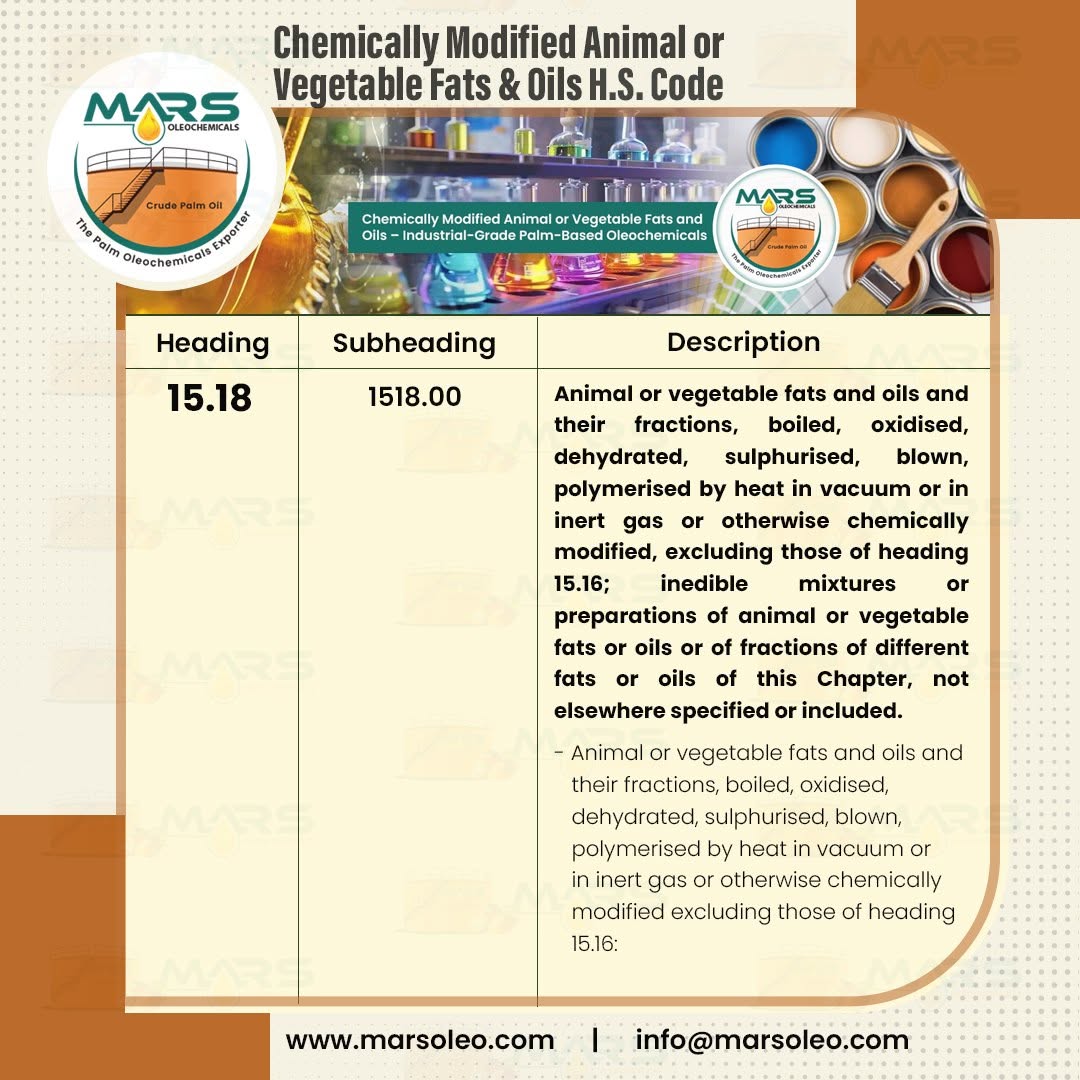
Chemically Modified Animal and Vegetable Fats & Oils are important raw materials used in selected industrial manufacturing processes, including surface coatings, specialty lubricants, resins and chemical formulations.
The international Harmonized System classifies specified chemically modified fats and oils under HS Heading 15.18, with the six-digit subheading 1518.00.
At Mars Oleochemicals Sdn. Bhd., Malaysia, we provide information about palm-based oleochemical products and their international trade classifications to support manufacturers, importers and exporters.
Understanding the properties, applications and HS classification of modified fats and oils helps businesses select appropriate materials and prepare accurate trade documentation.
HS Code 1518.00 covers certain animal, vegetable or microbial fats and oils and their fractions that have undergone specified chemical modifications.
These include fats and oils that have been boiled, oxidised, dehydrated, sulphurised, blown, polymerised by heat under specified conditions or otherwise chemically modified, excluding products classified under Heading 15.16.
The heading also includes certain inedible mixtures or preparations of fats and oils that are not more specifically classified elsewhere.
The classification is relevant to international commodity trading, industrial raw materials and customs documentation.
Chemically modified vegetable oils are oils whose chemical structures or properties have been intentionally altered to achieve particular industrial characteristics.
Vegetable oils contain triglycerides made up of fatty acid components. Different modification processes can alter the properties of these oils, depending on their chemical composition and intended application.
Such modifications may influence viscosity, reactivity, film-forming behaviour, drying characteristics and other functional properties.
Modified vegetable oils are used in industrial applications where untreated oils may not provide the required performance.

HS Code 1518 specified chemically modified fats and oils and certain inedible oil mixtures used in industrial applications.
Although both headings relate to processed fats and oils, they cover different classifications.
HS Heading 1516 generally covers specified hydrogenated, inter-esterified, re-esterified or elaidinised fats and oils, whether refined or not, provided they have not been further prepared.
HS Heading 1518 covers the specified chemically modified oils and certain inedible oil mixtures falling within its legal description.
Importers and exporters should avoid classifying a product solely by its commercial name.
Final tariff classification should be based on the exact product characteristics and the relevant destination-country customs tariff.
Chemically modified fats and oils provide manufacturers with additional formulation options through changes in their physical and chemical properties.
Depending on the oil and modification process, these materials can offer controlled viscosity, improved industrial functionality and compatibility with selected specialty chemical systems.
Vegetable-origin products can also provide bio-based feedstock options for applications traditionally using petroleum-derived ingredients.
Modified vegetable oils can contribute to the performance of specialty industrial products.
In appropriate formulations, they may provide lubrication, film-forming properties, viscosity control or improved compatibility with other raw materials.
Their functionality can support product design in coatings, lubricants, industrial additives and specialty chemical manufacturing.
Individual performance characteristics must be verified for the selected product grade and final application.
Palm-derived raw materials are used to produce a broad range of specialty oleochemical ingredients.
Depending on the product and process, palm-based oils and derivatives can support coatings, lubricants, chemical intermediates and industrial formulations.
Manufacturers should evaluate product specifications, feedstock origin, chemical properties and the intended end use when selecting materials. Not every palm-based fatty acid, ester or chemically processed product falls under HS Code 1518.
Accurate HS classification helps businesses prepare import and export documentation and determine applicable customs requirements.
The classification may influence tariff treatment, regulatory obligations and statistical reporting.
Although HS 1518.00 is a recognized six-digit international classification, national tariff schedules may provide additional digits and subdivisions.
Exporters should confirm the correct national code with customs authorities or qualified trade professionals before completing shipment documentation.
Mars Oleochemicals Sdn. Bhd. is an MPOB-licensed Malaysian exporter specializing in palm-based oleochemical products and derivatives.
We support international buyers seeking information about industrial palm-based raw materials, product specifications and export requirements.
Visit our website at www.marsoleo.com For product requirements, technical documentation, commercial information and international export inquiries, please email us at info@marsoleo.com.





Home :: Products :: Enquiry :: Contact Us :: Site Map
Copyright All Rights Reserved © 2025. Mars Oleochemicals :: Disclaimer :: Privacy Policy