


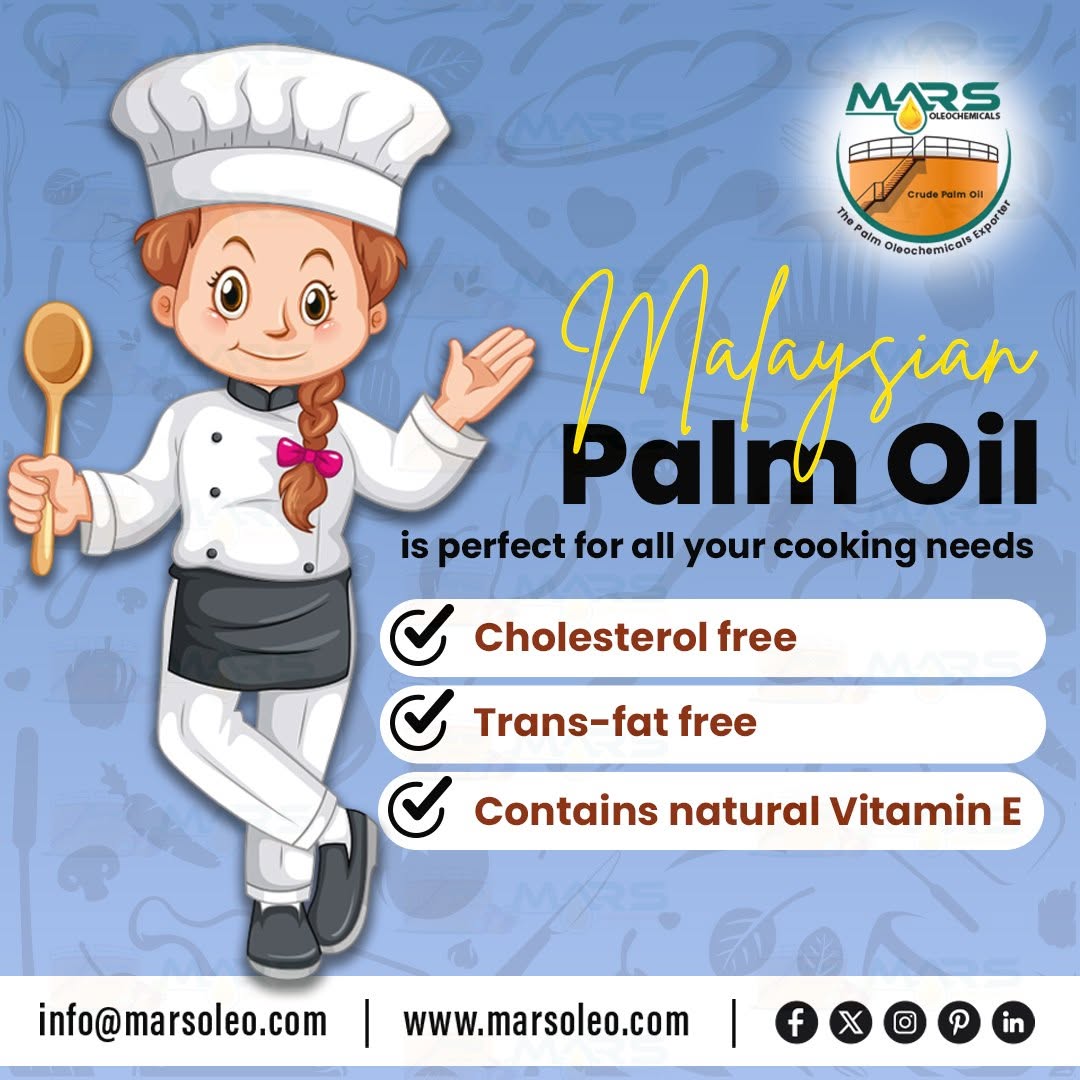
Malaysian Palm Oil is an important vegetable oil used in commercial cooking, food processing, baking and edible oil manufacturing across international markets. Extracted from the fleshy mesocarp of the oil palm fruit (Elaeis guineensis), palm oil contains both saturated and unsaturated fatty acids, giving it physical properties suitable for various food applications. Through refining and fractionation, palm oil can be processed into different commercial grades, including RBD Palm Oil, RBD Palm Olein and RBD Palm Stearin. RBD Palm Olein, the lower-melting liquid fraction, is widely used in cooking oils and commercial frying. Palm oil naturally contains vitamin E compounds, including tocopherols and tocotrienols, which contribute to its nutritional characteristics. Because palm oil is plant-derived, it contains no nutritionally significant dietary cholesterol. Non-hydrogenated palm oil also generally contains negligible industrial trans fats, although formal nutrient-content claims should follow applicable food-labeling standards. These characteristics make Malaysian palm oil an important ingredient for food manufacturers, refiners and international buyers researching functional vegetable oils.
Cooking and frying performance are important considerations when selecting palm oil for household and industrial food preparation. RBD Palm Olein, particularly suitable commercial cooking grades such as CP10, is commonly used in frying applications involving snack foods, instant noodles, prepared meals and food-service products. Palm olein's fatty acid composition contributes to useful oxidative and thermal stability under appropriate operating conditions. Compared with conventional palm oil, the more liquid palm olein fraction offers different physical characteristics that can be advantageous in cooking and frying operations. Refined palm oil products can also be incorporated into baking fats, shortening, margarine and selected food formulations where texture and melting properties are important. However, oil performance depends on temperature, heating duration, food moisture, handling, storage and repeated frying conditions. No cooking oil remains completely unchanged during prolonged or excessive heating. Manufacturers and food-service operators should therefore use appropriate oil management practices and select products according to the intended application. Mars Oleochemicals Sdn. Bhd. supports international sourcing enquiries for Malaysian palm oil products, including refined palm oil and palm olein grades used by food processors.

Malaysian palm oil contains vitamin E compounds and supports cooking when suitably refined and handled.
Natural Vitamin E, cholesterol and trans-fat composition are important subjects in the nutritional evaluation of Malaysian Palm Oil. Palm oil naturally contains the vitamin E family of compounds, particularly tocopherols and tocotrienols, which are associated with antioxidant activity. The concentrations of these components vary according to palm fruit quality, refining, fractionation, storage and processing conditions. Crude Palm Oil and specially processed Red Palm Oil may retain different amounts of naturally occurring micronutrients compared with conventional refined products. As a vegetable oil, palm oil contains no meaningful dietary cholesterol, while its natural semi-solid characteristics can provide fat functionality without requiring partial hydrogenation. This makes non-hydrogenated palm oil useful in certain food formulations developed to reduce industrial trans fats. Nevertheless, cholesterol-free and trans-fat-free claims should not be interpreted as evidence that palm oil is automatically healthier than other vegetable oils. Conventional palm oil contains a considerable proportion of saturated fatty acids, particularly palmitic acid. Nutritional guidance from the World Health Organization (WHO) recommends limiting saturated fat intake and favoring unsaturated fats as part of a balanced dietary pattern. Any commercial claims concerning vitamin E, cholesterol or trans fats should be supported by the actual product specifications, analytical results and destination-market regulations.
Mars Oleochemicals Sdn. Bhd., a Malaysia-based palm oil and oleochemical exporter, supports international sourcing and commercial enquiries for Crude Palm Oil (CPO), RBD Palm Oil, RBD Palm Olein, RBD Palm Stearin and related palm-derived products. International manufacturers seeking Malaysian Palm Oil for Cooking, RBD Palm Olein for Frying or Refined Vegetable Oils for Food Processing should identify the required product grade, intended application, quality specifications, packaging, quantity and destination port before purchasing. Relevant product quality parameters may include Free Fatty Acid (FFA), Moisture and Impurities (M&I), Iodine Value (IV), Peroxide Value (PV), Cloud Point, colour and fatty acid composition, depending on the grade. Food manufacturers may also request information concerning vitamin E content, refining status, trans-fat composition and compliance with applicable food standards. Product origin, commercial availability, export documentation, certifications and shipping arrangements should be verified for each transaction. Mars Oleochemicals supports international businesses sourcing Malaysian palm-derived ingredients for food manufacturing and compatible industrial applications. Buyers can visit our website at www.marsoleo.com For product requirements, technical documentation, commercial information and international export inquiries, please email us at info@marsoleo.com.
Is Malaysian Palm Oil suitable for cooking and frying? Yes. Appropriate food-grade Malaysian palm oil products, particularly RBD Palm Olein, are widely used in cooking, commercial frying and food manufacturing. Their fatty acid composition contributes to useful oxidative stability. Cooking performance depends on the selected grade, operating temperature, heating duration and oil handling.
Is Malaysian Palm Oil naturally cholesterol-free? Palm oil is a plant-derived vegetable oil containing no nutritionally significant dietary cholesterol. However, being cholesterol-free does not mean that it is free from saturated fats or that it automatically improves blood cholesterol levels. Nutrition claims should follow applicable labeling requirements.
Does Malaysian Palm Oil contain trans fats? Non-hydrogenated Malaysian palm oil generally contains negligible industrial trans fats and can provide functional properties without partial hydrogenation. Nevertheless, absolute trans-fat-free claims for commercial oils or finished food products should be supported by relevant analytical information and destination-market labeling requirements.
Does Malaysian Palm Oil naturally contain Vitamin E? Yes. Malaysian palm oil naturally contains vitamin E compounds, including tocopherols and tocotrienols. Vitamin E levels vary according to the oil grade, refining method, storage and processing. Crude and specially processed red palm oil products may retain different micronutrient concentrations from conventional refined palm oil.
How can international buyers source Malaysian cooking oil and RBD Palm Olein from Mars Oleochemicals? Enquiries should specify the desired oil grade, quality specifications, purchase quantity, packaging, destination port and delivery terms. Food-grade compliance, product availability, analytical documentation and export arrangements should be confirmed before purchase.










Home :: Products :: Enquiry :: Contact Us :: Site Map
Copyright All Rights Reserved © 2025. Mars Oleochemicals :: Disclaimer :: Privacy Policy


