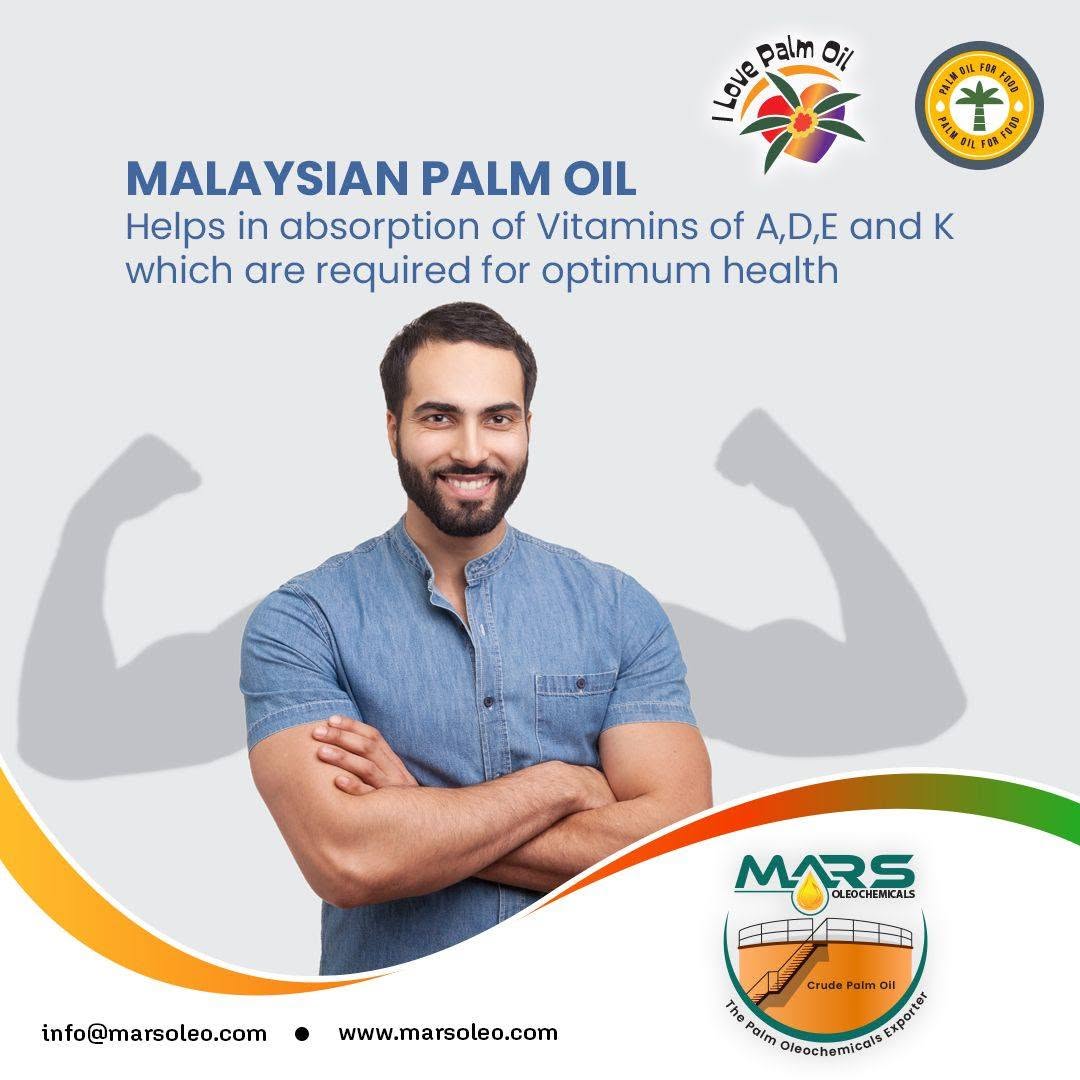
Malaysian palm oil is a widely used vegetable oil for food manufacturing, commercial cooking and processed-food applications. Like other edible fats and oils, it supplies dietary fat, which plays several functional roles in food and nutrition. One important role of dietary fat is supporting the intestinal absorption of the fat-soluble vitamins A, D, E and K. These vitamins are absorbed together with dietary lipids rather than dissolving directly in water.
Vitamins A, D, E and K are classified as fat-soluble vitamins. Consuming them with a meal containing some dietary fat can support their absorption and transport within the body. official guidance from the US National Institutes of Health notes that vitamin D absorption depends partly on the intestine's ability to absorb dietary fat, while reduced fat absorption can also reduce the absorption of vitamin K.

Malaysian Palm Oil and the Absorption How Dietary Fat Supports the Absorption of Vitamins A, D, E and K.
Palm oil can form part of a varied diet when consumed in suitable quantities and within applicable dietary guidance. However, it should not be presented as a unique treatment, supplement or guaranteed route to optimum health. The nutritional value of a meal depends on the complete dietary pattern, including fruits, vegetables, whole grains, proteins and an appropriate balance of fats. Current health guidance generally recommends limiting excessive saturated-fat intake and replacing some saturated fat with unsaturated fats where appropriate.
Mars Oleochemicals supplies Malaysian palm oil and palm-based products for food processing, bakery, confectionery, frying, shortening, margarine and other commercial applications. We support importers, distributors and manufacturers with product specifications, export documentation, packing options and international logistics. Buyers should select the correct palm oil grade according to the intended formulation, processing conditions and regulatory requirements in the destination market.
1. Does palm oil help the body absorb vitamins? Palm oil supplies dietary fat. Like other edible fats, dietary fat supports the absorption of the fat-soluble vitamins A, D, E and K. Palm oil is not the only fat capable of supporting this process.
2. Which vitamins are fat-soluble? Vitamins A, D, E and K are classified as fat-soluble vitamins because their absorption and transport involve dietary fat.
3. Is palm oil required for optimum health? No. Palm oil is not uniquely required for optimum health. It can be used as one dietary fat source within a varied and balanced diet.
4. What food products commonly use Malaysian palm oil? Malaysian palm oil is commonly used in cooking oils, frying products, bakery foods, margarine, shortening, confectionery, instant noodles, cream fillings and processed foods.
5. How can buyers request Malaysian palm oil? Buyers can contact info@marsoleo.com with the required palm oil grade, quantity, packing type, destination port and technical specification.











Home :: Products :: Enquiry :: Contact Us :: Site Map
Copyright All Rights Reserved © 2025. Mars Oleochemicals :: Disclaimer :: Privacy Policy