


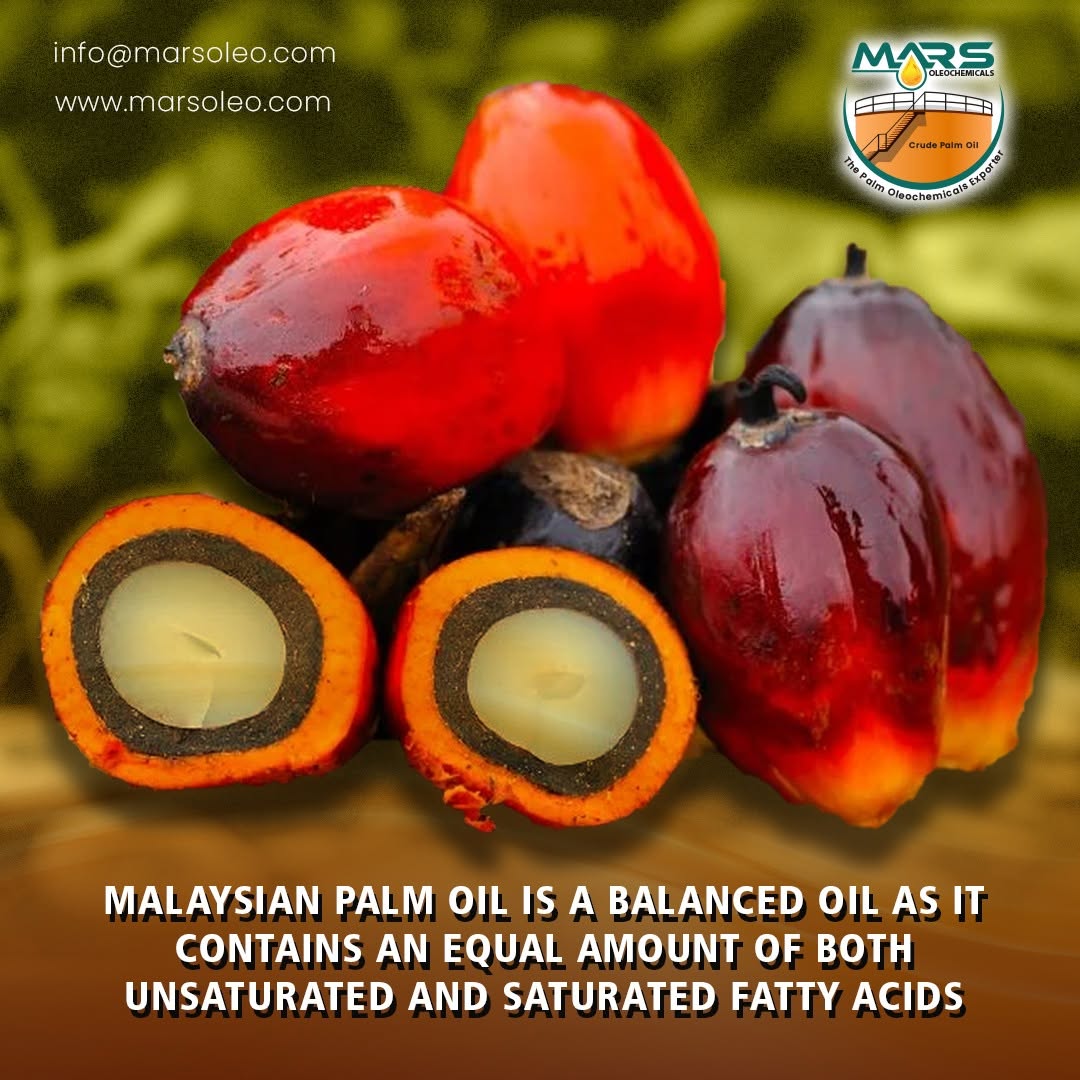
Malaysian Palm Oil is a plant-derived vegetable oil obtained from the fleshy mesocarp of oil palm fruit (Elaeis guineensis). Its distinctive fatty acid composition is an important characteristic for food manufacturers, vegetable oil processors and industrial buyers. According to the Malaysian Palm Oil Council (MPOC), conventional palm oil contains approximately 50% saturated fatty acids and 50% unsaturated fatty acids, including around 40% monounsaturated fatty acids and 10% polyunsaturated fatty acids. The major saturated fatty acids are palmitic acid and stearic acid, while oleic acid and linoleic acid account for most of its unsaturated fraction. This near-equal distribution contributes to palm oil's naturally semi-solid characteristics at typical room temperatures and makes it useful in selected food-processing applications. The term "balanced fatty acid composition" describes this approximate chemical ratio rather than establishing a recommended dietary balance. Actual fatty acid percentages can vary with oil palm variety, product grade, processing and fractionation.
The principal fatty acids in conventional palm oil include Palmitic Acid (C16:0), Oleic Acid (C18:1), Linoleic Acid (C18:2) and Stearic Acid (C18:0). Palmitic acid generally accounts for approximately 44-45% of the total fatty acids, while oleic acid contributes about 39-40%. Linoleic acid commonly represents approximately 9-11%, and stearic acid approximately 4-5%. These representative values explain why palm oil contains substantial proportions of both saturated and unsaturated components. Its fatty acid profile also differs significantly from Palm Kernel Oil, which is extracted from the seed and contains a much higher proportion of saturated fatty acids, particularly lauric acid. Furthermore, palm oil can be separated through fractionation into Palm Olein and Palm Stearin, each having different fatty acid distributions and physical properties. Palm Olein is more liquid and generally contains a higher proportion of unsaturated fatty acids, whereas Palm Stearin contains a higher proportion of saturated fatty acids and has a higher melting range. Product-specific analytical testing is necessary when exact composition is required for commercial specifications.

Malaysian palm oil contains approximately equal saturated and unsaturated fats, with proportions varying by grade.
The combination of saturated and unsaturated fatty acids contributes to the functional characteristics of Malaysian Palm Oil in food manufacturing, including texture, crystallization behavior, consistency and suitability for certain frying and baking applications. Refined palm oil is used in vegetable oil blends, margarines, shortenings and processed food formulations, while Palm Olein and Palm Stearin provide different melting and handling characteristics. Palm oil is naturally derived from plants and contains no naturally occurring dietary cholesterol. It also contains vitamin E compounds, including tocopherols and tocotrienols, although their concentrations vary with the oil grade and refining process. From a nutritional perspective, the presence of approximately equal saturated and unsaturated fatty acids does not automatically make palm oil a superior dietary fat. The World Health Organization (WHO) recommends limiting saturated fats to no more than 10% of total dietary energy and favoring unsaturated fats. Food manufacturers should therefore distinguish factual fatty acid composition from unsupported health claims and verify nutritional information through appropriate product analysis and applicable labeling standards.
Mars Oleochemicals Sdn. Bhd. supports international sourcing and export enquiries for Malaysian palm oil, palm-derived oleochemicals and related industrial ingredients. The company's published palm oil portfolio includes Crude Palm Oil (CPO), RBD Palm Oil, RBD Palm Olein CP10, CP8 and CP6, RBD Palm Stearin and other palm-based products. Each grade has different physical properties and technical characteristics that should be assessed according to the intended industrial application. International food manufacturers, vegetable oil processors and commercial distributors may require information about fatty acid composition, iodine value, slip melting point, cloud point, Free Fatty Acid (FFA) content, moisture, impurities and related quality parameters. Accurate product selection involves reviewing the agreed technical specification and appropriate batch documentation, including a Technical Data Sheet (TDS) and Certificate of Analysis (COA) where applicable. Commercial supply requirements should identify the product grade, quantity, packing, destination port and preferred shipment terms. Businesses researching Malaysian Palm Oil Fatty Acid Composition, saturated and unsaturated fats, vegetable oil characteristics and palm oil export products can visit our website at www.marsoleo.com For product requirements, technical documentation, commercial information and international export inquiries, please email us at info@marsoleo.com.
Does Malaysian palm oil contain equal amounts of saturated and unsaturated fatty acids? Conventional Malaysian palm oil typically contains approximately 50% saturated and 50% unsaturated fatty acids. The unsaturated portion consists mainly of oleic and linoleic acids, while the saturated portion consists mainly of palmitic and stearic acids. The ratio is approximate and varies according to product grade and composition.
What are the main fatty acids present in Malaysian palm oil? The principal fatty acids are palmitic acid (C16:0), oleic acid (C18:1), linoleic acid (C18:2) and stearic acid (C18:0). Typical palm oil contains approximately 44-45% palmitic acid, 39-40% oleic acid, 9-11% linoleic acid and 4-5% stearic acid. Exact proportions require product-specific analysis.
Is a 50:50 saturated and unsaturated fat ratio automatically healthier? No. The 50:50 ratio describes the chemical composition of conventional palm oil, not a recommended dietary proportion. Palm oil contains substantial saturated fat. WHO and AHA recommend limiting saturated fat intake and favoring unsaturated fat sources within an overall balanced dietary pattern.
Do Palm Olein and Palm Stearin have the same fatty acid composition as Palm Oil? No. Fractionation separates palm oil into fractions with different physical and chemical characteristics. Palm Olein is generally more liquid and contains a higher proportion of unsaturated fatty acids, while Palm Stearin is higher-melting and contains more saturated fatty acids. The actual composition depends on the commercial grade.
How can international buyers obtain Malaysian palm oil fatty acid specifications from Mars Oleochemicals? They should specify the required palm oil grade, fatty acid parameters, quantity, packing, intended application and destination port. Available technical specifications and batch-related quality documents can be discussed as part of the commercial enquiry.











Home :: Products :: Enquiry :: Contact Us :: Site Map
Copyright All Rights Reserved © 2025. Mars Oleochemicals :: Disclaimer :: Privacy Policy


