


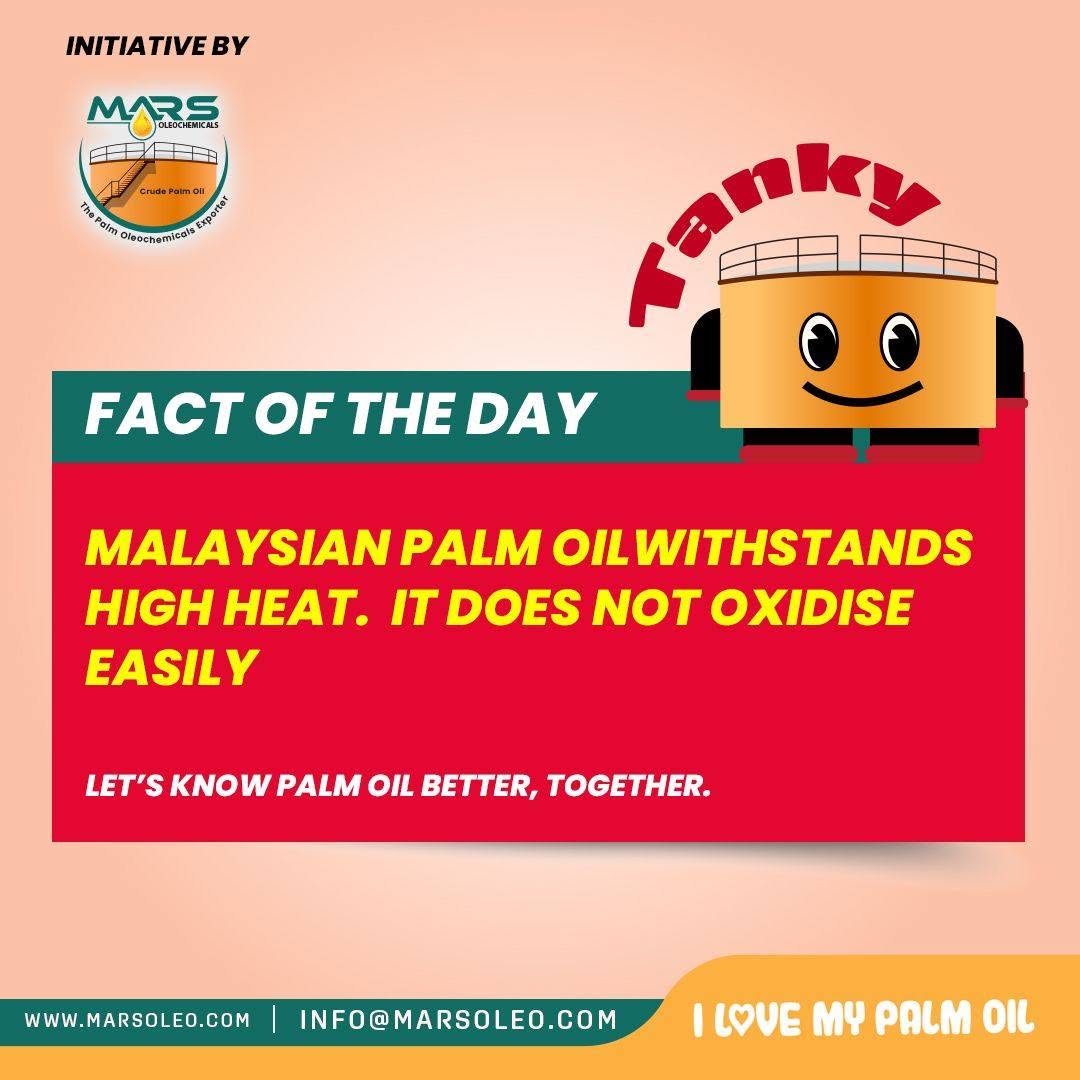
Palm oil possesses a distinctive fatty-acid composition containing both saturated and unsaturated fatty acids. This balance contributes to its physical characteristics and relatively good stability compared with highly polyunsaturated oils under certain processing conditions.
The oxidative stability of an edible oil is influenced by its fatty-acid composition. Oils containing higher proportions of highly unsaturated fatty acids are generally more susceptible to oxidation, while oils containing more saturated and monounsaturated fatty acids can show greater oxidative stability under comparable conditions.
Palm oil contains significant proportions of saturated fatty acids together with monounsaturated oleic acid. This composition can provide useful thermal and oxidative stability for suitable cooking and food-processing applications.

Palm oil's fatty acid composition supports heat stability, cooking performance and oxidative resistance.
Heat stability should not be interpreted as meaning that palm oil can never oxidise. All edible oils can deteriorate when exposed to excessive temperatures, oxygen, light or prolonged heating.
Oxidation is also influenced by factors including oil quality, refining, storage, heating duration, food moisture, contaminants and repeated frying cycles. Appropriate handling and processing practices therefore remain important regardless of the oil being used.
Malaysian palm oil is processed into various products and fractions that serve food manufacturing, food-service, oleochemical and industrial markets worldwide. Different fractions provide different melting characteristics and functional properties.
Mars Oleochemicals supplies Malaysian palm oil and palm-based products for international commercial requirements. Buyers can provide their required grade, specification, volume, packaging and destination for appropriate supply information.
Is Malaysian palm oil heat stable? Palm oil has relatively good heat stability because of its fatty-acid composition, making it suitable for various cooking and food-processing applications.
Does palm oil oxidise when heated? Palm oil can oxidise, like all edible oils, but its fatty-acid composition can provide relatively good oxidative stability under appropriate processing conditions.
Why is palm oil resistant to oxidation? Palm oil contains substantial saturated and monounsaturated fatty acids, which are generally less susceptible to oxidation than highly polyunsaturated fatty acids.
Can palm oil be used for frying? Yes. Appropriate palm oil grades and fractions are commonly used in frying and commercial food-processing applications.
Does high heat damage palm oil? Excessive or prolonged heating can degrade any edible oil. Temperature, heating duration, oxygen exposure and repeated use all influence oil quality.
What fatty acids are found in palm oil? Palm oil contains several fatty acids, with palmitic acid and oleic acid among its major components.
Why is oxidative stability important for cooking oils? Oxidative stability influences how an oil responds to heat, oxygen and storage conditions and can affect its quality during food processing.
Is palm oil used only for cooking? No. Palm oil and its derivatives are also used in oleochemicals, soaps, personal care products, specialty fats and numerous industrial applications.
Does Mars Oleochemicals supply Malaysian palm oil? Mars Oleochemicals supplies Malaysian palm oil and palm-based products for international commercial requirements.
How can buyers request palm oil supply information? Buyers can provide their required product, grade, specification, quantity, packaging and destination to info@marsoleo.com.













Home :: Products :: Enquiry :: Contact Us :: Site Map
Copyright All Rights Reserved © 2025. Mars Oleochemicals :: Disclaimer :: Privacy Policy


