


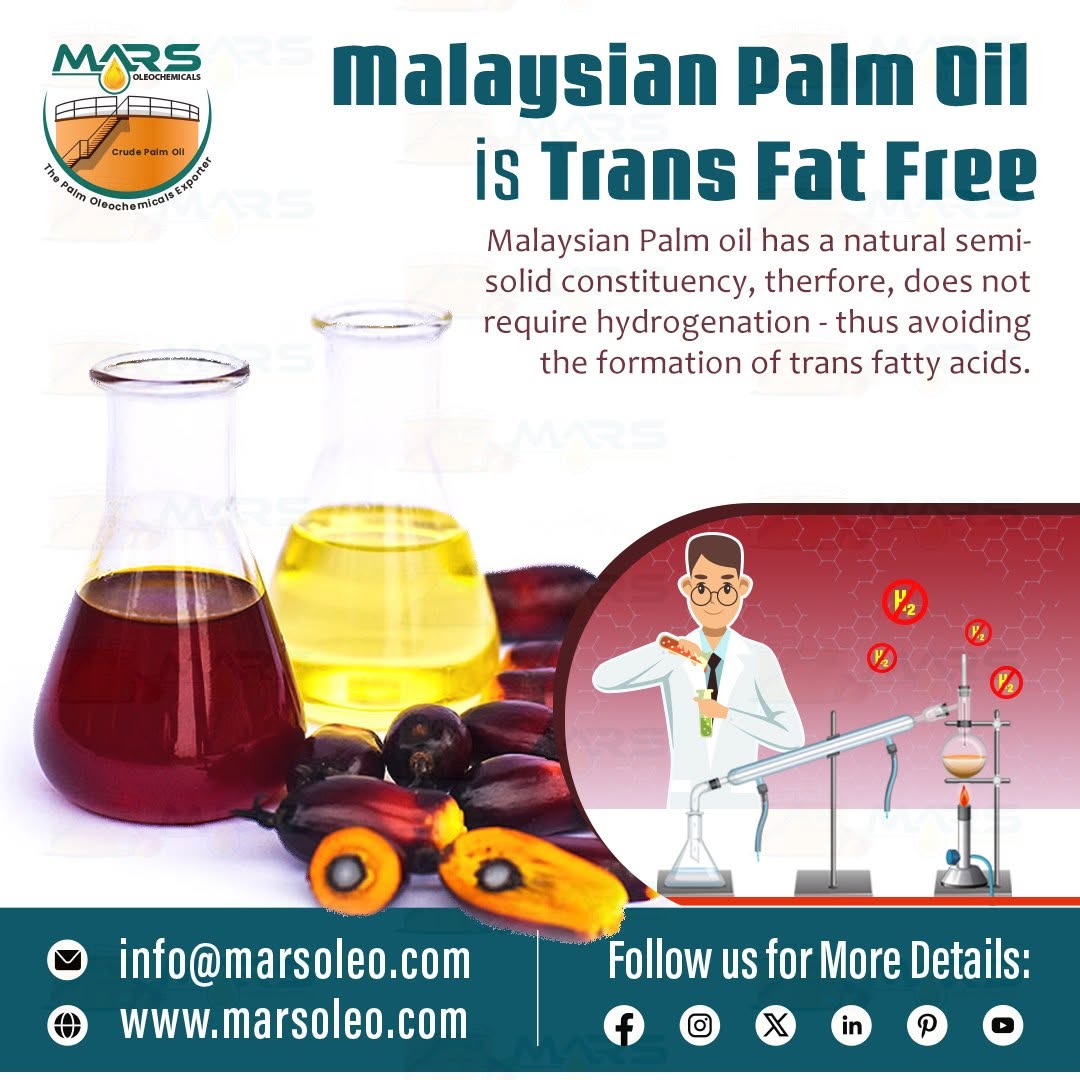
Malaysian Palm Oil is a widely used vegetable oil derived from the fleshy mesocarp of oil palm fruit (Elaeis guineensis). One of its important characteristics is that natural, non-hydrogenated palm oil is essentially free from trans fatty acids. Unlike certain vegetable oils that have historically undergone partial hydrogenation to achieve solid or semi-solid properties, palm oil naturally contains a combination of saturated and unsaturated fatty acids that provides useful physical characteristics for food manufacturing. This makes palm oil a commercially important ingredient in edible oils, specialty fats and processed food formulations.
Why Is Malaysian Palm Oil Naturally Trans Fat Free? Palm oil has a fatty acid composition containing significant proportions of palmitic acid and oleic acid, along with smaller amounts of linoleic and stearic acids. This composition gives palm oil its characteristic semi-solid behaviour at moderate temperatures. As a result, manufacturers can obtain specific fat structures through refining, fractionation, blending and other appropriate processing methods without necessarily relying on partial hydrogenation. The Malaysian Palm Oil Council identifies this property as an important functional advantage in palm-based edible fat manufacturing.
Palm Oil and Industrial Trans Fat Avoidance are closely connected to the development of alternative food fat formulations. Industrial trans fatty acids can form during partial hydrogenation, a process historically used to modify the consistency and performance of certain edible oils. Because palm oil and its fractions already offer various melting characteristics, they may be used in suitable formulations that avoid partially hydrogenated oils. However, the trans fat content of any finished product must be verified through relevant quality documentation and, where required, analytical testing.

Malaysian palm oil naturally contains negligible trans fats and versatile non-hydrogenated food fat formulations.
Malaysian Palm Oil in Food Manufacturing supports applications such as cooking oils, bakery shortenings, margarine, confectionery fats, frying oils and specialty vegetable fat preparations. Palm olein, the more liquid fraction of palm oil, is commonly used in edible cooking oil applications, while palm stearin provides more solid fat functionality in appropriate formulations. These characteristics enable manufacturers to develop products with selected melting properties, consistency and processing performance. Food manufacturers should select the appropriate grade based on technical specifications, regulatory requirements and finished-product performance.
Palm Oil Nutrition and Food Safety require balanced scientific communication. Although non-hydrogenated palm oil is naturally low in trans fats, it also contains substantial saturated fat. Avoiding industrial trans fats is beneficial, but the overall nutritional profile of food products depends on their full fat composition, processing and consumption patterns. Claims such as trans fat free, healthy, sustainable or certified should therefore be supported by applicable food regulations, analytical documentation and appropriate sourcing records.
Mars Oleochemicals Sdn. Bhd., Malaysia, supports international sourcing and export inquiries for Crude Palm Oil, Refined Bleached and Deodorised (RBD) Palm Oil, Palm Olein, Palm Stearin and related palm-based oleochemical products. Food manufacturers, importers, distributors and industrial buyers can contact Mars Oleochemicals to discuss product grades, quality specifications, packaging, supply availability and export requirements. Visit our website at www.marsoleo.com For product requirements, technical documentation, commercial information and international export inquiries, please email us at info@marsoleo.com.
Is Malaysian Palm Oil naturally trans fat free? Natural, non-hydrogenated Malaysian palm oil is essentially free from trans fatty acids and does not require partial hydrogenation for many food applications.
Why does palm oil not require partial hydrogenation? Palm oil naturally contains significant saturated and monounsaturated fatty acids that provide semi-solid properties. Fractionation and blending offer further fat functionality.
Is trans-fat-free palm oil healthier than other vegetable oils? Avoiding industrial trans fats is beneficial, but palm oil contains substantial saturated fat. Overall nutritional quality depends on the full dietary fat profile and consumption pattern.
Can palm oil be used instead of partially hydrogenated vegetable fats? Palm oil and its fractions may replace partially hydrogenated vegetable fats in selected bakery, margarine, confectionery and specialty fat applications, subject to formulation and regulatory requirements.
Where can manufacturers source Malaysian Palm Oil and its derivatives? Mars Oleochemicals Sdn. Bhd. supports international palm oil and derivative inquiries.





Home :: Products :: Enquiry :: Contact Us :: Site Map
Copyright All Rights Reserved © 2025. Mars Oleochemicals :: Disclaimer :: Privacy Policy


