


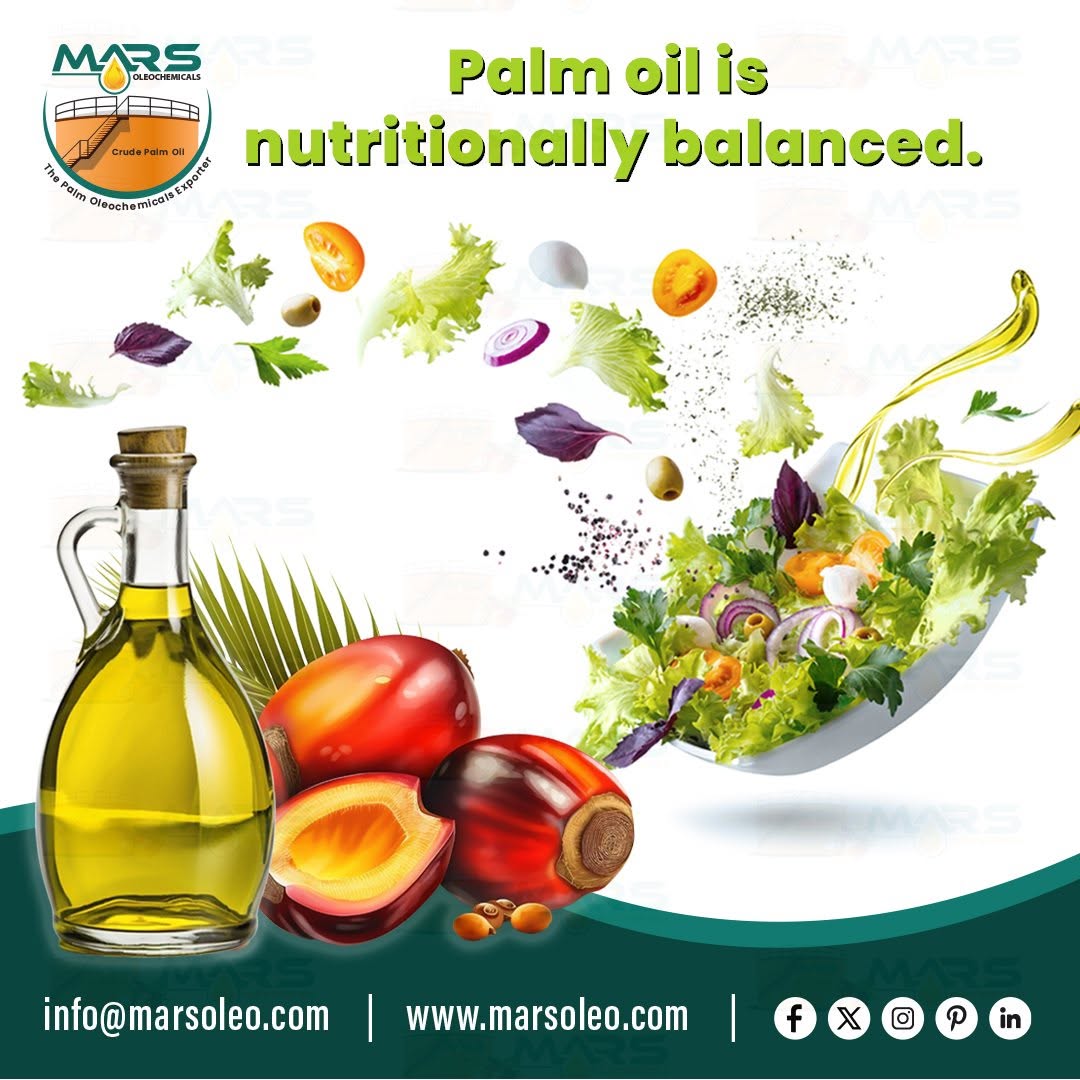
Malaysian Palm Oil is an important edible vegetable oil obtained from the fleshy mesocarp of the oil palm fruit. It is widely used across Food Manufacturing, Cooking Oils, Bakery Products, Margarine, Shortenings, Confectionery Fats and Industrial Food Processing because of its distinctive fatty acid composition and versatile functional properties. Palm oil is often described as a Nutritionally Balanced Oil because it contains approximately 50% Saturated Fatty Acids and 50% Unsaturated Fatty Acids, including around 40% Monounsaturated Fatty Acids and 10% Polyunsaturated Fatty Acids. The principal fatty acids include Palmitic Acid C16:0, Oleic Acid C18:1, Linoleic Acid C18:2 and Stearic Acid C18:0. This combination contributes to the oil's characteristic melting profile, semi-solid consistency and suitability for several food manufacturing applications. Unlike animal-derived fats, palm oil is naturally free of dietary cholesterol. However, its balanced fatty acid proportions should not be interpreted as proof of superior health effects. Palm oil contains a significant amount of saturated fat, and its nutritional suitability depends on total dietary composition, the quantities consumed and the fats it replaces. Recognized dietary guidance emphasizes choosing a varied diet that provides appropriate amounts of essential nutrients and prioritizes unsaturated fats. At Mars Oleochemicals Sdn. Bhd., Malaysian palm oil and related vegetable oil products form part of a commercial portfolio supporting international food manufacturers, distributors and industrial buyers.
Malaysian Palm Oil Nutrition is the presence of naturally occurring Vitamin E Compounds, including Tocopherols and Tocotrienols. These compounds belong to the vitamin E family and have antioxidant functions, making them important subjects of food science and nutritional research. Crude Palm Oil and Specially Processed Red Palm Oil also contain carotenoid pigments, particularly Beta-Carotene and Alpha-Carotene, which are responsible for the characteristic orange-red colour of palm oil before extensive refining. Certain carotenoids have Provitamin A Activity, meaning the body can convert them into vitamin A. Vitamin A contributes to normal vision and immune function, while vitamin E is an essential nutrient involved in protecting cells from oxidative damage. However, the nutritional composition varies significantly depending on the oil's processing history. Conventional Refined, Bleached and Deodorised (RBD) Palm Oil generally contains far lower concentrations of carotenoids than crude or specially processed red palm oil because bleaching and high-temperature deodorisation remove or degrade these compounds. Some tocopherols and tocotrienols may remain after refining, but their concentrations also vary. Accordingly, food manufacturers should verify the nutritional composition of the particular Crude Palm Oil, Red Palm Oil, RBD Palm Oil or Palm Olein being purchased. Any commercial claims regarding vitamin E or carotenoid content should be supported by product-specific analytical data and applicable food-labelling requirements.

Malaysian palm oil contains saturated and unsaturated fatty acids, with vitamin E and processing-dependent carotenoids.
Malaysian Palm Oil make it an established ingredient in the global food industry. Its combination of saturated and unsaturated fatty acids contributes to its Oxidative Stability, Melting Characteristics, Texture and Processing Performance. During refining and fractionation, palm oil can be separated into different commercial products, including RBD Palm Oil, RBD Palm Olein and RBD Palm Stearin. Palm olein is the lower-melting liquid fraction widely used in suitable Cooking Oil and Frying Oil Applications, while palm stearin is a higher-melting solid fraction used in selected Margarine, Shortening, Bakery and Specialty Fat Formulations. Palm oil and its fractions are also used in Biscuits, Cakes, Confectionery Coatings, Chocolate Compound Products, Cream Fillings, Frozen Desserts and Food-Service Formulations. These applications require different physical properties, including controlled melting behaviour, texture, crystallization and storage stability. Palm-based fat systems can provide functionality without necessarily requiring partial hydrogenation, a process historically associated with industrial trans-fat formation. Nevertheless, reducing industrial trans fats and managing saturated fat are separate nutritional considerations. Manufacturers should evaluate complete finished-product formulations rather than making broad health claims based on the vegetable oil ingredient alone. Product selection should consider the intended food application, required oil grade, stability, food safety, nutritional composition, product specification and relevant destination-market regulations.
Mars Oleochemicals Sdn. Bhd. supports international sourcing and export enquiries for Malaysian Crude Palm Oil, Refined Palm Oil, RBD Palm Olein, Palm Stearin, Palm-Based Specialty Fats and Related Oleochemical Products. These vegetable oil materials are relevant to manufacturers producing Cooking Oils, Margarine, Bakery Products, Shortenings, Confectionery, Food Ingredients and Industrial Food Products. International buyers researching Malaysian Palm Oil Nutrition, Palm Oil Fatty Acid Composition, Palm Oil Vitamin E Content, Palm Oil Food Applications and Palm Oil Suppliers in Malaysia should distinguish the nutritional characteristics of individual commercial grades. For example, Crude Palm Oil is a feedstock that generally requires appropriate refining before conventional edible oil applications, whereas RBD Palm Oil and Food-Grade RBD Palm Olein are processed oils intended for suitable food uses. Red Palm Oil is a distinct product designed to retain more natural carotenoids through specialized processing. Buyers should evaluate Free Fatty Acid (FFA), Iodine Value (IV), Peroxide Value (PV), Moisture and Impurities (M&I), Fatty Acid Composition, Slip Melting Point (SMP), Colour, Vitamin E Content and Other Relevant Quality Parameters according to the grade and application. Product certification, regulatory compliance, origin, packaging and destination-market requirements should also be verified before procurement. Mars Oleochemicals provides a commercial contact point for businesses evaluating palm oil and palm-derived products for international trade. Visit our website at www.marsoleo.com For product requirements, technical documentation, commercial information and international export inquiries, please email us at info@marsoleo.com.
Why is Malaysian palm oil described as nutritionally balanced? Malaysian palm oil is often called nutritionally balanced because it contains approximately 50% saturated and 50% unsaturated fatty acids. Its principal fatty acids include palmitic acid, oleic acid, linoleic acid and stearic acid. This describes its fatty acid composition rather than proving that it is nutritionally superior to other edible oils.
Does Malaysian palm oil contain natural vitamin E and antioxidants? Yes. Palm oil naturally contains vitamin E compounds, including tocopherols and tocotrienols. Crude and specially processed red palm oil also contain carotenoids. The concentrations of these compounds vary according to the source, processing method and commercial oil grade.
What is the difference between crude palm oil, red palm oil and RBD palm oil? Crude Palm Oil is extracted from the fleshy portion of oil palm fruit and contains naturally occurring pigments and other compounds. Red Palm Oil undergoes specialized processing designed to retain carotenoids. RBD Palm Oil is refined, bleached and deodorised for suitable food applications, usually resulting in a lighter-coloured oil with substantially reduced carotenoid content.
Can Malaysian palm oil be included in a balanced diet? Palm oil can be used as an edible fat within a varied diet, but it contains a significant proportion of saturated fatty acids. Dietary guidance recommends prioritizing unsaturated fats and considering total saturated fat intake. The nutritional quality of a diet depends on the overall foods and fats consumed, not on a single cooking oil.
Where can international food manufacturers source Malaysian palm oil? Enquiries should specify the required palm oil grade, technical specifications, order quantity, packaging, destination port and applicable food-grade documentation. Availability and commercial terms should be confirmed for each transaction.











Home :: Products :: Enquiry :: Contact Us :: Site Map
Copyright All Rights Reserved © 2025. Mars Oleochemicals :: Disclaimer :: Privacy Policy


