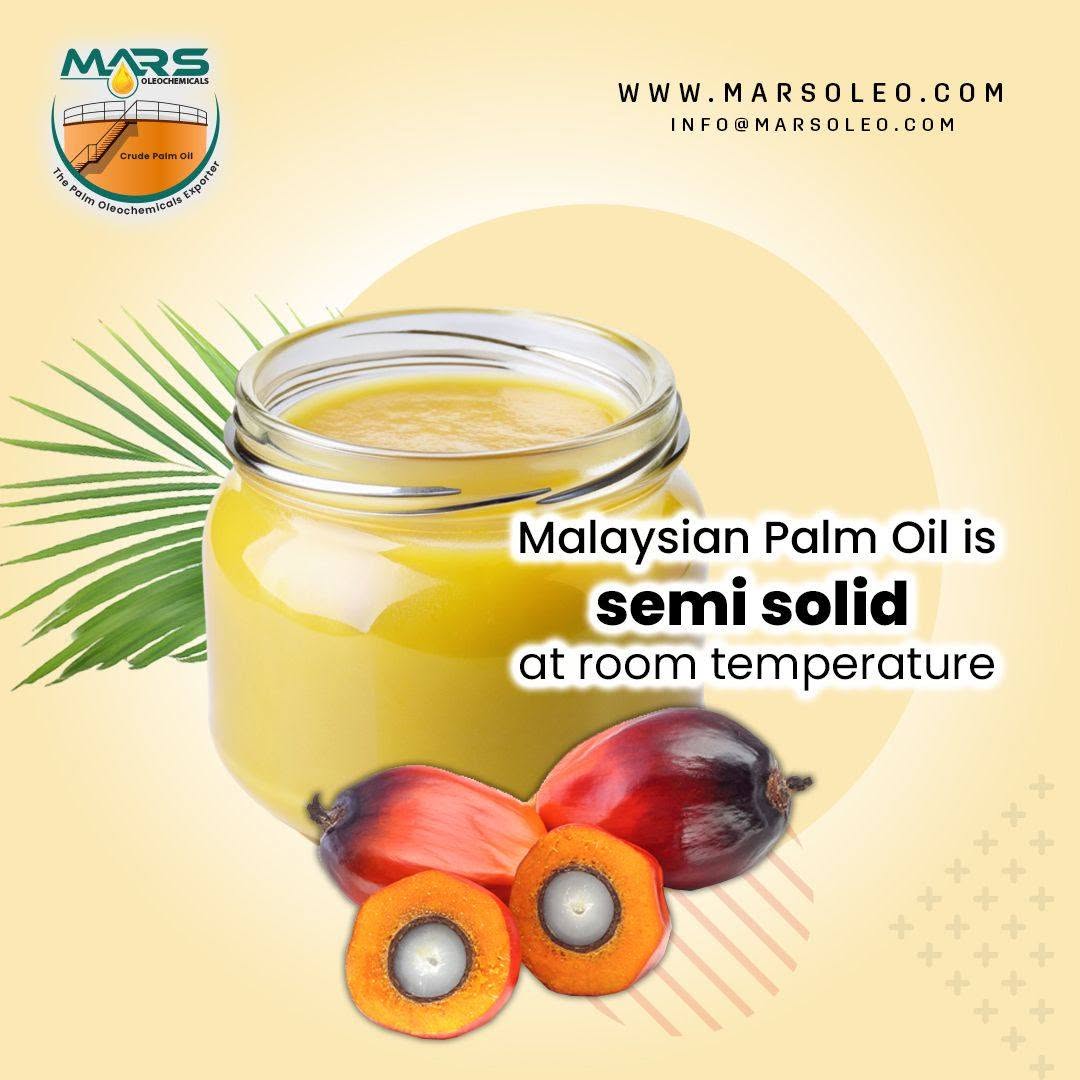
Palm oil contains a natural mixture of triglycerides with different melting characteristics. At typical room temperatures, part of this mixture is crystalline while part remains liquid, giving palm oil its characteristic semi-solid or soft-plastic consistency. MPOB reports that palm oil has a melting range of approximately 31–38°C and describes it as a soft plastic fat of medium melting point.
Palm oil's appearance and consistency change as temperature changes. At lower ambient temperatures it becomes firmer and more crystallised, while warming progressively melts the crystalline fat until a clear liquid forms. Mars Oleochemicals consequently describes RBD Palm Oil as a light-yellow liquid or semi-solid at room temperature that becomes clear yellow liquid when slightly heated.

Palm oil is naturally semi-solid at room temperature because its triglyceride composition crystallizes partially.
Natural semi-solid functionality gives palm oil useful structure in many fat-based food formulations. MPOC notes that its semi-solid nature allows palm oil to be incorporated into foods without necessarily requiring hydrogenation and supports applications such as margarine, shortening and confectionery fats. This physical characteristic can also contribute firmness, spreadability and texture in bakery-fat systems.
Palm oil can be physically fractionated into products with different melting characteristics. The softer or more liquid fraction is Palm Olein, while the harder fraction is Palm Stearin. MPOB describes palm oil fractionation as producing roughly a liquid olein fraction and a harder stearin fraction, enabling manufacturers to select a palm-based ingredient suited to particular temperature, texture and processing requirements.
Is palm oil semi-solid at room temperature? Yes. Palm oil is naturally semi-solid at typical room temperature, although its exact physical state varies with temperature, composition and product grade. MPOC describes palm oil as naturally semi-solid, including at approximately 20°C, while MPOB also identifies it as semi-solid around typical ambient conditions.
Why is palm oil semi-solid at room temperature? Palm oil contains a natural mixture of triglycerides with different melting characteristics, so part of the fat remains crystalline while another part remains liquid at typical room temperatures. Its fatty-acid and triacylglycerol composition gives palm oil this characteristic physical behaviour.
What is the melting point of palm oil? MPOB reports a typical palm oil melting range of approximately 31-38°C, although commercial specifications can vary by grade and measurement method. MPOB also describes palm oil as a soft plastic fat with a medium melting range.
Can RBD Palm Oil become liquid? Yes. RBD Palm Oil becomes a clear yellow liquid when sufficiently warmed and may appear liquid, semi-solid or partially crystallised depending on ambient temperature.
What is the difference between Palm Oil, Palm Olein and Palm Stearin? Palm oil can be fractionated into Palm Olein, the more liquid fraction, and Palm Stearin, the harder fraction, allowing manufacturers to select different melting and texture characteristics.
Why is semi-solid palm oil useful in food manufacturing? Its semi-solid character can provide structure, body and texture in products such as margarine, shortening, bakery fats and other formulated food systems. MPOC specifically identifies semi-solid fats as useful in biscuit, cookie, margarine and shortening applications.
Does palm oil need hydrogenation to become semi-solid? Palm oil is naturally semi-solid in suitable temperature conditions, so its semi-solid functionality can be used without necessarily relying on partial hydrogenation. MPOC identifies this as one of palm oil's useful functional properties in food manufacturing.
Where can buyers source Malaysian Palm Oil? International buyers can contact Mars Oleochemicals Sdn. Bh. for Malaysian Palm Oil specifications, melting characteristics, packing options, technical documentation, availability and export quotations. Mars currently publishes specifications and application information for RBD Palm Oil and related palm fractions.












Home :: Products :: Enquiry :: Contact Us :: Site Map
Copyright All Rights Reserved © 2025. Mars Oleochemicals :: Disclaimer :: Privacy Policy