


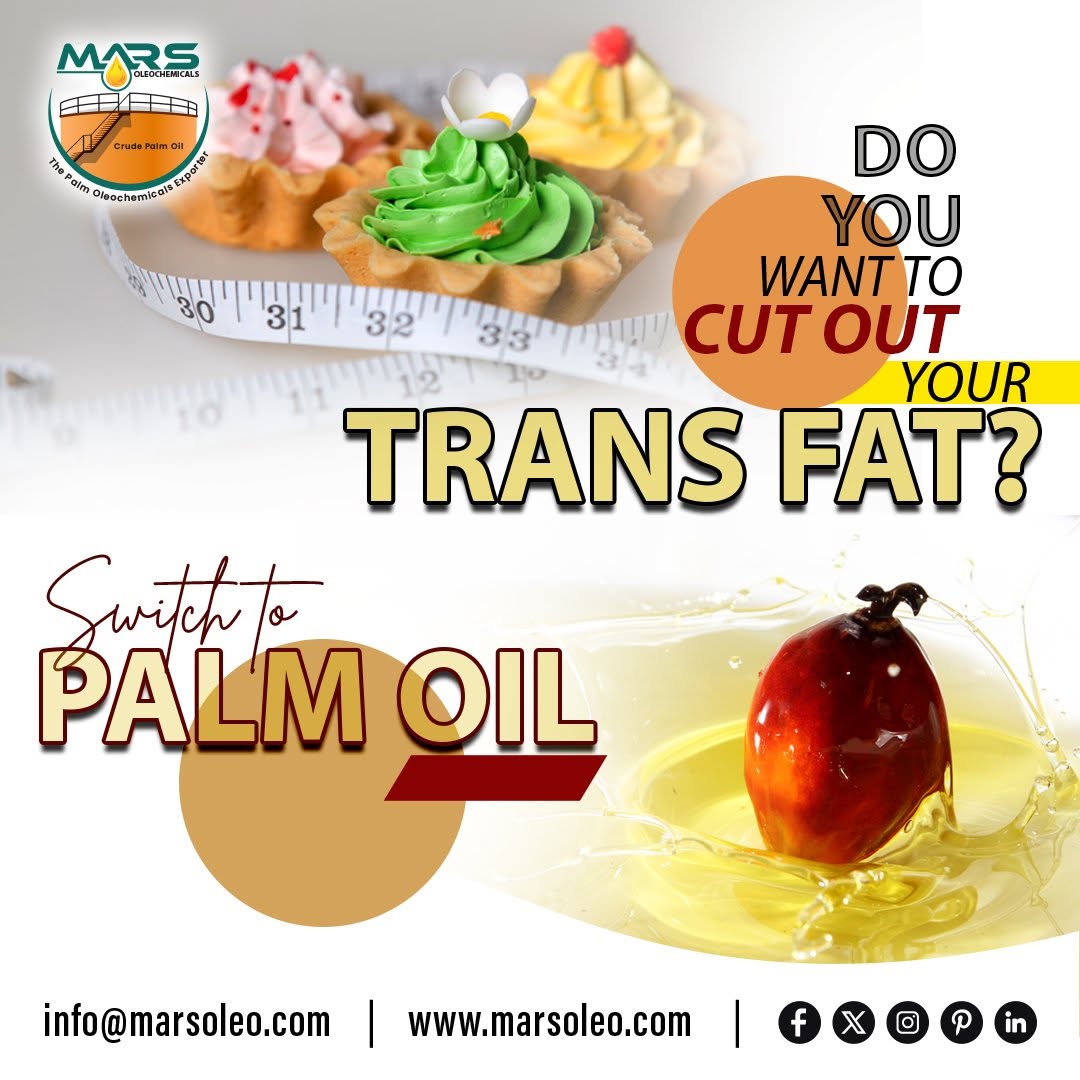
Malaysian Palm Oil is a plant-derived vegetable oil obtained from the fruit mesocarp of the oil palm tree. Its naturally occurring fatty acid composition gives conventional palm oil a semi-solid consistency under typical room-temperature conditions, making it useful in several food manufacturing applications. Unlike liquid vegetable oil products that were historically partially hydrogenated to obtain greater firmness, palm oil can provide solid-fat functionality without requiring that process. Partial hydrogenation is a major industrial source of trans-fatty acids, which are associated with increased cardiovascular health risks. Non-hydrogenated palm oil can therefore serve as a functional ingredient in selected formulations developed to eliminate industrial trans fats. Palm oil is also separated into fractions such as Palm Olein and Palm Stearin, allowing manufacturers to select materials with different melting and crystallization characteristics. Although palm oil does not need partial hydrogenation, its actual trans-fat content and the compliance of a finished food product should be established using appropriate technical information and analytical testing rather than assuming that every palm-based formulation is automatically trans-fat-free.
The food industry uses RBD Palm Oil, RBD Palm Olein and Palm Stearin for different functional purposes. RBD Palm Oil offers a combination of saturated and unsaturated triglycerides that contributes to semi-solid fat structure, while Palm Olein provides a more liquid fraction suitable for compatible cooking oil and frying applications. Palm Stearin contains a greater proportion of higher-melting components and can be incorporated into bakery fat blends, margarines, shortenings and specialty food formulations where firmness is required. These natural fractions provide manufacturers with formulation options that do not necessarily depend on partially hydrogenated oils. The Malaysian Palm Oil Board (MPOB) has published research describing palm oil's crystallization behavior, oxidative stability and performance in cooking and baking fats. Nevertheless, replacing partially hydrogenated ingredients requires more than a simple ingredient substitution. Manufacturers must evaluate the finished product's texture, flavor, melting behavior, shelf stability, saturated fat content and nutritional composition. Palm oil and its fractions can be technically useful alternatives for specific food applications, but they should not automatically be characterized as nutritionally superior to vegetable oils richer in unsaturated fatty acids.

Non-hydrogenated palm oil supports trans-fat-free formulations, its saturated fat content requires separate nutritional consideration.
Reducing industrially produced trans fats is a recognized public-health objective, and the World Health Organization recommends eliminating industrial trans fats from food supplies. However, trans-fat-free does not automatically mean low in saturated fat or healthier overall. Conventional palm oil contains approximately 50% saturated fatty acids, primarily palmitic acid, alongside unsaturated fatty acids such as oleic and linoleic acids. WHO recommends favoring unsaturated fats when replacing trans fats and limiting saturated fat intake within the overall dietary pattern. Food manufacturers developing non-hydrogenated formulations should assess the nutritional characteristics of the entire product rather than focusing exclusively on the absence of industrial trans fat. introduced a restriction on trans-fatty acids exceeding 2 grams per 100 grams of fat in specified foods intended for final consumers or retail supply, subject to the regulation's provisions. Separate requirements govern nutrition labeling and nutrient-content claims. Manufacturers should therefore confirm applicable trans-fat thresholds, analytical evidence, label wording and destination-market regulations before advertising a food as trans-fat-free. Product reformulation should aim to achieve suitable functionality while considering overall fat quality and regulatory compliance.
Mars Oleochemicals Sdn. Bhd. supports international sourcing and export enquiries for Malaysian palm oil, palm-derived oleochemicals and related vegetable oil products. Its published portfolio includes Crude Palm Oil (CPO), RBD Palm Oil, RBD Palm Olein, RBD Palm Stearin and palm oil specialty fats, alongside other oleochemical categories serving industrial manufacturers. Food manufacturers researching non-hydrogenated fat systems should select ingredients according to their intended application and required physical characteristics. Relevant product parameters may include fatty acid composition, solid fat content, iodine value, slip melting point, cloud point, free fatty acid content, peroxide value and applicable food safety specifications. Manufacturers should request suitable Technical Data Sheets (TDS), Certificates of Analysis (COA), ingredient documentation and any necessary certification records before commercial approval. The final food formulation should be evaluated independently for nutritional composition, quality, shelf life and regulatory labeling requirements. Buyers considering Malaysian palm oil for bakery fats, shortening, margarine, edible oil processing or related applications can visit our website at www.marsoleo.com For product requirements, technical documentation, commercial information and international export inquiries, please email us at info@marsoleo.com.
Is Malaysian palm oil naturally free from industrial trans fats? Non-hydrogenated Malaysian palm oil does not require partial hydrogenation to provide semi-solid fat functionality and is generally free from the industrial trans fats produced by that process. However, an absolute trans-fat-free claim should be supported by product-specific testing and applicable food labeling requirements.
Why is palm oil used as an alternative to partially hydrogenated oils? Palm oil naturally contains a combination of saturated and unsaturated fatty acids, giving it useful semi-solid characteristics. It can provide structure and texture in selected bakery fats, margarines and shortenings without partial hydrogenation. Its suitability must also be assessed in terms of saturated fat content and the nutritional quality of the finished product.
Does trans-fat-free palm oil automatically make food healthier? No. Trans fat and saturated fat are different nutritional considerations. Conventional palm oil contains approximately 50% saturated fatty acids. WHO recommends replacing trans fats primarily with unsaturated fats and considering saturated fat intake as part of overall dietary quality. A finished food must be evaluated on its complete nutritional composition.
What is the difference between RBD Palm Oil, Palm Olein and Palm Stearin? RBD Palm Oil is refined, bleached and deodorized palm oil. Palm Olein is the lower-melting liquid fraction commonly used in suitable cooking and frying applications, while Palm Stearin is the higher-melting solid fraction used in selected bakery fats, margarines and specialty formulations. Their physical properties determine their suitability for different manufacturing processes.
How can food manufacturers source Malaysian palm oil ingredients from Mars Oleochemicals? Buyers should provide the required palm oil grade, intended food application, technical specifications, quantity, packaging and destination port. Product availability, food-grade suitability, technical documentation and export arrangements should be verified for each transaction.








Home :: Products :: Enquiry :: Contact Us :: Site Map
Copyright All Rights Reserved © 2025. Mars Oleochemicals :: Disclaimer :: Privacy Policy


