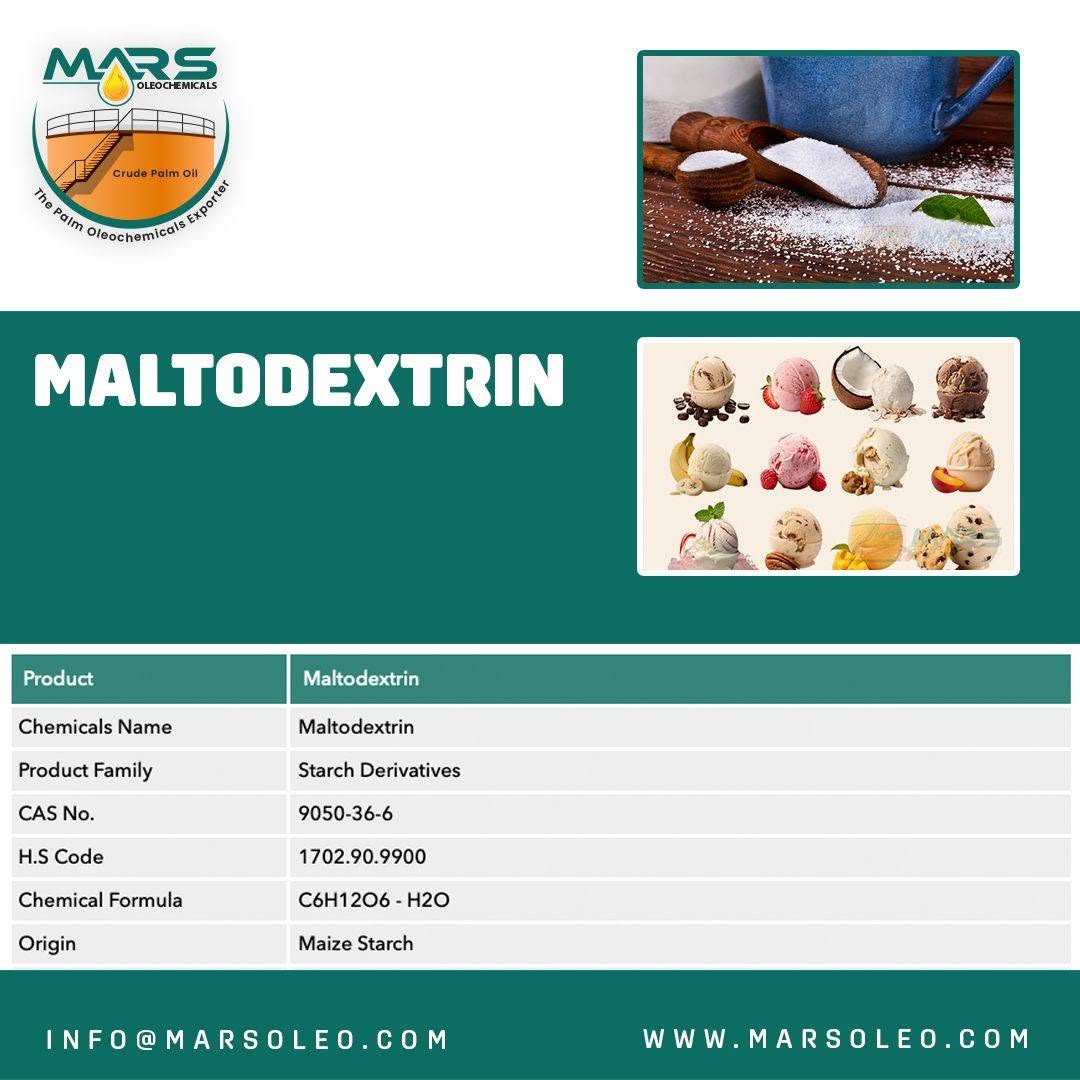
Maltodextrin is a starch-derived carbohydrate produced through controlled partial hydrolysis of starch. FDA defines it as a nutritive polymer composed primarily of D-glucose units linked through α-1,4 bonds with a Dextrose Equivalent below 20. Commercial food-grade maltodextrin is normally supplied as a white powder and can be produced from maize, potato or rice starch.
Dextrose Equivalent, or DE, measures reducing sugars expressed as glucose on a dry basis and indicates the extent of starch hydrolysis. Maltodextrin must remain below DE 20 under the FDA definition. Mars Oleochemicals currently publishes a DE range of 16-20, moisture of 5% maximum and pH of 4.0-7.0 for its maize-derived grade.

Maltodextrin Food Grade for Nutrition, Beverages, Bakery, Dairy and Global Manufacturing Applications from Malaysia Worldwide.
Food manufacturers use maltodextrin for bulking, texture development, solids adjustment, carrier systems and product stabilization. Common applications include instant beverages, bakery products, confectionery, dairy products, soups, sauces, seasonings, protein powders and sports-nutrition products. Because maltodextrin has relatively low sweetness, it can add carbohydrate solids without strongly increasing sweetness.
Mars Oleochemicals supplies maize-derived Maltodextrin Food Grade with published specifications covering moisture, DE, pH, ash, sulphur dioxide, bulk density, heavy metals and microbiological parameters. Commercial buyers should review the current TDS, SDS, COA, origin declaration and applicable food-safety or certification documents before product approval.
1. What is Maltodextrin? Maltodextrin is a starch-derived nutritive carbohydrate polymer consisting mainly of D-glucose units linked primarily by alpha-1,4 bonds. Food-grade maltodextrin has a Dextrose Equivalent below 20.
2. What is the correct chemical formula for Maltodextrin? The general polymer formula used for maltodextrin is (C6H10O5)n. Maltodextrin contains glucose chains of different lengths, so it does not have one fixed molecular weight.
3. What are the CAS and EC numbers for Maltodextrin? Maltodextrin commonly uses CAS number 9050-36-6 and EC or EINECS number 232-940-4.
4. What does DE mean in Maltodextrin? DE means Dextrose Equivalent. Maltodextrin has a DE below 20, while Mars Oleochemicals publishes a DE range of 16 to 20 for its commercial grade.
5. What is the HS code for Maltodextrin? Maltodextrin is commonly classified within international HS subheading 1702.90. Mars Oleochemicals publishes 1702.90.9900, while the complete national tariff extension should be confirmed with the relevant customs authority.
6. Is Maltodextrin a sweetener? Maltodextrin has relatively low sweetness and is better known as a bulking agent, carbohydrate source, carrier, texturizer and stabilizing ingredient rather than as a primary sweetener. FDA describes maltodextrin as a nonsweet nutritive saccharide polymer.
7. What is Maltodextrin used for in food? Maltodextrin is used in powdered beverages, bakery products, dairy foods, confectionery, soups, sauces, seasonings, instant foods and nutritional products for bulking, texture, carrier and solids management.
8. Why is Maltodextrin used in sports nutrition? Maltodextrin provides a readily digestible carbohydrate source and is used in suitable sports drinks, carbohydrate powders, energy products and nutrition formulations.
9. What is the INCI name for Maltodextrin? The recognised cosmetic ingredient name is Maltodextrin. It can provide binding, absorbent, film-forming, emulsion-stabilising and conditioning functions in suitable cosmetic formulations.
10. Where can buyers source Maltodextrin from Malaysia? International buyers can contact Mars Oleochemicals Sdn. Bhd. for Maltodextrin specifications, packing options, quality documents, current certifications, availability and export quotations.













Home :: Products :: Enquiry :: Contact Us :: Site Map
Copyright All Rights Reserved © 2025. Mars Oleochemicals :: Disclaimer :: Privacy Policy