


Oil palm produces fruit bunches containing an oil-rich fleshy mesocarp and a kernel. Palm oil comes primarily from the fruit pulp, while palm kernel oil is produced from the kernel.
FAO-based data published by Our World in Data compare the quantity of vegetable oil obtained from each hectare of agricultural land. These comparisons consistently show oil palm achieving substantially higher oil yields than several other globally important vegetable-oil crops.
A crop that produces more oil from each hectare naturally requires less agricultural area to produce a given tonne of vegetable oil.
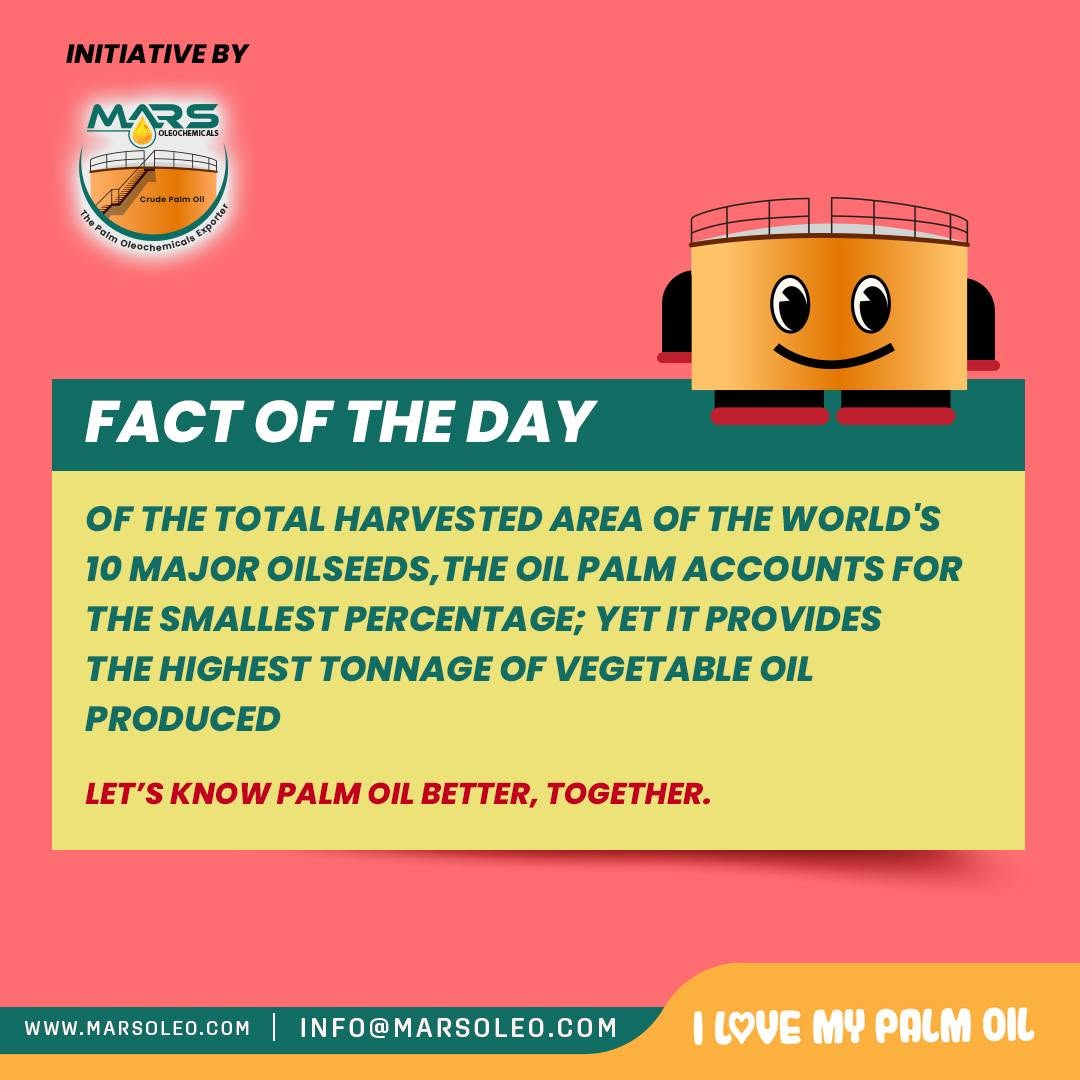
The inverse-yield comparison from FAO data therefore shows oil palm needing considerably less land per tonne of oil than lower-yield oil crops. This is the technically strongest way to describe the land-efficiency advantage shown in the attached Tankys Fact of the Day.

Oil palm produces high vegetable-oil yields per hectare, helping meet demand with comparatively less cropland.
Historical global comparisons illustrate this effect clearly. Our World in Data reports that in 2017, palm oil represented approximately 36% of global vegetable-oil production while using around 8.6% of the land devoted to vegetable-oil crops. This comparison demonstrates how high oil yield translates into a disproportionately large contribution to oil production relative to land use.
These percentages are historical rather than fixed. Production volumes, planted areas and crop shares change over time, so the webpage should avoid presenting those figures as permanent current statistics.
Land-use efficiency is only one part of environmental performance. High yield means more oil can be produced from a given hectare, but environmental outcomes also depend on where plantations are developed and how they are managed.
Palm-oil expansion has historically been associated with deforestation and habitat loss in some regions. Therefore, a technically balanced explanation should distinguish yield efficiency from broader questions of land conversion, biodiversity, greenhouse-gas emissions and responsible production.
What is oil palm? Oil palm is a tropical perennial crop whose fruits are processed to produce palm oil from the fruit pulp and palm kernel oil from the kernel.
Does oil palm produce more oil per hectare than other major oil crops? Yes. FAO-derived global comparisons show substantially higher oil yields for oil palm than several major alternative vegetable-oil crops.
Why does palm oil require comparatively less land? Oil palm produces a large quantity of oil per hectare, meaning less harvested area is required to produce a given tonne of vegetable oil compared with lower-yield crops.
Is oil palm technically an oilseed? Not strictly. Oil palm is a fruit-producing perennial crop. Palm oil is extracted from the fleshy fruit, while palm kernel oil comes from the kernel.
What percentage of vegetable oil does palm oil produce? The percentage changes by year. A widely cited historical comparison found that palm oil supplied about 36% of global vegetable oil in 2017.
How much land did palm oil use in that comparison? In the same 2017 comparison, palm oil used approximately 8.6% of the land devoted to vegetable-oil crops.
Does high yield make palm oil automatically sustainable? No. High yield improves land-use efficiency, but sustainability also depends on plantation location, land conversion, biodiversity, emissions and management practices.
Is palm oil more land-efficient than soybean oil? On an oil-output-per-hectare basis, oil palm has much higher average oil yield. Soybean, however, also produces valuable protein meal, so broader agricultural comparisons should account for co-products.
Is palm oil more land-efficient than sunflower oil? Global-average oil-yield data show oil palm producing substantially more vegetable oil per hectare than sunflower.
Does oil palm also produce palm kernel oil? Yes. Oil palm fruit provides palm oil from the mesocarp and palm kernel products from the kernel.
Does Mars Oleochemicals supply palm oil products? Mars Oleochemicals supplies palm oil and palm-kernel-based products for international commercial requirements.
How can buyers request information? Commercial buyers can send the required product, specification, quantity, packaging and destination to info@marsoleo.com.





Home :: Products :: Enquiry :: Contact Us :: Site Map
Copyright All Rights Reserved © 2025. Mars Oleochemicals :: Disclaimer :: Privacy Policy


