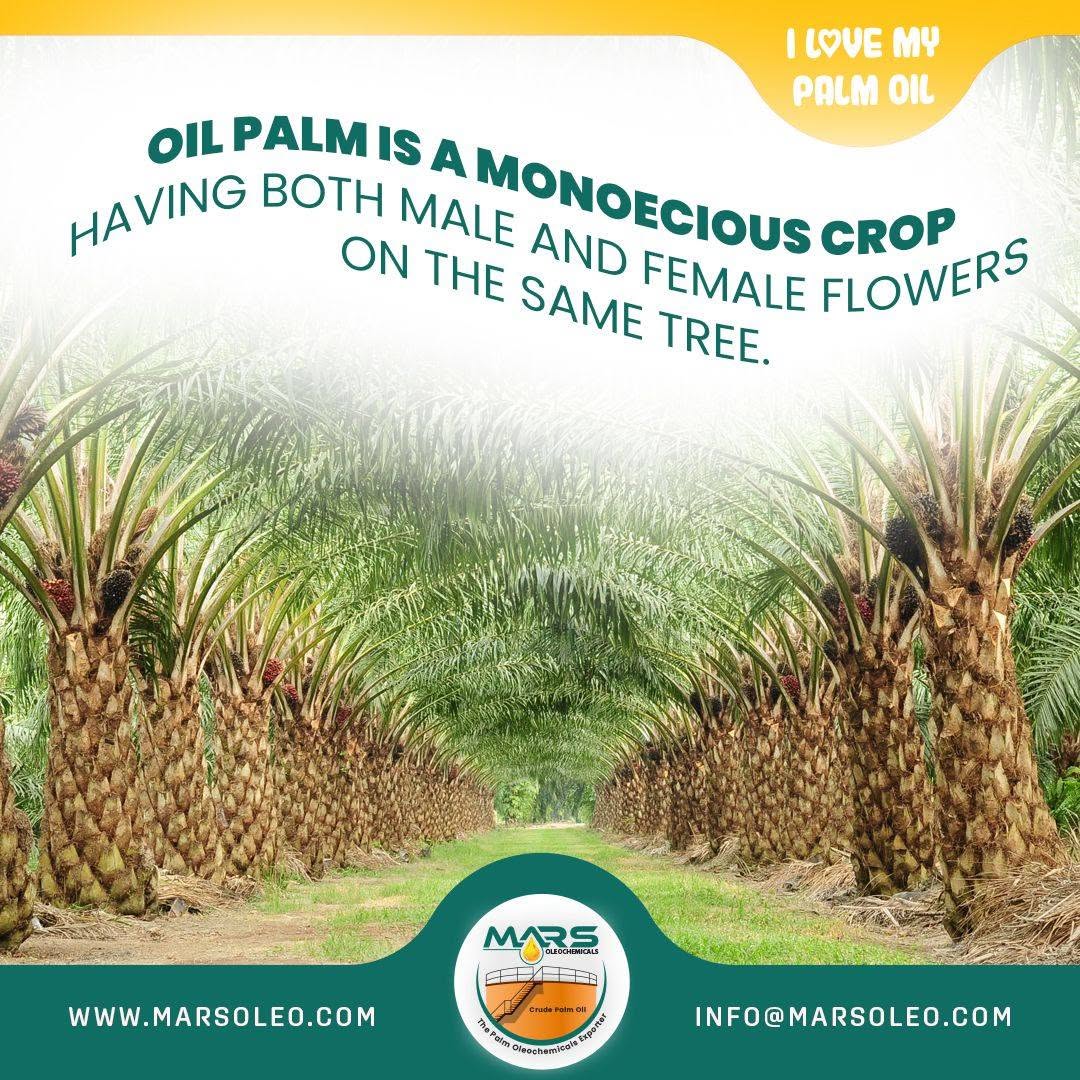
Oil palm, particularly Elaeis guineensis, is described as a monoecious crop because an individual tree can produce both male and female reproductive structures. Importantly, the flowers are not combined into one bisexual flower. Male and female flowers occur in separate inflorescences produced on the same palm. This distinction is fundamental to understanding oil-palm reproductive biology.
Male inflorescences produce the pollen needed for fertilisation. During anthesis, these flower clusters also play an important ecological role in supporting pollinating insects. Research published by MPOB describes anthesising male inflorescences as both feeding and breeding sites for the oil-palm pollinating weevil Elaeidobius kamerunicus.

Oil palm flowering explain pollination, fruit-set development and the biological origin of palm oil.
Female inflorescences can develop into fruit bunches after successful pollination and fertilisation. Pollination has a direct relationship with fruit set, and MPOB experiments have demonstrated that pollen availability influences fruit-set levels. Mature bunches ultimately contain numerous individual oil-palm fruits.
After pollination and fruit development, oil-palm fruits mature in dense fresh fruit bunches. Palm oil is extracted from the fleshy mesocarp of those fruits, while palm kernel oil is obtained from the kernel inside the seed. Therefore, the most accurate biological sequence is flowering → pollination → fertilisation → fruit-bunch formation → harvesting → oil extraction, rather than saying male and female flowers directly produce palm oil. Mars' existing educational page follows this relationship.
What does monoecious mean in oil palm? Monoecious means that the same individual oil palm produces both male and female reproductive structures, although they occur in separate inflorescences.
Does one oil palm tree have both male and female flowers? Yes. A single oil palm can produce both male and female inflorescences, but they generally occur as separate flower clusters rather than combined flowers.
Are oil palm flowers male and female at the same time? An individual palm can produce both types, but male and female inflorescences develop separately and their flowering periods do not necessarily coincide.
What is the function of male oil palm flowers? Male flowers produce pollen required for fertilisation and provide important feeding and breeding resources for the oil-palm pollinating weevil Elaeidobius kamerunicus.
What is the function of female oil palm flowers? After successful pollination and fertilisation, female flowers can develop into fruits that form an oil-palm fruit bunch.
Why is pollination important in oil palm? Pollination is essential for proper fruit set and bunch formation. Pollen availability and successful fertilisation influence the development of oil-palm fruits.
What pollinates oil palm flowers? Oil palms are pollinated particularly effectively by insects. The weevil Elaeidobius kamerunicus is an important pollinator in commercial oil-palm plantations.
Do male flowers produce palm oil? No. Male flowers produce pollen. Palm oil is obtained later from the mesocarp of fruits formed on successfully pollinated female inflorescences.
Where does palm oil come from? Palm oil is extracted from the fleshy mesocarp of mature oil-palm fruit. Palm kernel oil, by contrast, comes from the kernel inside the seed.












Home :: Products :: Enquiry :: Contact Us :: Site Map
Copyright All Rights Reserved © 2025. Mars Oleochemicals :: Disclaimer :: Privacy Policy