


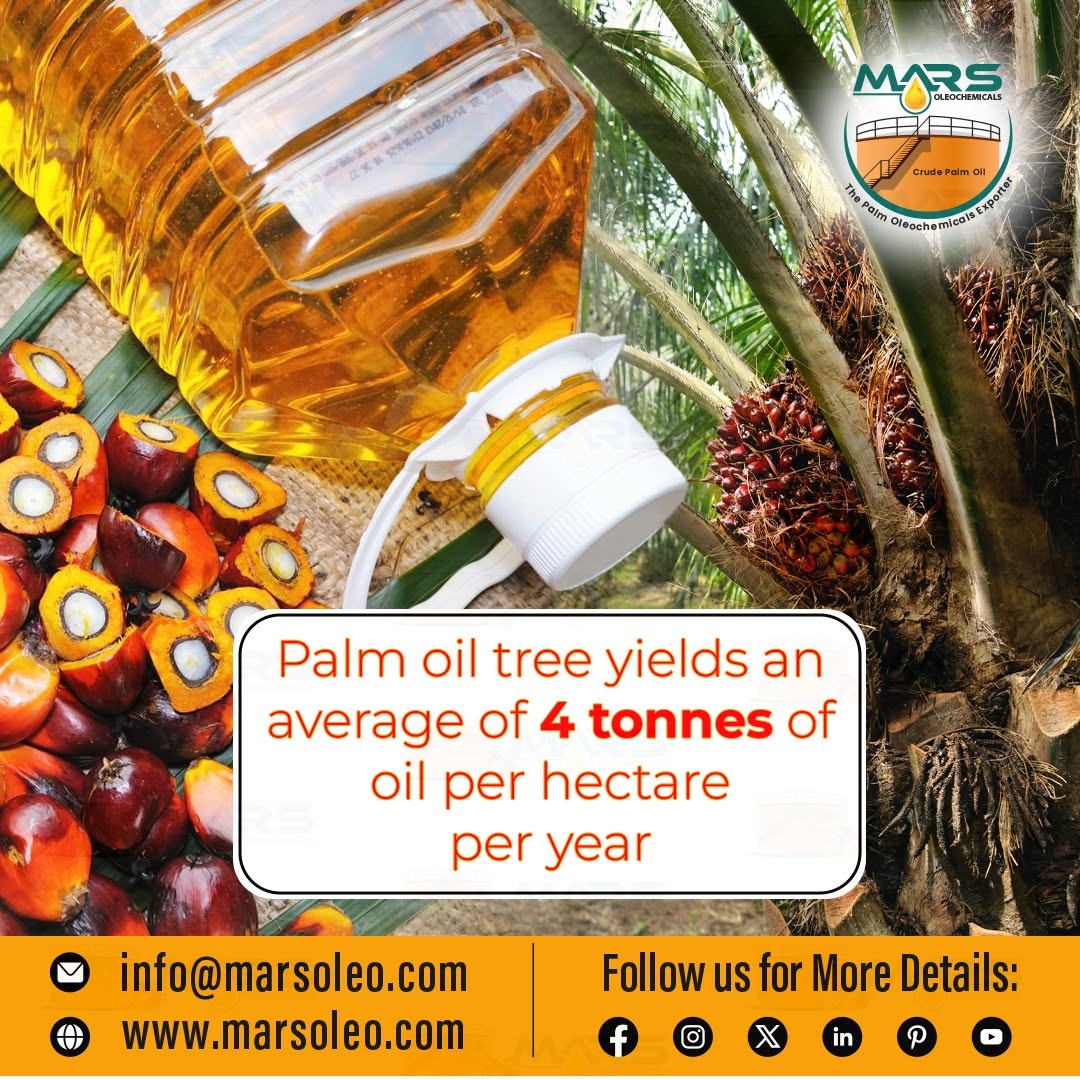
Oil palm is recognized as one of the world's most productive commercial oil-bearing crops, providing substantial vegetable oil output from cultivated agricultural land. Unlike many annual oilseed crops, mature oil palm trees produce fresh fruit bunches throughout the year under suitable tropical growing conditions. Productive plantations can achieve around four tonnes of palm oil per hectare annually, although actual production varies considerably depending on palm age, soil quality, climate, agricultural management and milling efficiency. This relatively high oil yield makes oil palm an important crop for the global food, vegetable oil and oleochemical industries.
Palm oil yield per hectare is influenced by two major factors: fresh fruit bunch (FFB) productivity and the oil extraction rate (OER) achieved during milling. According to the Malaysian Palm Oil Board (MPOB), Malaysian oil palm estates recorded an average FFB yield of 16.70 tonnes per hectare in 2024, corresponding to approximately 3.28 tonnes of crude palm oil per hectare. In 2025, estate FFB productivity increased to 17.77 tonnes per hectare, while the national oil extraction rate reached 19.74%. These figures demonstrate the importance of agricultural productivity, ripe fruit harvesting, efficient mill operations and continuous improvements in plantation management.

Oil palm delivers high vegetable oil yields, efficient agricultural production and diverse industrial applications.
The high productivity of oil palm plantations provides significant commercial advantages for vegetable oil manufacturing. Palm fruit produces two commercially important oils: palm oil extracted from the fruit mesocarp and palm kernel oil obtained from the kernel. These oils can be further processed into refined palm oil, palm olein, palm stearin, specialty fats and oleochemical raw materials. Their diverse applications include cooking oils, bakery fats, cosmetic ingredients, soap noodles, fatty acids, fatty alcohols, surfactants and other industrial products. High oil yields can help improve land-use efficiency, although environmental sustainability also requires responsible sourcing and protection of natural ecosystems.
Mars Oleochemicals Sdn. Bhd., Malaysia, supports international sourcing and export inquiries for crude palm oil, refined palm oil products, palm kernel oil derivatives and palm-based oleochemicals. Manufacturers, distributors, importers and international buyers can contact Mars Oleochemicals to discuss product specifications, available grades, packaging, quality documentation and international supply requirements. Visit our website at www.marsoleo.com For product requirements, technical documentation, commercial information and international export inquiries, please email us at info@marsoleo.com.
How much palm oil can one hectare of oil palm plantation produce annually? Productive plantations can produce approximately four tonnes of oil per hectare annually under favourable conditions. Malaysia's average estate crude palm oil yield was 3.28 tonnes per hectare in 2024.
Why is oil palm considered a high-yielding vegetable oil crop? Oil palm produces fruit bunches throughout the year in suitable tropical environments and provides relatively high vegetable oil output per cultivated hectare.
What factors influence oil palm yield per hectare? Oil palm yield depends on palm age, planting material, climate, soil fertility, nutrition, harvesting efficiency, pest management and oil extraction performance.
Does high palm oil yield automatically mean sustainable production? No. High yield improves land-use efficiency, but sustainable production also requires responsible land management, forest protection, environmental safeguards and supply chain traceability.
Where can international buyers source Malaysian palm oil and oleochemicals? Mars Oleochemicals Sdn. Bhd. supports international inquiries for palm oil and palm-based oleochemicals.






Home :: Products :: Enquiry :: Contact Us :: Site Map
Copyright All Rights Reserved © 2025. Mars Oleochemicals :: Disclaimer :: Privacy Policy


