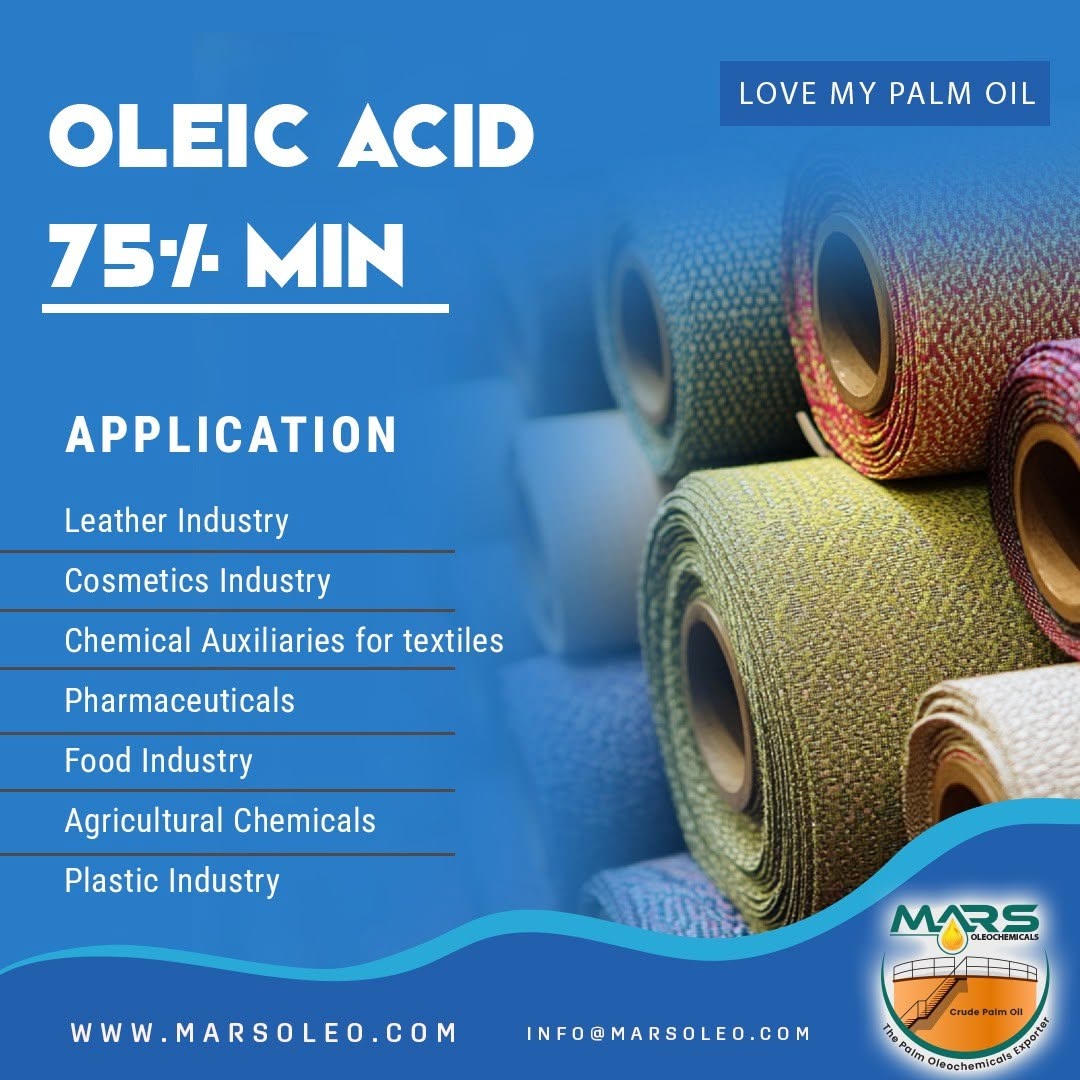
Oleic Acid is a monounsaturated C18:1 fatty acid with the molecular formula C18H34O2. Oleic Acid 75% Min is a commercial fatty-acid grade containing at least 75% oleic acid and supplied by Mars from vegetable-oil feedstocks. The current Mars specification describes the material as a pale-yellow liquid and identifies palm oil, palm-kernel oil and coconut oil among its origins.
Oleic Acid and its derivatives are used in leather-processing systems for tanning, fat-liquoring, conditioning and finishing formulations. In textile manufacturing, suitable oleic-acid derivatives can function as softening, wetting, emulsifying and processing auxiliaries. Mars specifically identifies both leather processing and textile auxiliaries among the applications of Oleic Acid 75% Min.

Oleic acid provides emulsifying, lubricating, wetting and dispersing functionality across diverse industrial formulations worldwide.
Oleic Acid is an important intermediate for producing oleate esters, metallic soaps, surfactants, fatty amines and other specialty derivatives. These materials can provide lubricity, emulsification, dispersion and corrosion-control functionality in metalworking fluids, industrial lubricants, coatings and chemical formulations. Mars' current SDS explicitly identifies ester production, lubricants, metallic soaps, coatings, paints and corrosion inhibitors among its applications.
Yes, when the grade and regulatory specification are suitable for the intended application. Appropriate Oleic Acid grades can be used in creams, lotions, ointments, capsules and selected regulated food systems. However, buyers should confirm purity, specifications, regulatory status and supporting documentation rather than assuming every industrial Oleic Acid 75% grade is suitable for food or pharmaceutical use.
What is Oleic Acid 75% Min? Oleic Acid 75% Min is a commercial vegetable-derived fatty-acid grade containing a minimum of 75% Oleic Acid, a monounsaturated C18:1 fatty acid.
What is Oleic Acid 75% used for? Oleic Acid 75% is used in leather, textiles, lubricants, metalworking fluids, cosmetics, surfactants, esters, plastics, rubber, coatings, agricultural chemicals and other industrial formulations.
Is Oleic Acid used in the leather industry? Yes. Oleic Acid and suitable derivatives are used in leather tanning, conditioning and finishing formulations. Mars specifically identifies leather processing as an application.
How is Oleic Acid used in textile manufacturing? Oleic Acid can serve as a raw material for textile auxiliaries providing wetting, softening, emulsification and processing functionality depending on the formulation.
Is Oleic Acid used in lubricants? Yes. Oleic Acid and oleate esters are used in industrial lubricants, metalworking fluids and related formulations where lubricity and surface interaction are required.
Can Oleic Acid 75% be used in cosmetics? Suitable cosmetic-grade Oleic Acid can be used in creams, lotions, moisturizers and hair-care products. Manufacturers should verify the exact grade and regulatory requirements for their formulation.
Can Oleic Acid be used in food and pharmaceuticals? Selected Oleic Acid grades can be used in food and pharmaceutical applications, but the product must meet the applicable purity, specification and regulatory requirements.
What is the HS Code for Oleic Acid 75%? Mars currently lists HS Code 3823.12.0000 for Oleic Acid 75% Min. Importers should confirm destination-specific customs classification before shipment.










Home :: Products :: Enquiry :: Contact Us :: Site Map
Copyright All Rights Reserved © 2025. Mars Oleochemicals :: Disclaimer :: Privacy Policy