


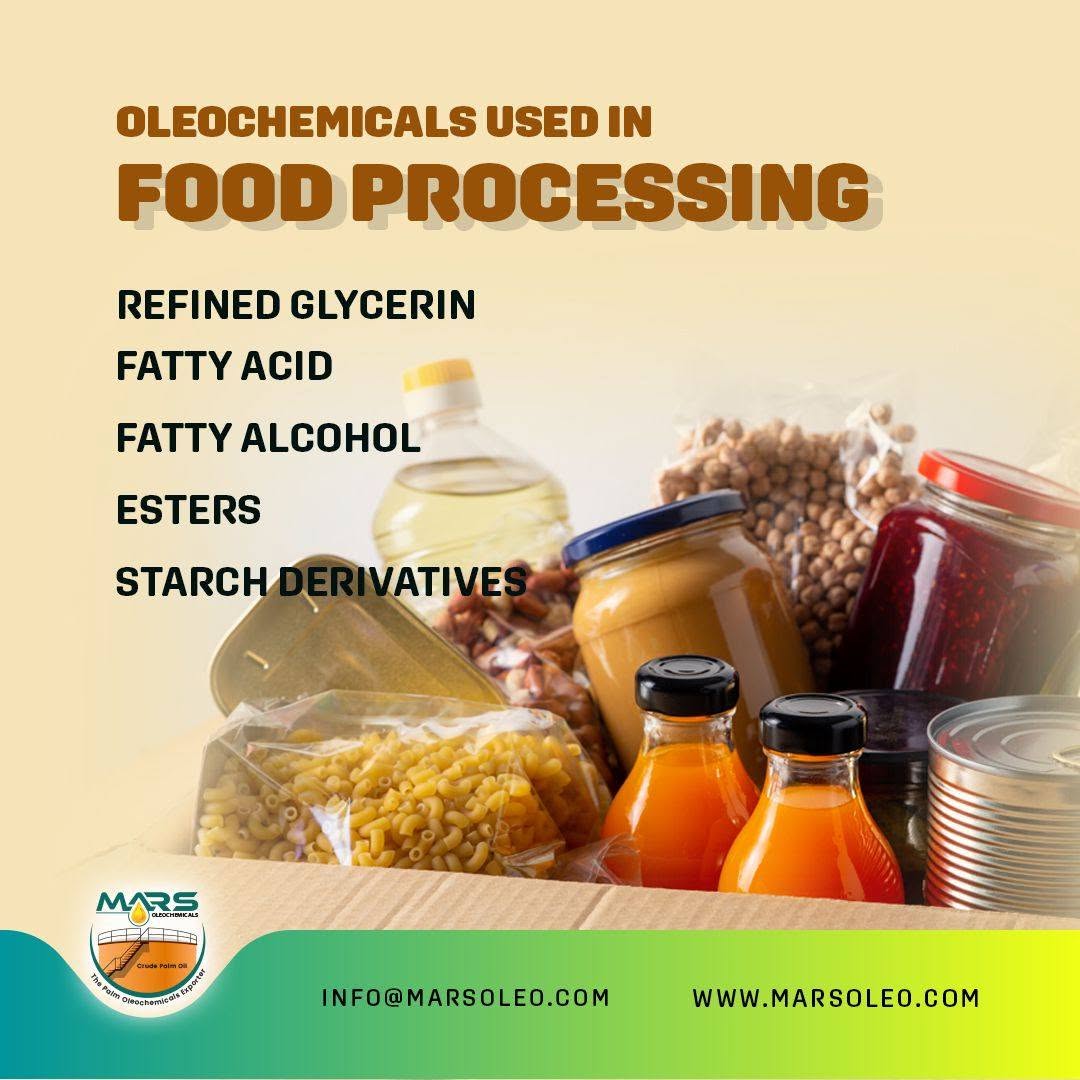
Food manufacturers use a wide variety of functional ingredients to control texture, moisture, emulsification, sweetness, body and processing behavior. Suitable food-grade oleochemicals such as Glycerine and selected Fatty Acid Esters can serve important formulation functions, while starch-derived ingredients provide additional carbohydrate-based functionality.
Food-grade Refined Glycerine can function as a humectant, solvent and texture-supporting ingredient in suitable formulations. Selected food-grade Fatty Acids and Fatty Acid Esters may also serve as ingredients or intermediates for emulsification and other food-processing applications, depending on regulatory approval and grade.

Food-grade oleochemicals and starch derivatives texture, emulsification, processing and product consistency applications.
Starch-derived ingredients such as Sorbitol, Glucose Syrup, Dextrose Monohydrate, Maltodextrin and High Maltose Corn Syrup serve bakery, confectionery, beverage and processed-food markets. Depending on the product, they can contribute sweetness, moisture management, bulking, body and processing functionality.
Mars Oleochemicals supports commercial requirements for selected food-grade oleochemicals and starch-derived ingredients. Buyers should provide the required product, specification, quantity, packing, intended food application and destination so the appropriate grade and supporting documentation can be evaluated.
What Oleochemicals are used in food processing? Suitable food-grade oleochemicals can include Refined Glycerine, selected Fatty Acids, Fatty Acid Esters and glyceride-based ingredients.
Are Starch Derivatives Oleochemicals? No. Starch Derivatives are carbohydrate-derived ingredients and are a separate product family from oleochemicals.
Why is Glycerine used in food processing? Food-grade Glycerine can provide humectancy, moisture management, solvent functionality and texture support in suitable food formulations.
Are Fatty Acid Esters used in food? Certain food-permitted Fatty Acid Esters and glyceride systems can function as emulsifiers, texture modifiers or processing ingredients.
What is Glyceryl Monostearate? Glyceryl Monostearate, or GMS, is a Fatty Acid Ester used in suitable formulations for functions such as emulsification, texture and stabilization.
What is Maltodextrin used for? Maltodextrin can provide bulking, body, carrier functionality, solids and texture in many processed-food formulations.
Are Fatty Alcohols used directly in food processing? Fatty Alcohols should not be broadly described as direct food ingredients. Any food-related use should be supported by the specific grade, application and regulatory status.
Do industrial-grade chemicals qualify as food-grade ingredients? No. Industrial grade and food grade are not interchangeable. The supplied ingredient must meet the requirements applicable to its intended food application.
Does Mars Oleochemicals supply food-processing ingredients? Mars Oleochemicals supports commercial requirements for selected food-grade oleochemicals and starch-derived ingredients, subject to specification and availability.
How can buyers contact Mars Oleochemicals? Commercial enquiries can be sent to info@marsoleo.com.















Home :: Products :: Enquiry :: Contact Us :: Site Map
Copyright All Rights Reserved © 2025. Mars Oleochemicals :: Disclaimer :: Privacy Policy


