


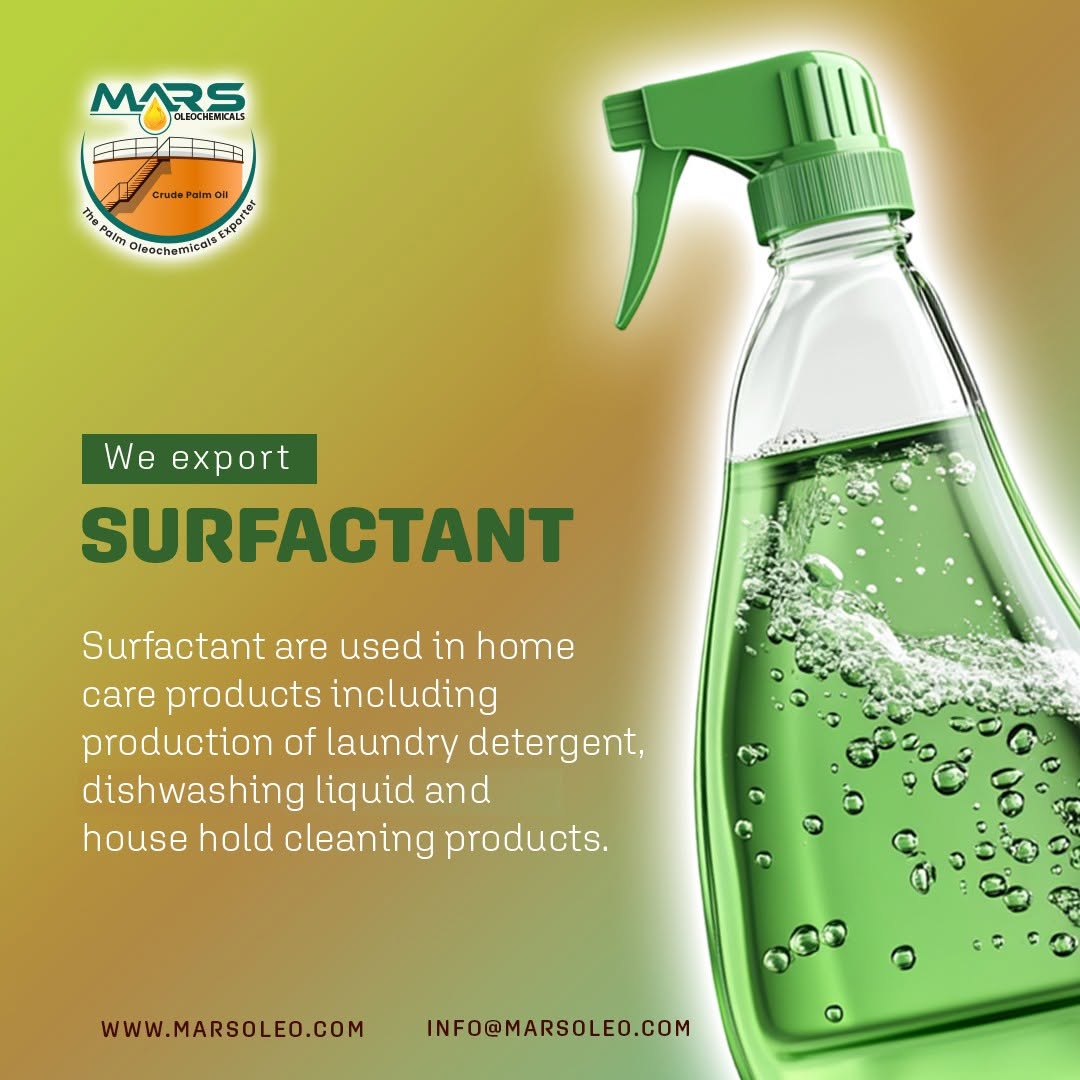
Surfactants are important chemical ingredients used in the manufacture of laundry detergents, dishwashing liquids, household cleaners and personal care products. The term surfactant refers to a surface-active agent capable of reducing surface or interfacial tension, allowing water to interact more effectively with oily soils and other substances. Palm-based surfactants can be manufactured from vegetable-derived feedstocks, including palm oil, palm kernel oil and coconut oil. These raw materials are converted into fatty acids, fatty alcohols, methyl esters and other intermediates that support downstream surfactant production. Different chemical structures provide different cleansing, wetting, emulsifying and foaming characteristics. Mars Oleochemicals Sdn. Bhd., a Malaysian exporter of palm-based oleochemicals, offers a range of surfactants relevant to international home care and industrial cleaning manufacturers.
Surfactants are commonly classified into four major categories: anionic, nonionic, cationic and amphoteric surfactants. Anionic surfactants, including Sodium Lauryl Ether Sulfate (SLES), Sodium Lauryl Sulfate (SLS) and Methyl Ester Sulphonates (MES), are widely used in cleaning products because of their detergency and wetting characteristics. Nonionic surfactants provide additional wetting and emulsifying functionality in suitable formulations. Amphoteric surfactants, including Cocamidopropyl Betaine (CAPB), are used in selected liquid cleansing systems and can complement other surfactant categories. Cationic surfactants are commonly associated with conditioning and certain specialty applications. The performance of each ingredient depends on its chemical structure, active matter concentration, compatibility and intended use.

Surfactants reduce surface tension, helping laundry detergents, dishwashing liquids and household cleaners remove oily soils.
Surfactants contribute to cleaning performance by helping water wet surfaces, interact with oils and disperse soils. In laundry detergents, suitable surfactants help detach and suspend oily dirt from fabrics during washing. In dishwashing liquids, they support the removal of grease and food residues from appropriate washable surfaces. Household cleaning products also rely on surfactants for wetting, emulsification, soil dispersion and foam characteristics. The effectiveness of a finished product depends on the complete formulation, cleaning conditions and compatibility of its ingredients. Manufacturers selecting vegetable-derived surfactants should consider product specifications, active matter, pH, stability, intended application and applicable safety requirements.
Mars Oleochemicals Sdn. Bhd. supports international sourcing and export inquiries for palm-derived surfactants and related oleochemical products. Its published surfactant portfolio includes SLES N70, SLS-95, CAPB 30, CAPB 45, Cocamide DEA and Methyl Ester Sulphonates in different commercial forms. These materials are relevant to manufacturers developing laundry detergents, dishwashing liquids, household cleaning products and compatible industrial cleaning systems. Commercial product evaluation should consider chemical classification, active concentration, product quality specifications, batch documentation and destination-market regulatory requirements. Businesses researching Malaysian palm-based surfactants can explore the product information at visiting our website at www.marsoleo.com. For product requirements, technical documentation, commercial information and international export inquiries, please email us at info@marsoleo.com. for available technical documentation and commercial information.
What are palm-based surfactants and how do they work? Palm-based surfactants are surface-active ingredients manufactured using chemical feedstocks derived from palm oil, palm kernel oil or related vegetable oils. They contain water-attracting and oil-attracting molecular regions that help reduce surface tension, allowing cleaning formulations to wet surfaces and disperse oils and dirt.
Which surfactants are commonly used in laundry detergents and dishwashing liquids? Common surfactant ingredients include Sodium Lauryl Ether Sulfate (SLES), Sodium Lauryl Sulfate (SLS), Methyl Ester Sulphonates (MES) and selected nonionic or amphoteric surfactants. Their suitability depends on the required cleansing performance, product formulation and intended application.
What is the difference between anionic, nonionic and amphoteric surfactants? Anionic surfactants carry a negative charge in solution and are widely used for detergency. Nonionic surfactants have no formal ionic charge and are commonly selected for wetting and emulsification. Amphoteric surfactants can exhibit different charge characteristics depending on conditions and are used in selected cleansing formulations.
Are palm-derived surfactants automatically eco-friendly and biodegradable? No. Vegetable-derived feedstocks do not automatically establish environmental safety or biodegradability. Environmental performance depends on the individual surfactant's chemical structure, biodegradation behavior, aquatic toxicity and other relevant characteristics. Any sustainability or biodegradability claim should be supported by appropriate testing or certification.
What should manufacturers evaluate when selecting surfactants for home care products? Manufacturers should review the required surfactant classification, active matter concentration, cleansing characteristics, product compatibility and intended application. Technical Data Sheets (TDS), Safety Data Sheets (SDS), Certificates of Analysis (COA) and applicable regulatory documentation help support ingredient evaluation.





Home :: Products :: Enquiry :: Contact Us :: Site Map
Copyright All Rights Reserved © 2025. Mars Oleochemicals :: Disclaimer :: Privacy Policy


