


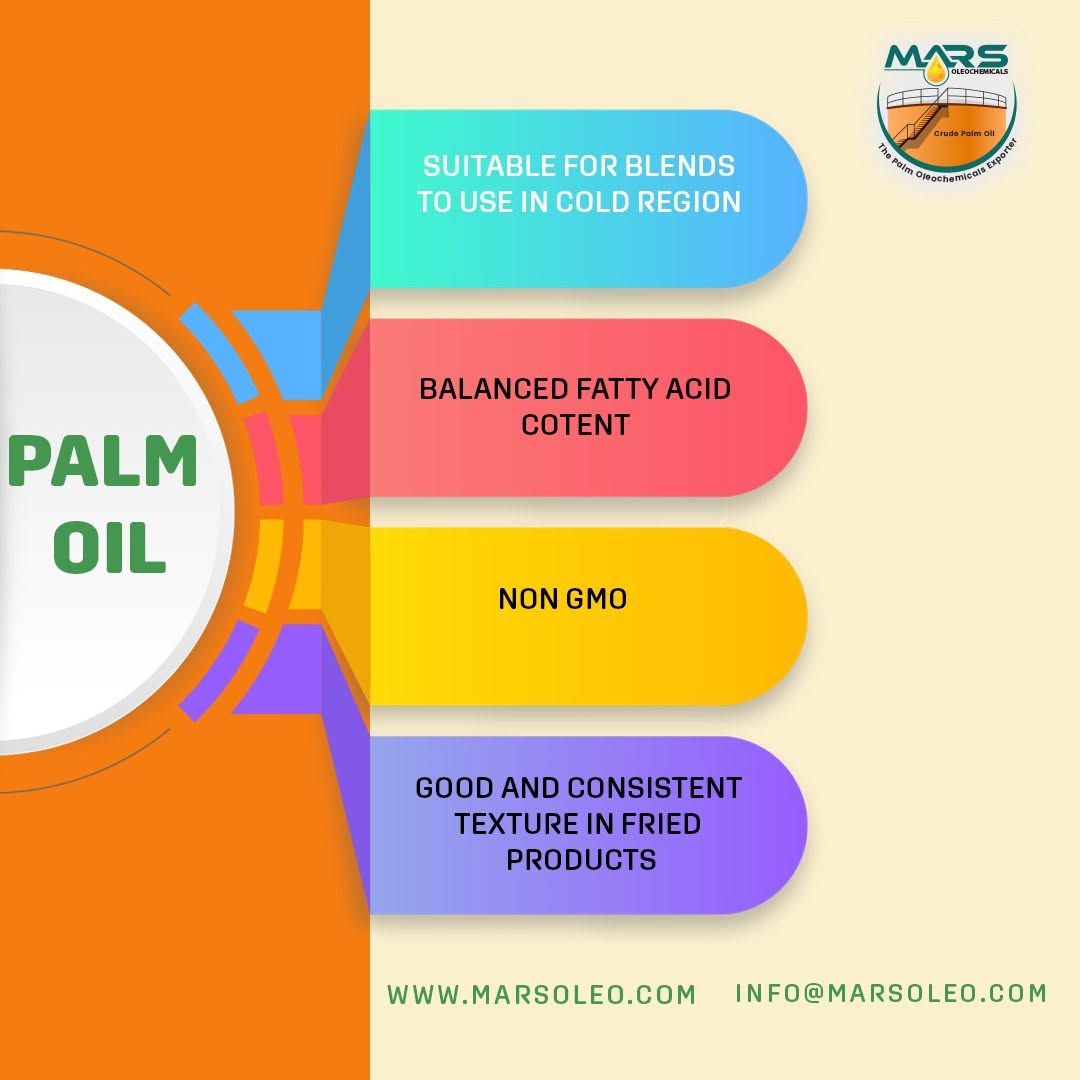
Palm Oil can be fractionated into products with different physical characteristics, enabling manufacturers to select the appropriate material for each application. RBD Palm Olein is the more liquid fraction and is widely used in cooking oils, blended edible oils and commercial frying applications.
Temperature is an important consideration when choosing Palm Olein. CP10, CP8 and CP6 represent different commercial cloud-point grades, with lower-cloud-point products offering improved clarity under cooler conditions. Buyers serving cold or seasonal markets should therefore specify the required cloud point when requesting supply.

Palm olein provides versatile blending, frying performance and low-temperature options for manufacturers.
Palm Olein is widely used in commercial frying because of its useful oxidative and thermal characteristics. It can support repeatable frying processes across products such as snack foods, French fries, chicken and instant noodles. Final product texture nevertheless depends on the complete frying system and not on the oil alone.
Food manufacturers should consider cloud point, fatty-acid composition, iodine value, free fatty acid, color, moisture and impurities, packaging, intended application and destination. Choosing the appropriate Palm Olein grade helps ensure that its physical characteristics match the manufacturing process and market conditions.
Is palm oil suitable for cold regions? Standard palm oil can crystallize at lower temperatures. Low-cloud-point Palm Olein grades are generally more suitable when improved low-temperature clarity is required.
What is Palm Olein? Palm Olein is the more liquid fraction obtained after fractionating palm oil and is widely used for cooking and frying.
What does CP mean in Palm Olein? CP refers to cloud point, an important parameter indicating when an oil begins to become visibly cloudy during cooling.
What is Palm Olein CP10? CP10 is a widely used commercial Palm Olein grade suitable for many cooking and frying applications.
What is Palm Olein CP8? CP8 is a lower-cloud-point Palm Olein grade providing improved low-temperature clarity compared with CP10.
What is Palm Olein CP6? CP6 is further fractionated to provide lower cloud-point performance for temperature-sensitive applications.
Which Palm Olein is best for colder markets? The appropriate grade depends on required storage temperature and product specification. CP8 or CP6 may be considered where lower cloud-point performance is required.
Is palm oil suitable for frying? Yes. Palm oil and particularly RBD Palm Olein are widely used for commercial frying applications.
Does Palm Olein support consistent fried-food texture? Palm Olein can support consistent frying performance, although final texture also depends on food formulation, temperature, frying time and oil management.
Does palm oil have a balanced fatty-acid profile? Palm oil contains substantial amounts of both saturated and unsaturated fatty acids, particularly palmitic and oleic acids.
Is Malaysian palm oil Non-GMO? Commercial Malaysian palm oil generally originates from conventionally bred oil palm. Formal Non-GMO claims should be supported by appropriate documentation where required.
Does Mars Oleochemicals supply Palm Olein CP10? Yes. CP10 is included in the Mars Oleochemicals Palm Olein portfolio.
Does Mars Oleochemicals supply CP8 and CP6? Yes. Mars Oleochemicals' portfolio includes RBD Palm Olein CP8 and CP6 alongside CP10.
How can buyers request Palm Olein? Buyers can provide the required cloud point, grade, specification, quantity, packaging, application and destination to info@marsoleo.com.










Home :: Products :: Enquiry :: Contact Us :: Site Map
Copyright All Rights Reserved © 2025. Mars Oleochemicals :: Disclaimer :: Privacy Policy


