


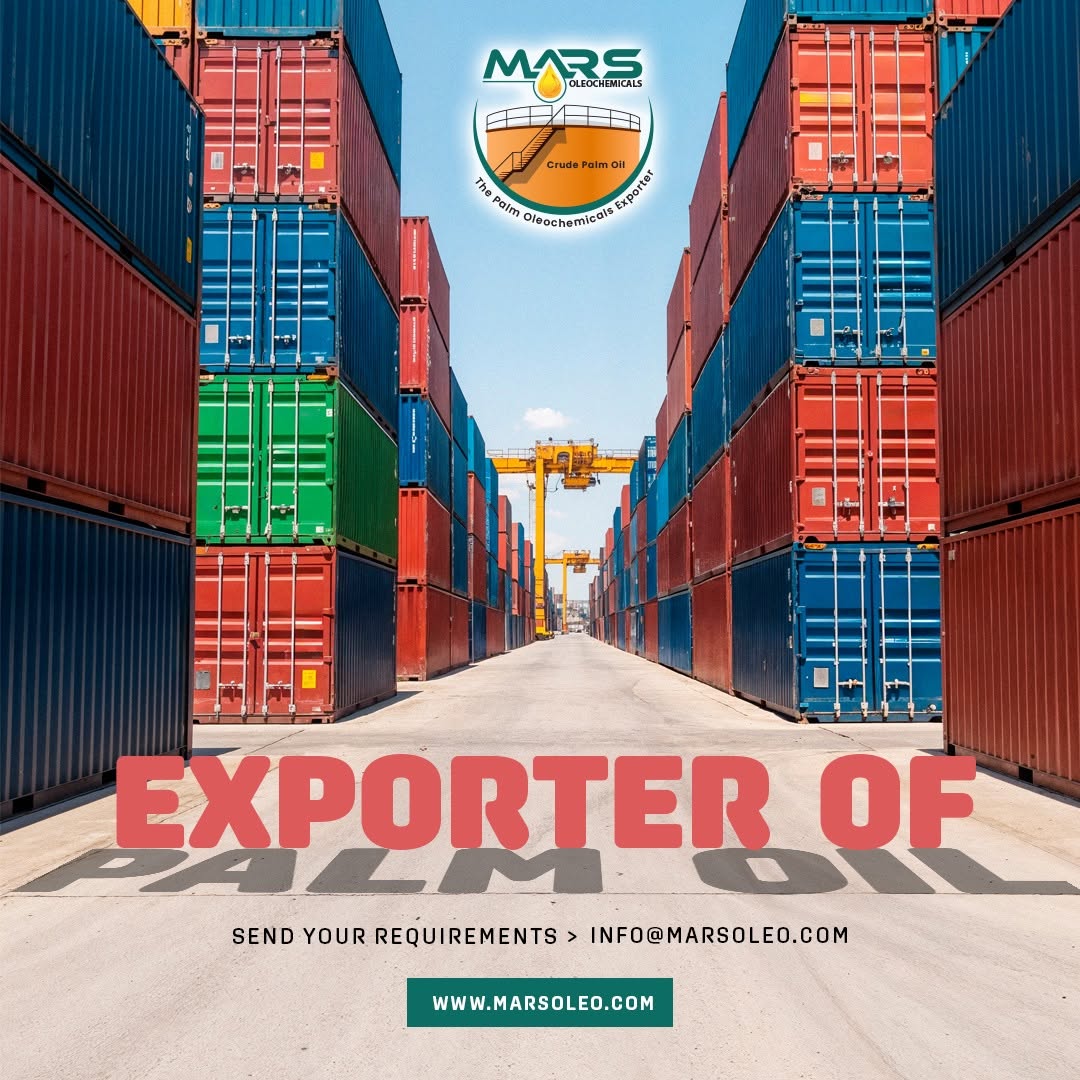
Palm Oil Exporter Malaysia is an important commercial search category for international buyers seeking reliable access to crude and refined palm oil products for food manufacturing, oil refining and downstream industrial processing. Malaysia has an established palm oil industry supported by mills, refineries, fractionation facilities, storage terminals, transportation providers and international maritime trade infrastructure. Major commercial products include Crude Palm Oil (CPO), RBD Palm Oil, RBD Palm Olein and RBD Palm Stearin, each with distinct technical properties and intended applications. Crude Palm Oil serves as a raw material for refining and suitable industrial processing, while refined palm oil and its fractions are used in food manufacturing, specialty fat production and selected industrial applications. Mars Oleochemicals Sdn. Bhd., a Malaysia-based palm oil and oleochemical exporter, supports international commercial enquiries involving palm oil products and related palm-derived ingredients. Successful international procurement begins with identifying the required product grade, technical specification, commercial quantity and appropriate sourcing arrangements. Clear product information helps buyers evaluate the suitability of Malaysian palm oil for their particular manufacturing operations and commercial supply requirements.
Malaysian Palm Oil Shipping involves selecting suitable cargo handling and transport arrangements based on product characteristics, shipment quantity, destination and relevant logistics requirements. Depending on compatibility and carrier acceptance, appropriate liquid palm oil grades may be transported using Flexibags, ISO Tank Containers, Intermediate Bulk Containers (IBCs), drums or bulk liquid vessels. These transport methods have different loading, handling, cleaning, temperature and weight considerations. A conventional dry freight container does not directly contain liquid palm oil; a compatible and approved liquid cargo containment system is required where containerized liquid transport is used. Food-grade palm oil shipments also require appropriate hygiene controls and suitable food-contact materials. Palm oil may become more viscous or partially solidify under certain temperature conditions, making loading and discharge planning important. Exporters, freight forwarders and receiving terminals should therefore confirm the intended packing method, product compatibility, shipping-line acceptance, permitted payload and discharge arrangements before shipment. Clearly defined transport requirements help reduce avoidable handling problems and support efficient international cargo coordination.

Malaysian palm oil exports require approved cargo packing, verified product quality and accurate shipping documents.
Palm Oil Export Quality Assurance involves confirming that the supplied product matches the agreed technical and contractual requirements. Crude Palm Oil is commonly evaluated using parameters such as Free Fatty Acid (FFA) content, moisture, impurities and relevant refining-quality indicators. Refined palm oil and its fractions require different quality criteria, including parameters such as iodine value, moisture, color, melting characteristics and cloud point where applicable. International buyers should review the agreed Technical Data Sheet (TDS), product specification and batch-specific Certificate of Analysis (COA) before finalizing cargo acceptance. Common export documentation includes a Commercial Invoice, Packing List and Bill of Lading, along with applicable customs declarations and any required origin, inspection or certification documents. Under the international Harmonized System, palm oil and its fractions that have not been chemically modified fall under HS Heading 1511, with additional tariff classifications determined by the product and destination country. Malaysian export activities are also subject to applicable MPOB licensing conditions and customs requirements. Accurate shipment records, proper tariff classification and consistent cargo information support effective international trade compliance.
Mars Oleochemicals Sdn. Bhd. supports international sourcing and export enquiries for Crude Palm Oil, RBD Palm Oil, RBD Palm Olein, RBD Palm Stearin and palm-derived oleochemical ingredients. Its broader product portfolio includes Refined Glycerine, Soap Noodles, Fatty Acids, Fatty Alcohols, Surfactants and specialty derivatives used by manufacturers across food processing, personal care, household cleaning and industrial chemical sectors. International customers should specify the exact product grade, required technical characteristics, quantity in metric tonnes, preferred packaging, destination port, shipment period and agreed delivery terms when requesting commercial information. Buyers requiring food-grade materials, particular product certifications or sustainability documentation should confirm their requirements before purchase, because individual grades and shipments may have different specifications and supporting records. Pricing, product availability, shipment methods and applicable export arrangements should be established for each transaction. Businesses researching Malaysian Palm Oil Exporters, bulk palm oil container shipping, crude palm oil supply and refined palm oil exports can visit our website at www.marsoleo.com For product requirements, technical documentation, commercial information and international export inquiries, please email us at info@marsoleo.com.
What palm oil products does Mars Oleochemicals export from Malaysia? Mars Oleochemicals publishes a palm oil portfolio including Crude Palm Oil, RBD Palm Oil, RBD Palm Olein and RBD Palm Stearin. The company also supports enquiries for palm-derived oleochemicals such as Refined Glycerine, Fatty Acids, Fatty Alcohols, Soap Noodles and Surfactants. Product availability, technical specifications and commercial terms must be confirmed for each transaction.
Can Malaysian palm oil be exported in 20-foot shipping containers? Yes. Suitable liquid palm oil products may be shipped in approved flexibags, ISO tanks, IBCs or other compatible containers, subject to product characteristics, carrier approval and cargo weight limits. A conventional dry shipping container cannot hold liquid palm oil directly without an appropriate containment system.
What documents are commonly required for Malaysian palm oil exports? Common documents include a Commercial Invoice, Packing List, Bill of Lading and applicable customs declaration. Depending on the product and destination, buyers may require a Certificate of Analysis, Certificate of Origin, inspection report or relevant certification records. The exact documentation requirements depend on the shipment and applicable regulations.
How can buyers verify the quality and sustainability certification of Malaysian palm oil? Buyers should review the agreed product specifications, Technical Data Sheet and batch-specific Certificate of Analysis. If sustainability-certified palm oil is required, the relevant certification, validity, product scope and supporting supply-chain records should also be verified. Malaysian origin alone does not establish sustainability certification.
How can international buyers request a palm oil export quotation from Mars Oleochemicals? Enquiries should identify the required product grade, technical specifications, quantity, packaging preference, destination port, shipment period and commercial delivery terms. Availability, documentation and shipping arrangements are reviewed for the specific requirement.








Home :: Products :: Enquiry :: Contact Us :: Site Map
Copyright All Rights Reserved © 2025. Mars Oleochemicals :: Disclaimer :: Privacy Policy


