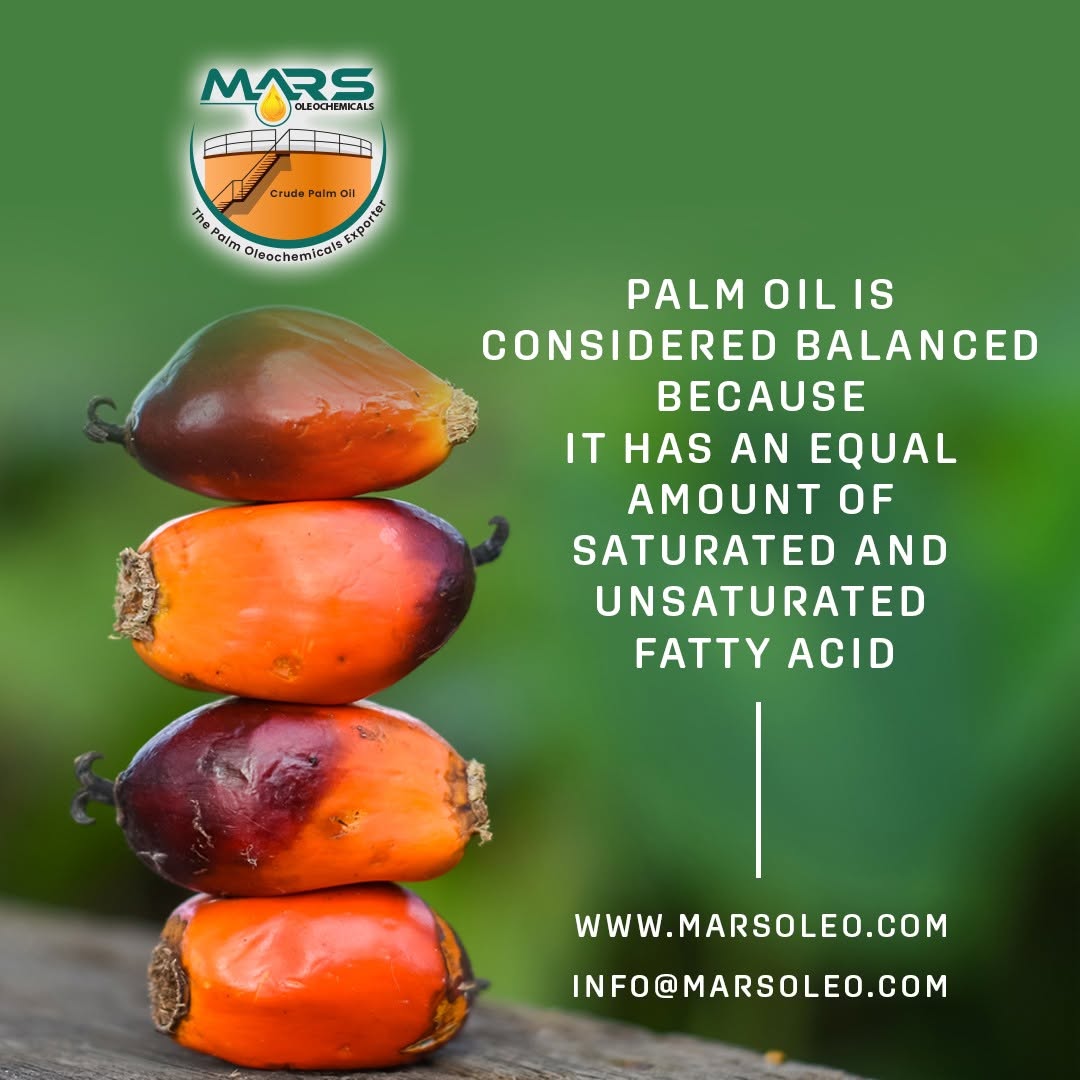
Palm oil is a naturally occurring vegetable oil obtained from the fruit of the oil palm. Its fatty-acid profile contains substantial proportions of both saturated and unsaturated fatty acids, which contribute to the oil's characteristic physical and functional properties.
Saturated fatty acids contain no carbon-carbon double bonds. In palm oil, palmitic acid is the major saturated fatty acid, with smaller quantities of stearic acid and other saturated fatty acids.
These higher-melting components contribute to palm oil's semi-solid characteristics at typical ambient temperatures and influence its use in structured food-fat systems.
Palm-derived saturated fatty acids are also important raw materials for downstream oleochemical manufacturing.

Palm oil's combination of saturated and unsaturated fatty acids and its importance across food and industrial applications.
Palm oil also contains substantial quantities of unsaturated fatty acids, especially oleic acid, which is monounsaturated. Linoleic acid provides a smaller polyunsaturated component.
These unsaturated components contribute to the liquid portion of palm oil and influence properties including flow, melting profile and formulation behavior.
The combination of saturated and unsaturated fatty acids gives palm oil functional characteristics that differ from highly unsaturated vegetable oils or harder saturated fats.
Fatty-acid composition influences several important oil characteristics, including:
Melting behavior, Oxidative stability, Texture, Solid-fat content, Frying performance, Storage properties, Fractionation behavior and Formulation suitability
This explains why palm oil can be processed into multiple commercial fractions for different applications.
What fatty acids are found in palm oil? Palm oil contains several fatty acids, with palmitic acid, oleic acid, linoleic acid and stearic acid among the most important.
Is palm oil saturated or unsaturated? Palm oil contains both saturated and unsaturated fatty acids in substantial amounts.
Does palm oil contain equal saturated and unsaturated fat? Its composition is often roughly balanced between saturated and unsaturated fatty acids, but exact proportions vary between samples.
What is the main saturated fatty acid in palm oil? Palmitic acid is generally the principal saturated fatty acid found in palm oil.
What is the main unsaturated fatty acid in palm oil? Oleic acid is generally the main monounsaturated fatty acid present in palm oil.
Does palm oil contain linoleic acid? Yes. Palm oil contains linoleic acid as one of its polyunsaturated fatty-acid components.
Why is palm oil semi-solid? Its mixture of higher-melting saturated components and lower-melting unsaturated components contributes to its semi-solid behavior around typical ambient temperatures.
What is the difference between palm olein and palm stearin? Palm olein is the more liquid palm fraction, while palm stearin is the harder, higher-melting fraction.
Why is palm oil used in food manufacturing? Palm oil offers useful texture, stability, melting characteristics and formulation flexibility across many food products.
Is palm oil used for oleochemicals? Yes. Palm-based oils are important feedstocks for fatty acids, fatty alcohols, glycerine, surfactants and other oleochemical products.
Does Mars Oleochemicals supply Malaysian palm oil? Mars Oleochemicals supplies palm oil and related palm-based products for international commercial requirements.
How can buyers request palm oil supply information? Buyers can provide the required product, grade, specification, quantity, packaging and destination to info@marsoleo.com.












Home :: Products :: Enquiry :: Contact Us :: Site Map
Copyright All Rights Reserved © 2025. Mars Oleochemicals :: Disclaimer :: Privacy Policy