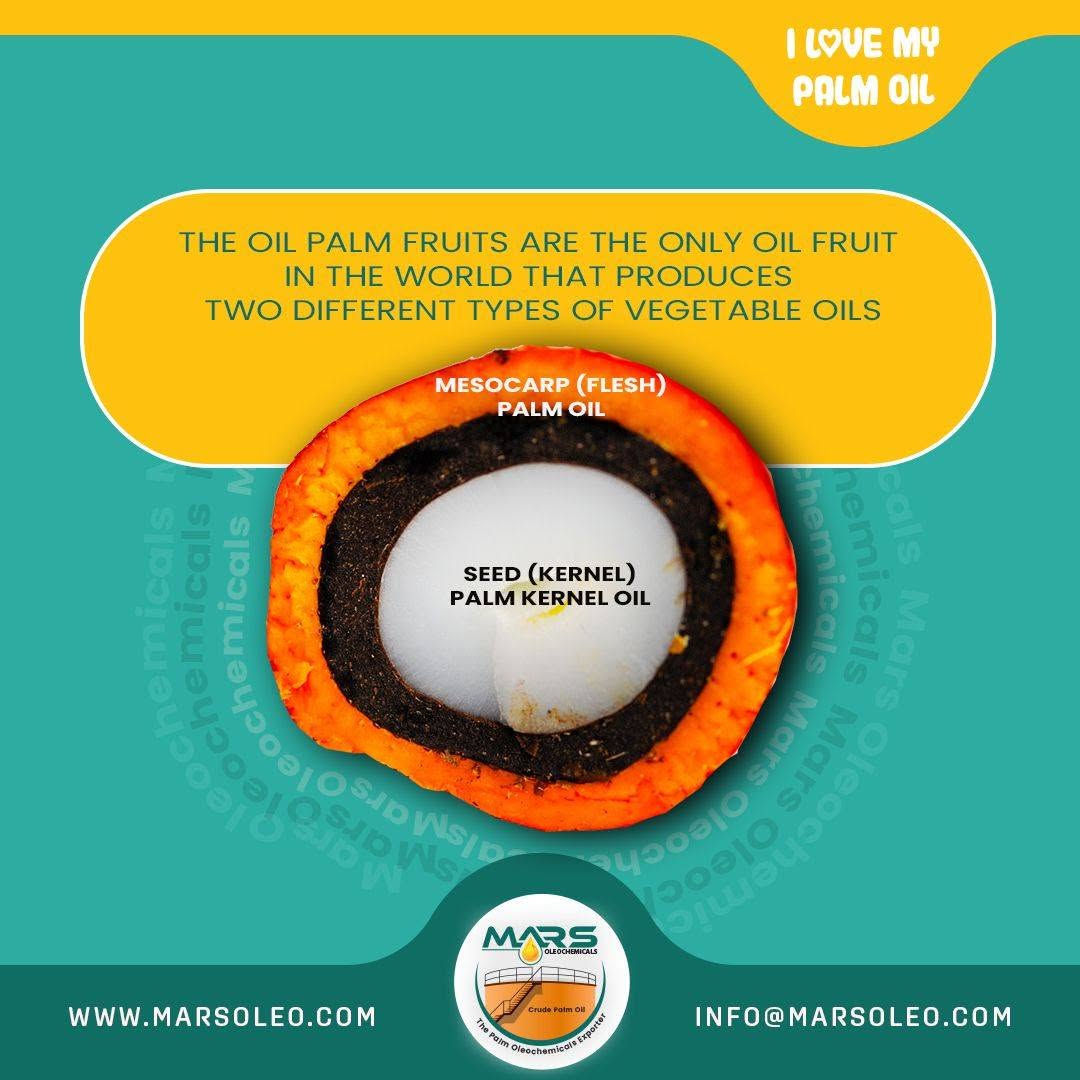
Oil-palm fruit contains several distinct structural layers. The outer portion includes the fleshy, oil-bearing mesocarp, while inside the hard shell is the kernel or seed. These two tissues contain chemically different oils. The mesocarp provides palm oil, whereas the kernel provides palm kernel oil. This makes oil palm commercially valuable for producing two separate vegetable-oil streams from the same fruit.
Palm oil is extracted from the fleshy mesocarp surrounding the hard shell of the fruit. The initial product is known as Crude Palm Oil (CPO). CPO can subsequently be refined into RBD Palm Oil and fractionated into products such as Palm Olein and Palm Stearin. These products serve cooking, frying, bakery, margarine, shortening, specialty-fat and numerous industrial applications.

Oil palm fruit produces palm oil from mesocarp and palm kernel oil from its kernel.
Palm kernel oil is extracted from the seed or kernel inside the oil-palm fruit rather than from the orange fruit flesh. The crude product is known as Crude Palm Kernel Oil (CPKO). Palm kernel oil has a much higher concentration of lauric and other medium-chain fatty acids than palm oil, which gives it different physical and chemical characteristics and makes it particularly valuable for specialty fats and oleochemical manufacturing.
Although they originate from the same fruit, palm oil and palm kernel oil are not interchangeable. Palm oil is relatively rich in palmitic and oleic acids, while palm kernel oil is a lauric-type oil rich in lauric and myristic acids. These compositional differences influence melting behaviour, formulation performance and downstream uses across food, soap, detergent, cosmetic, personal-care and industrial markets.
Does one oil-palm fruit produce two different oils? Yes. Palm oil comes from the fleshy mesocarp, while palm kernel oil is obtained from the kernel inside the same fruit.
Which part of the oil palm fruit produces palm oil? Palm oil is extracted from the fleshy, oil-rich mesocarp surrounding the fruit's hard shell.
Which part produces palm kernel oil? Palm kernel oil is extracted from the seed or kernel inside the hard shell of the oil-palm fruit.
Is palm kernel oil the same as palm oil? No. The oils originate from different tissues and have different fatty-acid compositions, physical properties and applications.
What does CPO mean? CPO means Crude Palm Oil, the unrefined oil extracted primarily from the fleshy mesocarp of oil-palm fruit.
What does CPKO mean? CPKO means Crude Palm Kernel Oil, the crude oil obtained from the kernels of oil-palm fruit.
What is Palm Olein? Palm Olein is the more liquid fraction obtained when palm oil is fractionated and is widely used for cooking and frying applications.
What is Palm Stearin? Palm Stearin is the higher-melting solid fraction of palm oil and is commonly used where greater solid-fat functionality is required.
Why are palm oil and palm kernel oil used differently? Their fatty-acid profiles differ significantly. Palm oil contains more palmitic and oleic acids, while palm kernel oil contains much more lauric acid, leading to different melting and processing characteristics.









Home :: Products :: Enquiry :: Contact Us :: Site Map
Copyright All Rights Reserved © 2025. Mars Oleochemicals :: Disclaimer :: Privacy Policy