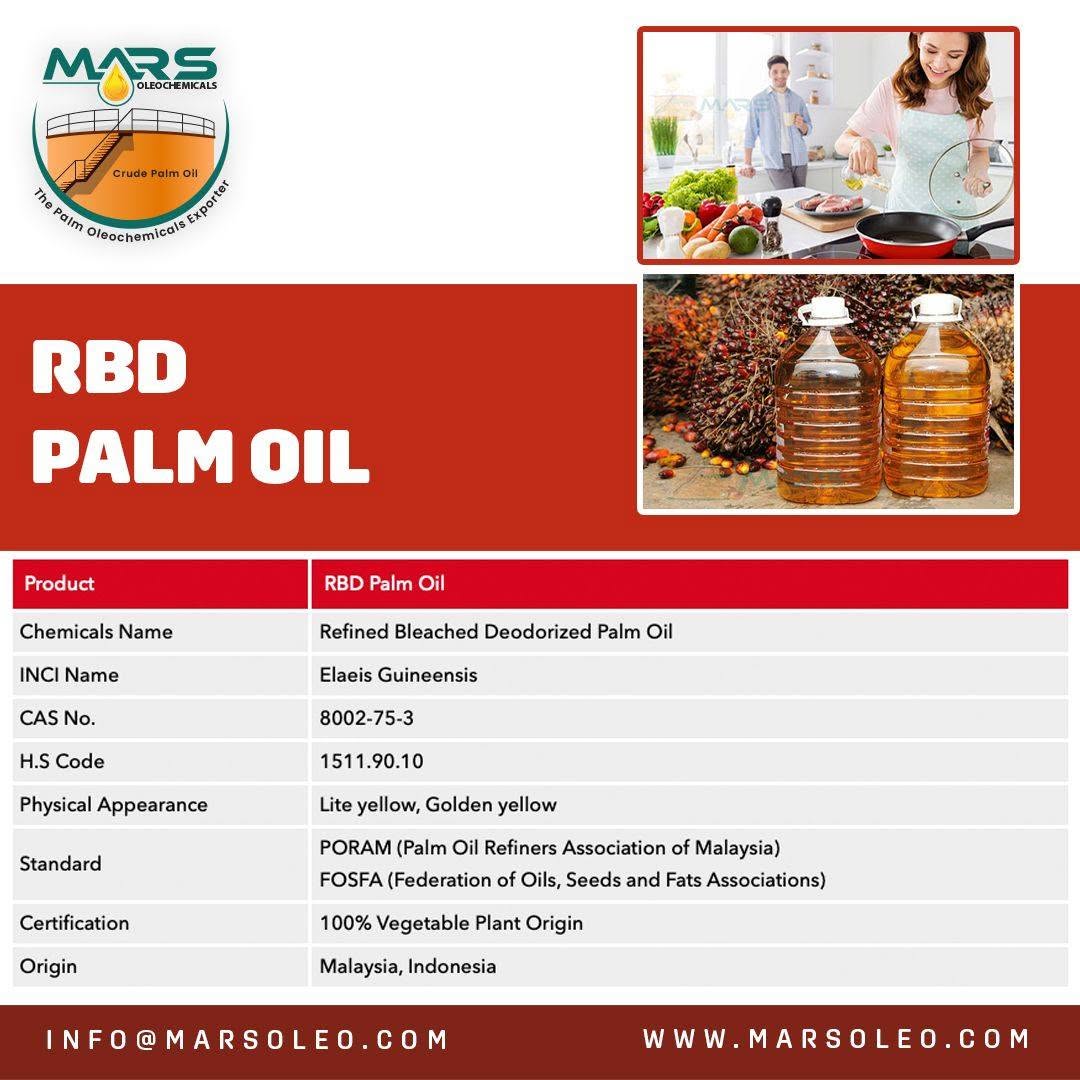
RBD Palm Oil is produced when Crude Palm Oil undergoes refining, bleaching and deodorisation. These processes reduce free fatty acids, moisture, impurities, pigments and undesirable odours, producing a lighter-coloured oil suitable for commercial food processing. RBD Palm Oil remains a natural triglyceride mixture rather than one chemically defined compound.
RBD Palm Oil is the refined parent oil before fractionation. Fractionation separates it into RBD Palm Olein, the softer or liquid fraction, and RBD Palm Stearin, the harder fraction. RBD Palm Oil itself may become semi-solid at lower ambient temperatures, whereas palm olein is normally selected when a more consistently liquid cooking oil is required.

RBD Palm Oil for Frying Food Manufacturing and Reliable Global Supply from Malaysia Worldwide Markets.
Food processors use RBD Palm Oil for commercial frying, instant-noodle production, snack foods, shortenings, margarines, bakery fats and other formulated food systems. Its semi-solid character can provide structure in fat-based products, while heating converts it into a clear liquid for processing and frying. The final application depends on the product specification, melting point and formulation design.
Mars Oleochemicals supplies RBD Palm Oil in steel drums, jerry cans, IBCs, flexibags, ISO tanks and bulk-vessel arrangements, subject to current commercial availability. Buyers should request the current specification, Safety Data Sheet, Technical Data Sheet, Certificate of Analysis, Certificate of Origin, packing plan and applicable certification documents before approving an order.
1. What is RBD Palm Oil? RBD Palm Oil is palm oil that has undergone refining, bleaching and deodorisation to reduce impurities, colour, odour and flavour. It is used in food manufacturing and selected non-food applications.
2. What does RBD mean? RBD means Refined, Bleached and Deodorised. These processing stages convert crude palm oil into a lighter-coloured, neutral-smelling and commercially usable refined oil.
3. Is RBD Palm Oil liquid or solid at room temperature? RBD Palm Oil may be liquid, semi-solid or solid depending on temperature. A commercial grade with a slip melting point of approximately 33 to 39 degrees Celsius becomes clear and liquid when sufficiently warmed.
4. Is RBD Palm Oil the same as RBD Palm Olein? No. RBD Palm Oil is the refined parent oil. Fractionation separates it into liquid RBD Palm Olein and harder RBD Palm Stearin.
5. What is the correct INCI name for palm oil? The recognised cosmetic ingredient name is Elaeis Guineensis Oil. Elaeis Guineensis alone identifies the oil-palm species rather than the complete ingredient name.
6. What are the CAS number and HS code for RBD Palm Oil? Palm oil commonly uses CAS number 8002-75-3. The international six-digit HS subheading for palm oil other than crude is 1511.90, while national tariff extensions vary by country.
7. What is RBD Palm Oil used for? RBD Palm Oil is used in commercial frying, instant noodles, snack foods, shortening, margarine, bakery products, confectionery fats, vanaspati, food formulations and soap manufacturing.
8. Which quality parameters should buyers review? Buyers should review free fatty acids, moisture and impurities, iodine value, peroxide value, colour, slip melting point, fatty-acid composition, odour, flavour and the current Certificate of Analysis.
9. Are PORAM and FOSFA product certifications? No. PORAM provides palm-oil trade specifications and standard contract terms, while FOSFA provides contractual frameworks for international oils, seeds and fats trading. Product certifications must be declared separately.
10. Where can buyers source RBD Palm Oil from Malaysia? International buyers can contact Mars Oleochemicals Sdn. Bhd. for RBD Palm Oil specifications, packing options, quality documents, current certifications, availability and export quotations from Malaysia.










Home :: Products :: Enquiry :: Contact Us :: Site Map
Copyright All Rights Reserved © 2025. Mars Oleochemicals :: Disclaimer :: Privacy Policy