Refined glycerine, also known as glycerin or glycerol, is a clear, colourless, odourless and viscous liquid. Its chemical formula is C3H8O3, CAS Number 56-81-5, and it mixes readily with water. High-purity grades such as Refined Glycerine 99.7% USP are used across cosmetics, personal care, pharmaceutical, food and industrial manufacturing. Mars identifies its Refined Glycerine 99.7% USP as vegetable-origin material.
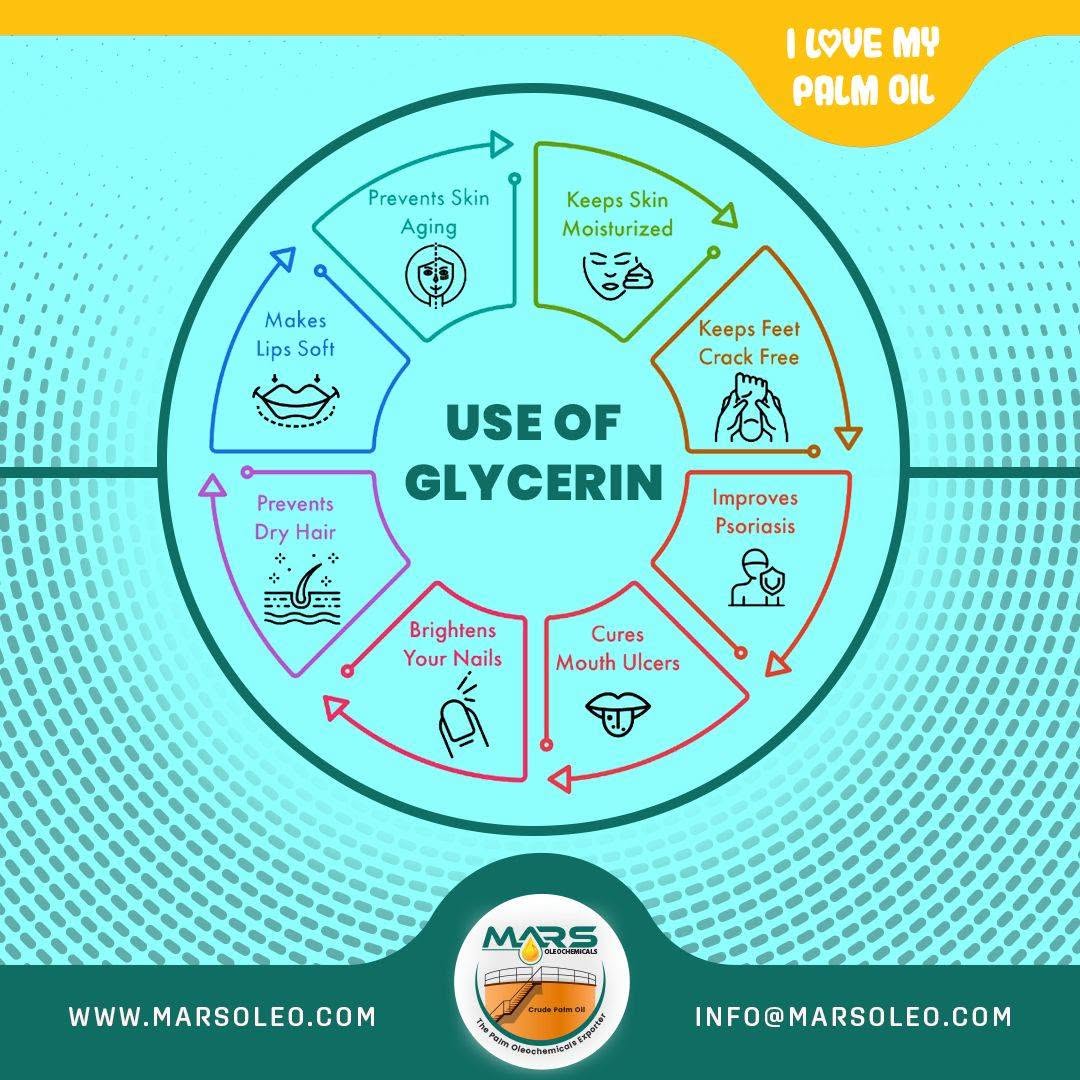
Glycerin functions primarily as a humectant, meaning it interacts strongly with water and helps increase moisture within suitable formulations and the skin's outer layer. Scientific reviews report that topical glycerol can improve stratum-corneum hydration, skin-barrier function and mechanical properties. This explains its widespread use in moisturizers, facial creams, body lotions, hand-care products and other formulations designed for dry skin.

Glycerin is a versatile humectant that attracts and retains moisture while texture and formulation stability.
Glycerin's moisture-management properties make it useful in lip-care, hair-care, cleansing and cosmetic products. In lip products it can contribute to softness and moisture retention, while shampoos and conditioners may use glycerin as part of a broader formulation intended to manage dryness and improve product feel. It is also commonly incorporated into liquid soaps, body washes, toothpaste and oral-care formulations.
Glycerin should not be marketed as a cure for psoriasis or mouth ulcers. Moisturizing formulations can help manage the dryness associated with psoriasis, and dermatologists recommend moisturizers as supportive skin care, but psoriasis requires condition-appropriate treatment. Similarly, authoritative guidance for mouth ulcers does not identify plain glycerin as a standard cure. For a raw-material supplier webpage, the appropriate wording is that glycerin is used in skin-care and oral-care formulations, with the performance of any finished therapeutic product depending on its complete formulation and regulatory approval.
What is glycerin? Glycerin, glycerine and glycerol are names used for the same three-carbon polyhydric alcohol with the molecular formula C3H8O3 and CAS Number 56-81-5.
What does glycerin do in skincare? Glycerin functions as a humectant that helps attract and retain moisture, supporting skin hydration and skin-barrier performance.
Is glycerin used in moisturizers? Yes. Glycerin is widely used in moisturizers, creams, lotions and other skincare products because of its moisture-retaining properties.
Can glycerin help dry skin? Glycerol-containing moisturizers can help improve hydration and support the skin barrier in dry skin. The complete product formulation determines its overall performance.
Is glycerin used in lip products? Yes. Glycerin can be used as a humectant in suitable lip-care formulations to support moisture retention and softness.
Is glycerin used in hair-care products? Yes. Glycerin is used in shampoos, conditioners and other hair-care formulations where humectancy and moisture management are desirable.
Does glycerin prevent skin aging? It is more accurate to say that glycerin supports skin hydration and barrier function. “Prevents skin aging” is too broad and should not be used as an absolute product claim.
Does glycerin cure psoriasis? No. Glycerin should not be presented as a cure for psoriasis. Moisturizers can help relieve dryness associated with psoriasis, but treatment should follow appropriate medical guidance.
Does glycerin cure mouth ulcers? Plain glycerin should not be marketed as a cure for mouth ulcers. Glycerin can be used as an ingredient or carrier in oral-care formulations, but treatment claims depend on the complete product and supporting evidence.
What is Refined Glycerine 99.7% USP used for? It is used as a humectant, solvent, carrier, sweetener and formulation aid across personal care, cosmetics, pharmaceuticals, food and industrial products.
Is all glycerine vegetable-derived? No. Glycerine can have vegetable, animal or synthetic origins. Mars identifies its Refined Glycerine 99.7% USP grade as vegetable-derived from palm-based feedstocks.












Home :: Products :: Enquiry :: Contact Us :: Site Map
Copyright All Rights Reserved © 2025. Mars Oleochemicals :: Disclaimer :: Privacy Policy