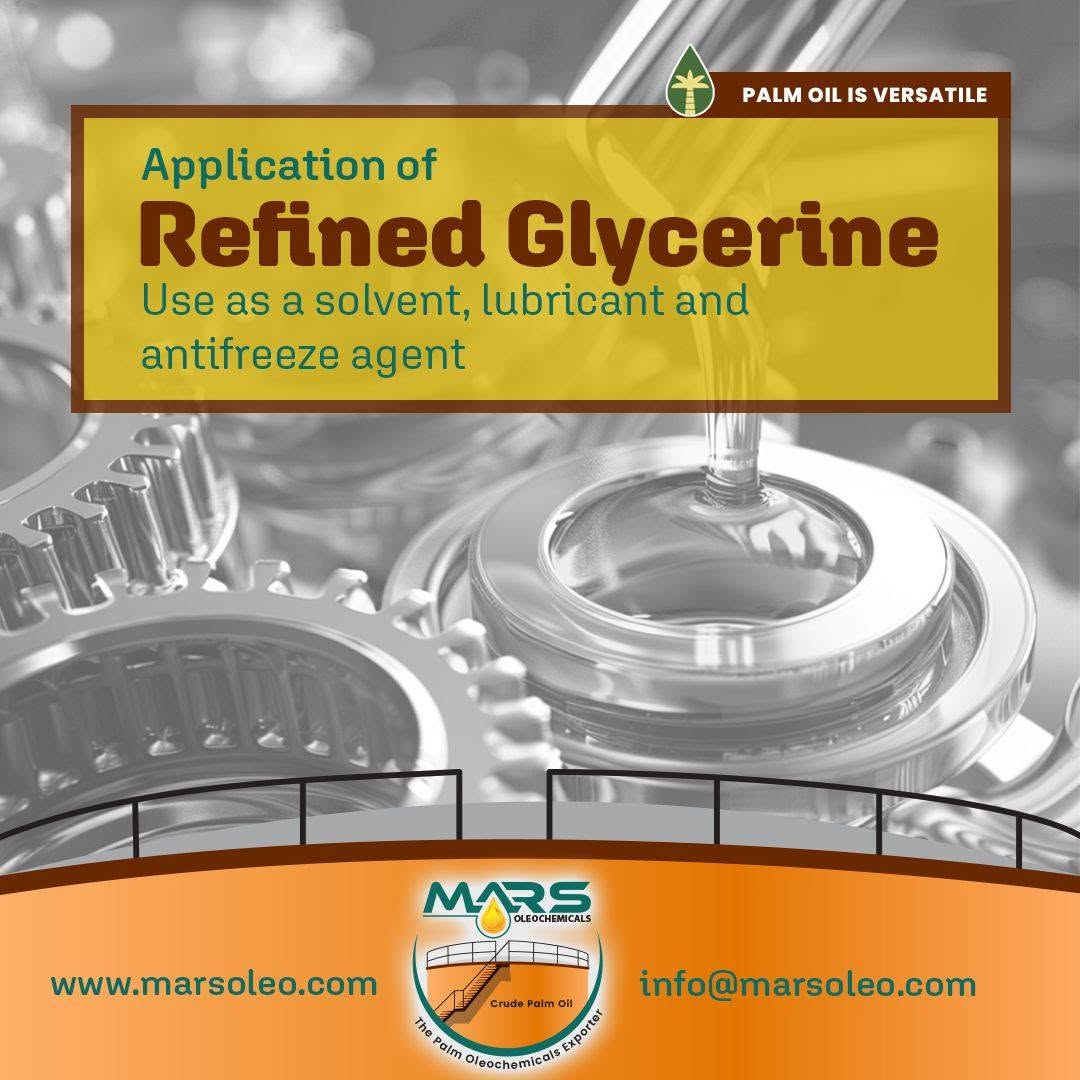
Refined glycerine, also known as glycerol, is a clear, viscous and water-miscible liquid with a comparatively high boiling point. These physical characteristics support its use in selected technical formulations where solvent performance, viscosity, stability and compatibility with water-based components are important.
Glycerine can act as a solvent, carrier or processing vehicle for compatible ingredients in chemical mixtures, coatings, printing inks, resins and other industrial formulations. Its suitability depends on the substances being dissolved, required viscosity, process temperature, concentration and finished-product performance.

Refined glycerine serves as a solvent, lubricant and antifreeze component in selected industrial formulations worldwide.
Glycerine may contribute viscosity and lubricating performance in selected processing fluids and specialty lubricant formulations. When mixed with water, it lowers the freezing point, supporting certain antifreeze, cooling and freeze-protection systems. It should be treated as a formulation component rather than a universal replacement for established coolant fluids.
Mars Oleochemicals Sdn. Bhd. supplies Malaysian refined glycerine to manufacturers, importers, distributors and industrial buyers worldwide. Customers can request specifications, packing options, quality documentation, availability and export quotations for Refined Glycerine 99.7% USP and other available grades.
1. What is refined glycerine used for in industrial applications? Refined glycerine is used as a solvent, carrier, processing lubricant, functional fluid and antifreeze component in selected chemical, coating, textile, ink, resin and manufacturing formulations.
2. Why can refined glycerine function as a solvent? Refined glycerine is water-miscible and can dissolve or carry selected ingredients. This makes it useful as a solvent or formulation vehicle in compatible industrial and chemical-processing systems.
3. Can refined glycerine be used as a lubricant? Yes. Glycerine can provide lubricating and viscosity-related functions in selected processing fluids, machinery applications and specialty formulations. Its suitability must be confirmed through compatibility and performance testing.
4. How is glycerine used in antifreeze formulations? When blended with water, glycerine can lower the mixture's freezing point. It may therefore be used as a component in selected antifreeze, cooling, heat-transfer and freeze-protection formulations.
5. Can glycerine directly replace ethylene glycol in every antifreeze system? No. Glycerine should not automatically replace ethylene glycol or another coolant ingredient. Viscosity, heat-transfer performance, corrosion protection, temperature range and equipment compatibility must be evaluated for each formulation.
6. Are glycerine, glycerin and glycerol the same substance? Glycerine, glycerin and glycerol are commonly used names for the same chemical substance, 1,2,3-propanetriol, with CAS number 56-81-5 and molecular formula C3H8O3.
7. Which refined glycerine grade is suitable for industrial use? The suitable grade depends on the formulation and customer specification. Buyers should confirm glycerine purity, water content, colour, contaminants, regulatory requirements and technical documentation before use.
8. Where can international buyers source refined glycerine from Malaysia? International buyers can contact Mars Oleochemicals Sdn. Bhd. for refined glycerine specifications, packing options, documentation, product availability and export quotations from Malaysia.











Home :: Products :: Enquiry :: Contact Us :: Site Map
Copyright All Rights Reserved © 2025. Mars Oleochemicals :: Disclaimer :: Privacy Policy