


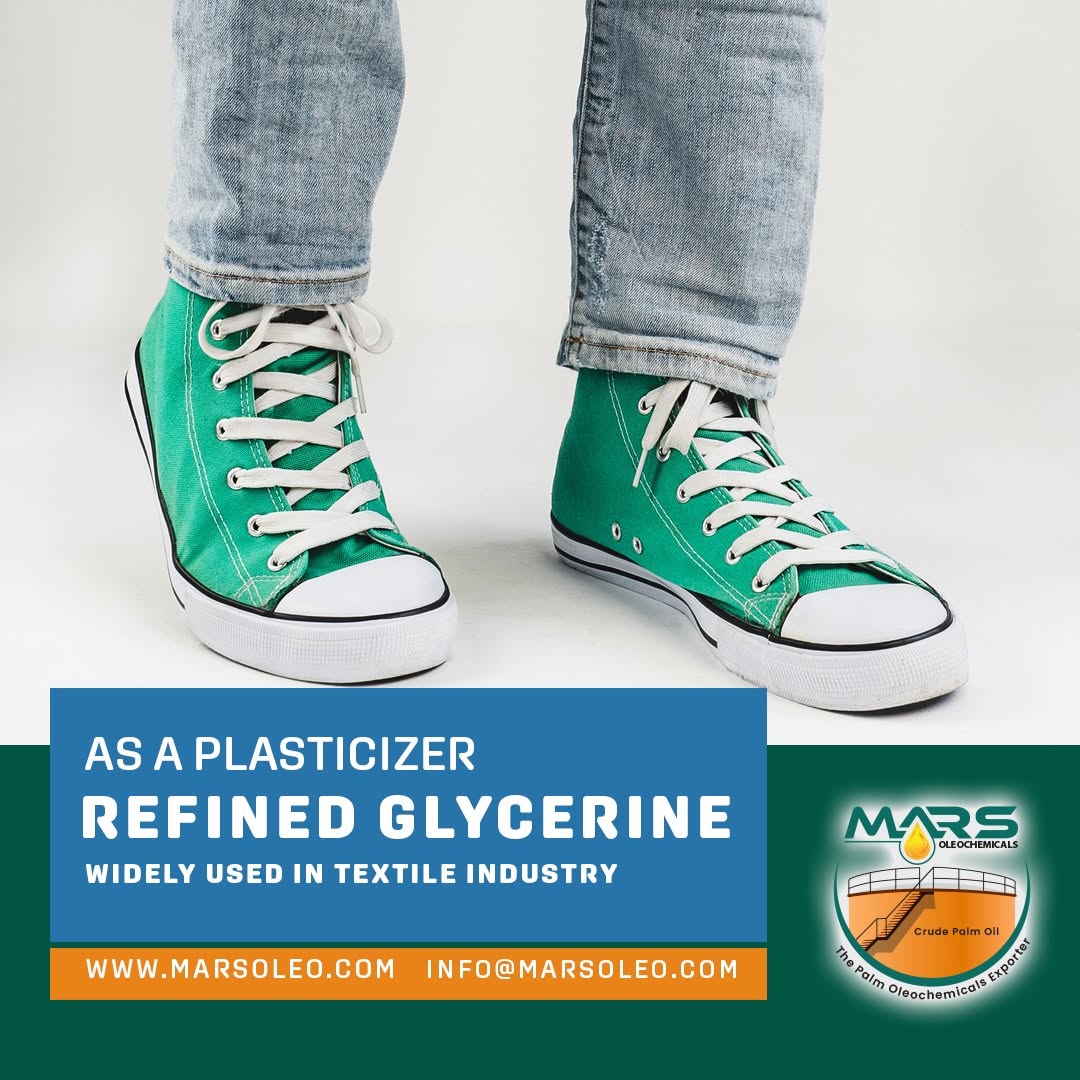
Refined glycerine is a clear, viscous and hygroscopic liquid that can perform several useful functions in textile-processing formulations. Its water affinity, viscosity and compatibility with many aqueous systems make it useful as a humectant, plasticizer and processing aid in selected textile applications. The exact function depends on the fabric, polymer system, additives and manufacturing process.
The attached Mars Oleochemicals refined glycerine as a plasticizer widely used in the textile industry. In suitable coating, binder or polymer-containing formulations, glycerine may help modify flexibility and reduce brittleness by acting as a plasticizing component. The effect depends on the formulation chemistry and required finished-textile performance.

Refined glycerine ointment formulations as a humectant, solvent and moisture-retaining formulation ingredient effectively.
Refined glycerine is hygroscopic, it can help retain moisture in suitable textile pastes, coatings and processing systems. This can be valuable where excessive drying during processing could negatively affect application characteristics. Glycerine may also contribute viscosity, lubrication and workable consistency to selected textile formulations, including printing and finishing systems.
Mars Oleochemicals supplies refined glycerine for international textile, chemical and industrial requirements. Buyers should specify the required glycerine purity, technical specification, intended textile application, quantity, packaging and destination. This helps ensure that the selected grade is appropriate for the manufacturing process rather than assuming one glycerine specification is suitable for every textile use.
What is refined glycerine? Refined glycerine is a high-purity form of glycerol used across textile, pharmaceutical, personal-care, food and industrial formulations depending on grade and specification.
Is refined glycerine used in the textile industry? Yes. Glycerine can be used in selected textile printing, coating, finishing and auxiliary formulations.
Is glycerine a plasticizer? Yes. Glycerine can act as a plasticizer in suitable polymer and formulation systems by helping modify flexibility and reduce brittleness.
Why is glycerine used as a humectant in textiles? Glycerine is hygroscopic and helps retain moisture, which can be useful in textile pastes and formulations where controlled drying is required.
Is glycerine used in textile printing? Yes. Glycerine may be incorporated into selected textile-printing and printing-paste formulations as a humectant and processing aid.
Can glycerine improve textile flexibility? In suitable binder, coating or polymer systems, glycerine may provide plasticizing effects that support flexibility.
Does glycerine make fabric softer? Glycerine may contribute to softer or more flexible characteristics in some formulations, but final fabric feel depends on the entire textile-finishing system.
Does glycerine increase textile durability? This should not be assumed universally. Durability depends on fiber type, formulation, treatment process and performance requirements.
Is glycerine used in textile coatings? Yes. Glycerine can be used in suitable coating systems where humectancy, flexibility or plasticizing properties are required.
Can glycerine be used in sizing formulations? Glycerine may be incorporated into certain sizing or related textile formulations as a plasticizer or moisture-management ingredient.
What refined glycerine grades does Mars Oleochemicals supply? Mars Oleochemicals supplies refined glycerine grades including 99.7% and 99.5%, subject to agreed specifications.
How can textile manufacturers request a quotation? Buyers can provide the required grade, purity, technical specification, quantity, packaging, textile application and destination to info@marsoleo.com.










Home :: Products :: Enquiry :: Contact Us :: Site Map
Copyright All Rights Reserved © 2025. Mars Oleochemicals :: Disclaimer :: Privacy Policy


