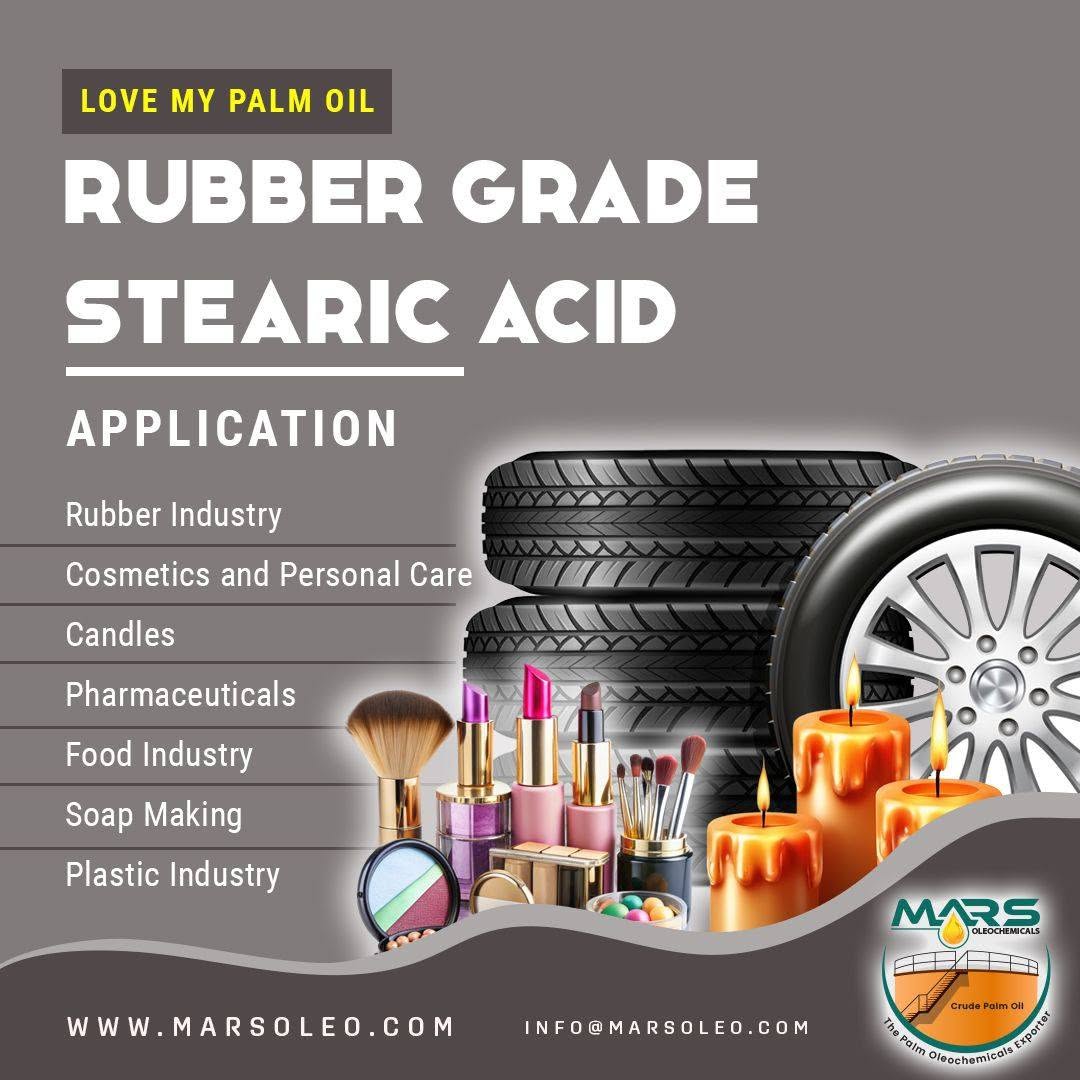
Rubber Grade Stearic Acid is a commercial fatty-acid material formulated specifically for rubber-processing requirements. Unlike chemically pure stearic acid, commercial rubber grades may contain controlled proportions of palmitic acid, stearic acid and smaller amounts of other fatty acids. Mars currently supplies its rubber grade in white bead or granular form with defined acid value, iodine value, titre, saponification value and fatty-acid distribution.
Rubber Grade Stearic Acid rubber formulations, stearic acid can function as a processing aid, lubricant, dispersing agent and component of the vulcanization activation system. It can help distribute zinc oxide, fillers and other ingredients throughout the compound while influencing internal friction, viscosity and processing behaviour. These functions can improve mixing, calendaring, extrusion and moulding performance when the product is correctly selected and dosed.

Rubber-grade stearic acid supports processing, dispersion, lubrication and vulcanization activation in tyre and rubber compounds.
Rubber Grade Stearic Acid many sulfur-cured rubber compounds, stearic acid interacts with zinc oxide and helps create active zinc-containing species that support accelerator performance. This is why the technically accurate wording is “vulcanization activator” or “co-activator”, rather than describing stearic acid as the primary vulcanizing or curing agent. Actual performance depends on the elastomer system, accelerator package, fillers, dosage and processing conditions.
Rubber Grade Stearic Acid is used across tyre and general rubber manufacturing. Applications include passenger-car tyres, truck and bus tyres, motorcycle tyres, inner tubes, conveyor belts, automotive hoses, industrial hoses, seals, gaskets, footwear, rubber sheets, mats, vibration-control products and moulded rubber components. It can be used with natural rubber and various synthetic-rubber systems depending on compound design.
What is Rubber Grade Stearic Acid? Rubber Grade Stearic Acid is a commercial fatty-acid material formulated for rubber processing. It commonly functions as a vulcanization activator, processing aid, lubricant and dispersing agent in rubber compounds.
What is Rubber Grade Stearic Acid used for? It is used in tyres, tubes, belts, hoses, seals, gaskets, footwear, rubber sheets, moulded products and other natural- and synthetic-rubber applications.
Why is Stearic Acid used in tyre manufacturing? Stearic Acid supports compound processing, ingredient dispersion, lubrication and vulcanization activation. It commonly works with zinc oxide in sulfur-cured tyre compounds.
Is Stearic Acid a vulcanization activator? Yes. In many sulfur-cured rubber systems, Stearic Acid works with zinc oxide as part of the activation system supporting accelerator performance. It should not be described as the principal curing agent.
Is Rubber Grade Stearic Acid chemically pure C18 Stearic Acid? Not necessarily. Commercial rubber grades can contain controlled proportions of palmitic acid, stearic acid and smaller quantities of other fatty acids. Buyers should check the actual chain-distribution specification.
Can Rubber Grade Stearic Acid be used in cosmetics or food? The broader Stearic Acid family has cosmetic, personal-care, pharmaceutical and selected food applications, but not every Rubber Grade Stearic Acid should automatically be used for those purposes. Food, pharmaceutical and cosmetic manufacturers should select an appropriately specified and documented grade for the intended application.
What parameters should buyers check? Important parameters include acid value, iodine value, titre, saponification value, colour, fatty-acid distribution, physical form and consistency. Compound compatibility should also be evaluated before commercial use.
Where can buyers source Rubber Grade Stearic Acid from Malaysia? Mars Oleochemicals Sdn. Bhd. for current specifications, SDS, TDS, certificate of analysis, packing information, availability and export quotations from Malaysia.












Home :: Products :: Enquiry :: Contact Us :: Site Map
Copyright All Rights Reserved © 2025. Mars Oleochemicals :: Disclaimer :: Privacy Policy