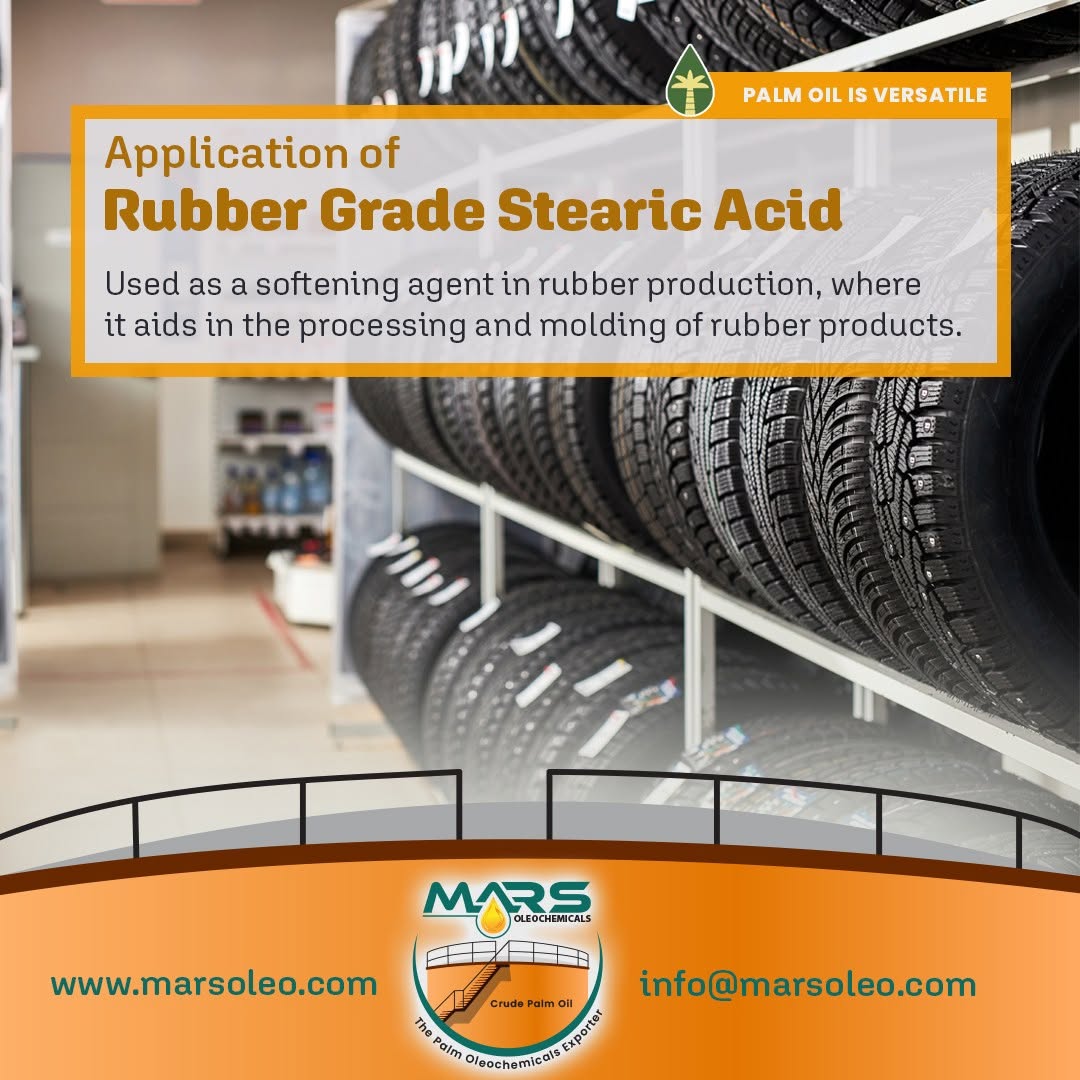
Rubber-grade stearic acid is a saturated fatty-acid material prepared to meet the processing requirements of rubber manufacturers. Although pure stearic acid is octadecanoic acid with the formula C18H36O2 and CAS number 57-11-4, commercial rubber grades may contain controlled proportions of palmitic, stearic and other fatty acids. Mars Oleochemicals lists its rubber grade in white bead or granular form.
In many sulfur-cured compounds, stearic acid works with zinc oxide as part of the vulcanization activation system. This interaction helps zinc-based activating species function within the rubber matrix and supports the action of accelerators. Stearic acid should therefore be described as a co-activating formulation ingredient rather than as the principal curing agent.

Rubber-grade stearic acid acts as vulcanization activator, processing aid, lubricant and dispersing agent in compounds.
Stearic acid can perform several processing functions within a rubber compound. It may support filler and zinc-oxide dispersion, reduce internal friction, influence compound viscosity and improve movement during mixing, calendaring, extrusion or moulding. These effects depend on the selected rubber grade, dosage and complete formulation.
Mars Oleochemicals Sdn. Bhd. supplies palm-based rubber-grade stearic acid to tyre manufacturers, rubber compounders, industrial-product manufacturers, importers and distributors worldwide. Buyers can request the current specification, SDS, TDS, certificate of analysis, fatty-acid distribution, packing information and export quotation from Malaysia.
1. What is rubber-grade stearic acid? Rubber-grade stearic acid is a commercial fatty-acid blend formulated for rubber processing. It is commonly used as a vulcanization activator, processing aid, lubricant, softening component and dispersing agent.
2. What is rubber-grade stearic acid used for? Rubber-grade stearic acid is used in tyres, tubes, belts, hoses, seals, gaskets, footwear, rubber sheets, moulded components and other natural- or synthetic-rubber products.
3. How does stearic acid support rubber vulcanization? In many sulfur-cured rubber compounds, stearic acid works with zinc oxide to form active zinc-containing species that support accelerator performance and the vulcanization process.
4. Is stearic acid a rubber softening agent? Stearic acid may provide softening, lubricating and viscosity-related effects in suitable rubber compounds. Its influence depends on the formulation, fillers, polymer type, dosage and processing conditions.
5. How does stearic acid improve rubber processing? Stearic acid can support ingredient dispersion, internal lubrication, compound flow, mixing, calendaring, extrusion and moulding. It may also help incorporate zinc oxide and fillers more uniformly.
6. Is rubber-grade stearic acid used in tyre manufacturing? Yes. Rubber-grade stearic acid is commonly incorporated into tyre compounds as part of the processing and vulcanization system. The required amount depends on the tyre component and compound design.
7. How should manufacturers select a rubber-grade stearic acid? Manufacturers should evaluate acid value, iodine value, titre, saponification value, colour, fatty-acid distribution, physical form, consistency and compatibility with the intended rubber compound. Mars Oleochemicals lists these parameters in its published rubber-grade specification.
8. Are all stearic acid grades chemically pure C18 stearic acid? No. Commercial rubber-grade stearic acid may be a controlled blend containing palmitic acid, stearic acid and smaller quantities of other fatty acids. Buyers should review the actual chain-distribution specification.
9. Where can buyers source rubber-grade stearic acid from Malaysia? International buyers can contact Mars Oleochemicals Sdn. Bhd. for rubber-grade stearic acid specifications, packing options, technical documentation, availability and export quotations from Malaysia.













Home :: Products :: Enquiry :: Contact Us :: Site Map
Copyright All Rights Reserved © 2025. Mars Oleochemicals :: Disclaimer :: Privacy Policy