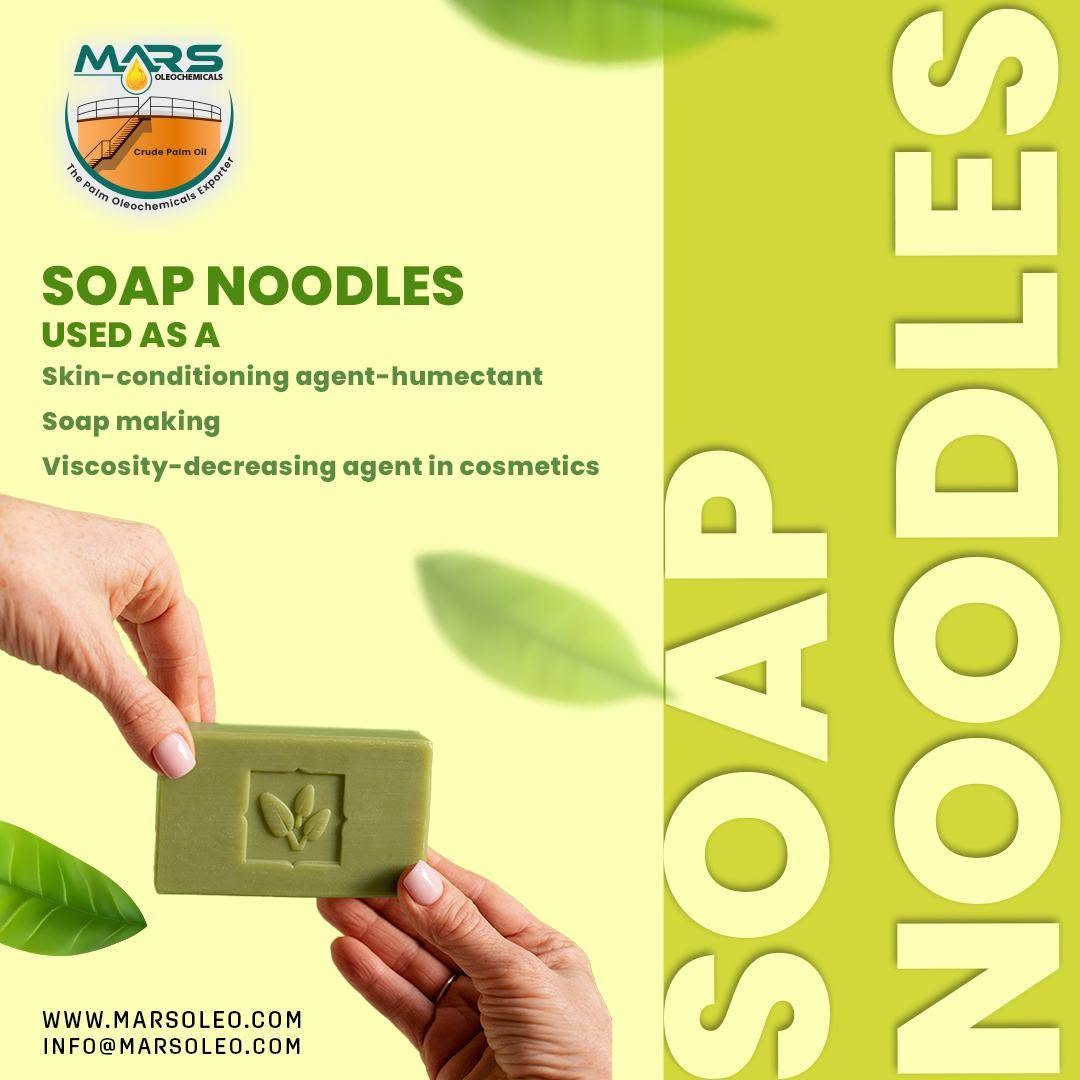
Soap Noodles are essential semi-finished raw materials used in the manufacturing of toilet soaps, laundry soaps, beauty bars and personal cleansing products. Produced through the saponification of vegetable oils or the neutralization of fatty acids, palm-based soap noodles consist mainly of sodium salts of fatty acids derived from Palm Oil, Palm Stearin and Palm Kernel Oil. Their consistent composition, cleansing properties and adaptability make them valuable ingredients in commercial soap production. Mars Oleochemicals Sdn. Bhd., Malaysia, supplies palm-based oleochemical products to international manufacturers seeking suitable soap manufacturing raw materials.
Palm-Based Soap Noodles depends on their fatty acid composition, Total Fatty Matter (TFM), moisture content, alkalinity and processing characteristics. Commercial soap noodles are available in different grades, including common 80:20 and 90:10 fatty-material blend ratios. Palm-derived fatty acids contribute to soap bar hardness and structure, while palm kernel-derived fatty acids help develop lathering and cleansing characteristics. Manufacturers can select appropriate soap noodle grades according to their desired soap bar performance, appearance, processing requirements and end-use applications.

Malaysian palm-based soap noodles, their cleansing properties, benefits and uses in toilet and laundry soap.
Soap Noodles Applications extend across toilet soap manufacturing, laundry soap production, hotel amenity soaps, cosmetic cleansing bars and specialty hygiene products. They provide a ready-to-process soap base that can be blended with fragrances, colourants, glycerine, emollients and other formulation ingredients. Although soap noodles primarily provide cleansing functionality, suitable finished soap formulations may incorporate skin-conditioning ingredients and humectants to improve the overall sensory experience. Glycerine, for example, is commonly used as a moisture-retaining ingredient, while additional emollients and formulation adjustments influence the texture, conditioning properties and performance of the final soap bar.
Mars Oleochemicals Malaysia, we support international buyers through a diversified portfolio of Soap Noodles, Refined Glycerine, Fatty Acids, Fatty Alcohols, Surfactants, Esters and other Palm-Based Oleochemical Products. Our commercial focus includes specification-based product sourcing, export documentation, packaging requirements and international shipment coordination. By connecting manufacturers with suitable Malaysian palm-derived raw materials, Mars Oleochemicals supports global soap, personal care and household cleaning industries. Product selection should consider the intended application, required quality parameters and any applicable sourcing or certification requirements.
Visit our website at www.marsoleo.com For product requirements, technical documentation, commercial information and international export inquiries, please email us at info@marsoleo.com.
What are the main advantages of palm-based Soap Noodles? Palm-based Soap Noodles provide a convenient raw material for manufacturing toilet soaps, laundry soaps and personal cleansing bars. Their advantages include consistent processing characteristics, useful cleansing properties, formulation flexibility and availability in multiple fatty acid compositions and TFM grades.
Can Soap Noodles be used as skin-conditioning agents and humectants? Soap Noodles primarily function as cleansing soap bases. Suitable finished formulations may contain glycerine, emollients and other conditioning ingredients that help improve moisture retention and the overall cleansing experience. Humectant performance should not be attributed automatically to every soap noodle grade.
Are Soap Noodles used as viscosity-decreasing agents in cosmetics? Soap Noodles are mainly designed for manufacturing solid soap products rather than functioning as general-purpose viscosity reducers in cosmetics. Their influence on viscosity depends on the specific formulation, processing conditions and additional ingredients.
What are the major applications of palm-based Soap Noodles? Soap Noodles are widely used in toilet soap production, laundry soap manufacturing, beauty bars, hotel soaps, specialty cleansing bars and customized soap products. Different formulations may include fragrances, colourants, glycerine and other suitable ingredients.
What is the difference between Soap Noodles 80:20 and 90:10? The 80:20 and 90:10 designations commonly describe different proportions of palm-derived and palm kernel-derived fatty materials. These differences can affect soap bar hardness, cleansing properties, lather and processing behaviour. Actual quality depends on TFM, moisture, alkalinity and the complete product specification.



Home :: Products :: Enquiry :: Contact Us :: Site Map
Copyright All Rights Reserved © 2025. Mars Oleochemicals :: Disclaimer :: Privacy Policy