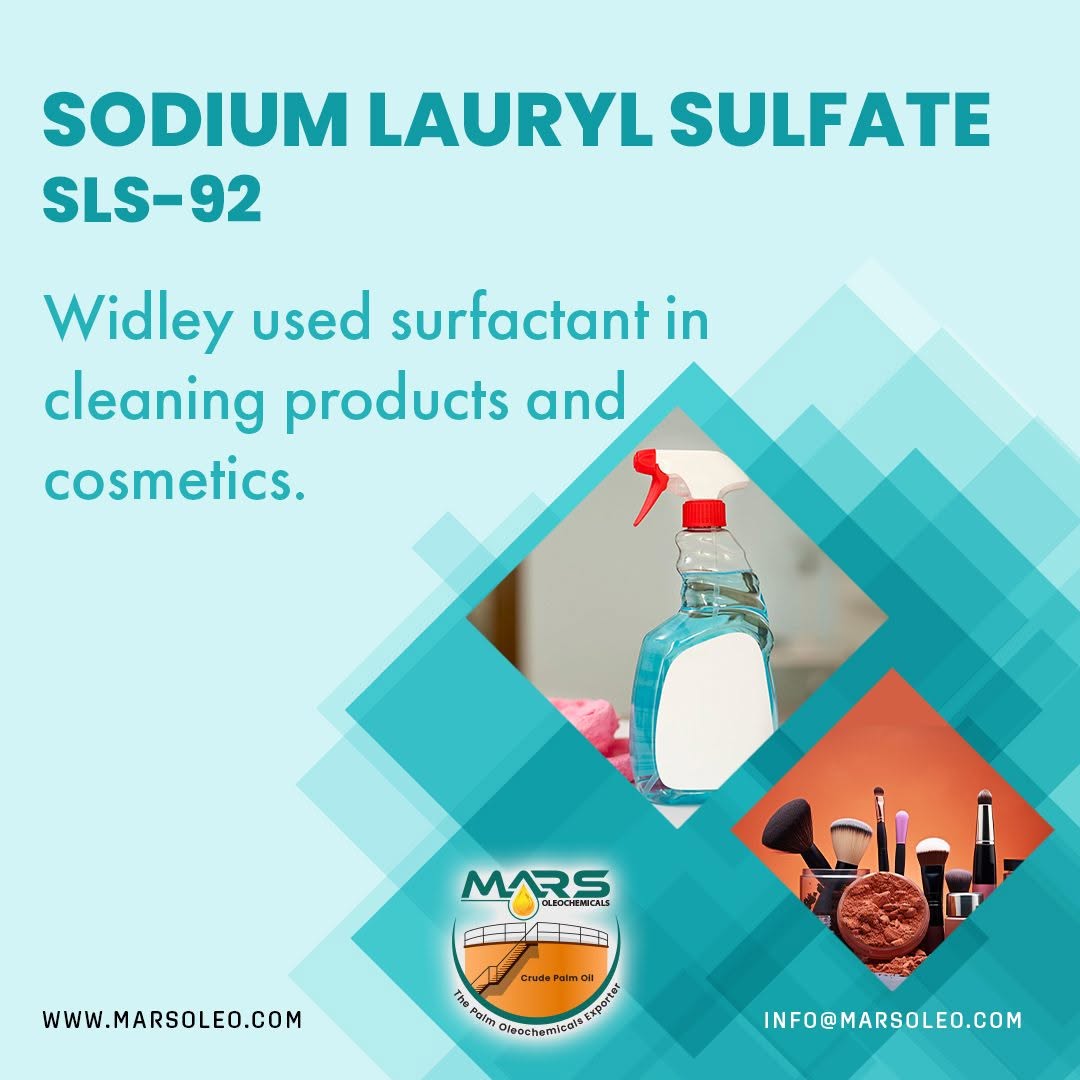
Sodium Lauryl Sulfate (SLS-92) is a high-active anionic surfactant widely used in the global detergent, cleaning, cosmetics and personal care industries. Recognized for its effective cleansing, foaming, wetting, emulsifying and dispersing properties, SLS supports the development of a broad range of consumer and industrial formulations. Chemically known as Sodium Dodecyl Sulfate (CAS No. 151-21-3), it functions by reducing surface and interfacial tension, helping cleaning solutions interact with oils, dirt and other substances. Commercial SLS-92 grades typically contain approximately 92% active matter, subject to supplier specifications. Mars Oleochemicals Sdn. Bhd., Malaysia, offers surfactants and oleochemical raw materials supporting industrial manufacturers and international chemical buyers.
Home care and detergent manufacturing industries, Sodium Lauryl Sulfate SLS-92 is used in suitable formulations for household cleaning, laundry detergents, dishwashing products, surface cleaners and specialty cleaning applications. Its anionic surface-active properties help improve wetting, foam generation and the removal of oily soils from various surfaces. SLS is also used in selected industrial cleaning systems where emulsification and detergency are required. The effectiveness of a finished cleaning product depends on the complete formulation, including its surfactant combination, water conditions and other functional ingredients. As a concentrated commercial surfactant grade, SLS-92 provides manufacturers with an ingredient suitable for developing application-specific cleansing systems.

Sodium Lauryl Sulfate SLS-92, a high-active anionic surfactant for detergents, cleaning products and personal care formulations.
Cosmetics, personal care and oral care industries, Sodium Lauryl Sulfate is used primarily for its cleansing and foaming functions. It appears in selected shampoos, body washes, liquid soaps, facial cleansers and toothpaste formulations, where its performance contributes to foam formation and cleansing efficiency. SLS can also serve as a wetting or emulsifying ingredient in appropriately designed specialty formulations, including selected pharmaceutical preparations. Because SLS may cause irritation at unsuitable concentrations or under prolonged exposure, formulators must evaluate the complete finished product for compatibility, intended contact duration and applicable regulatory requirements. Correct grade selection and product testing are essential for each intended application.
Mars Oleochemicals Malaysia, we support global manufacturing industries through a portfolio of Sodium Lauryl Sulfate (SLS), Sodium Lauryl Ether Sulphate (SLES), Cocamidopropyl Betaine (CAPB), Fatty Alcohol Ethoxylates, Fatty Alcohols, Fatty Acids and other Palm-Based Oleochemicals. Vegetable-derived fatty alcohols from palm kernel or coconut sources can serve as raw materials for selected surfactant products. Our emphasis on technical specifications, product documentation and commercial export support helps customers identify suitable ingredients for their formulations. Through reliable sourcing and international supply coordination, Mars Oleochemicals connects manufacturers with functional surfactants and oleochemical raw materials for household, personal care and industrial applications.
Visit our website at www.marsoleo.com For product requirements, technical documentation, commercial information and international export inquiries, please email us at info@marsoleo.com.
What is Sodium Lauryl Sulfate SLS-92, and what are its main advantages? Sodium Lauryl Sulfate SLS-92 is a high-active anionic surfactant used in cleaning and selected personal care formulations. Its main advantages include effective cleansing, strong foaming, wetting, emulsification and dispersion. The SLS-92 designation generally indicates approximately 92% active matter, subject to supplier specifications.
What are the main benefits of SLS-92 in detergent and cleaning formulations? SLS-92 helps remove oily dirt and grease, improves wetting and supports foam generation in suitable cleaning formulations. It is used in laundry detergents, dishwashing products, household cleaners and selected industrial cleaning systems.
What are the common applications of Sodium Lauryl Sulfate SLS-92? SLS is used in household detergents, liquid soaps, shampoos, body washes, toothpastes, surface cleaners and selected industrial wetting applications. Suitability of a particular SLS-92 grade depends on the product specifications and regulatory requirements.
What is the difference between Sodium Lauryl Sulfate (SLS) and Sodium Lauryl Ether Sulphate (SLES)? SLS is sodium lauryl sulfate, while SLES is sodium laureth sulfate. SLES contains ethoxylated groups that are absent from SLS. Both are anionic surfactants, but they differ in chemical structure and formulation characteristics.
Is Sodium Lauryl Sulfate SLS-92 suitable for cosmetics and personal care products? SLS can be used in appropriately formulated cosmetics and personal care products, particularly rinse-off cleansers. However, the concentrated SLS-92 raw material should not be confused with a finished cosmetic product. Formulators must evaluate grade suitability, irritation potential, concentration and applicable product safety requirements.






Home :: Products :: Enquiry :: Contact Us :: Site Map
Copyright All Rights Reserved © 2025. Mars Oleochemicals :: Disclaimer :: Privacy Policy