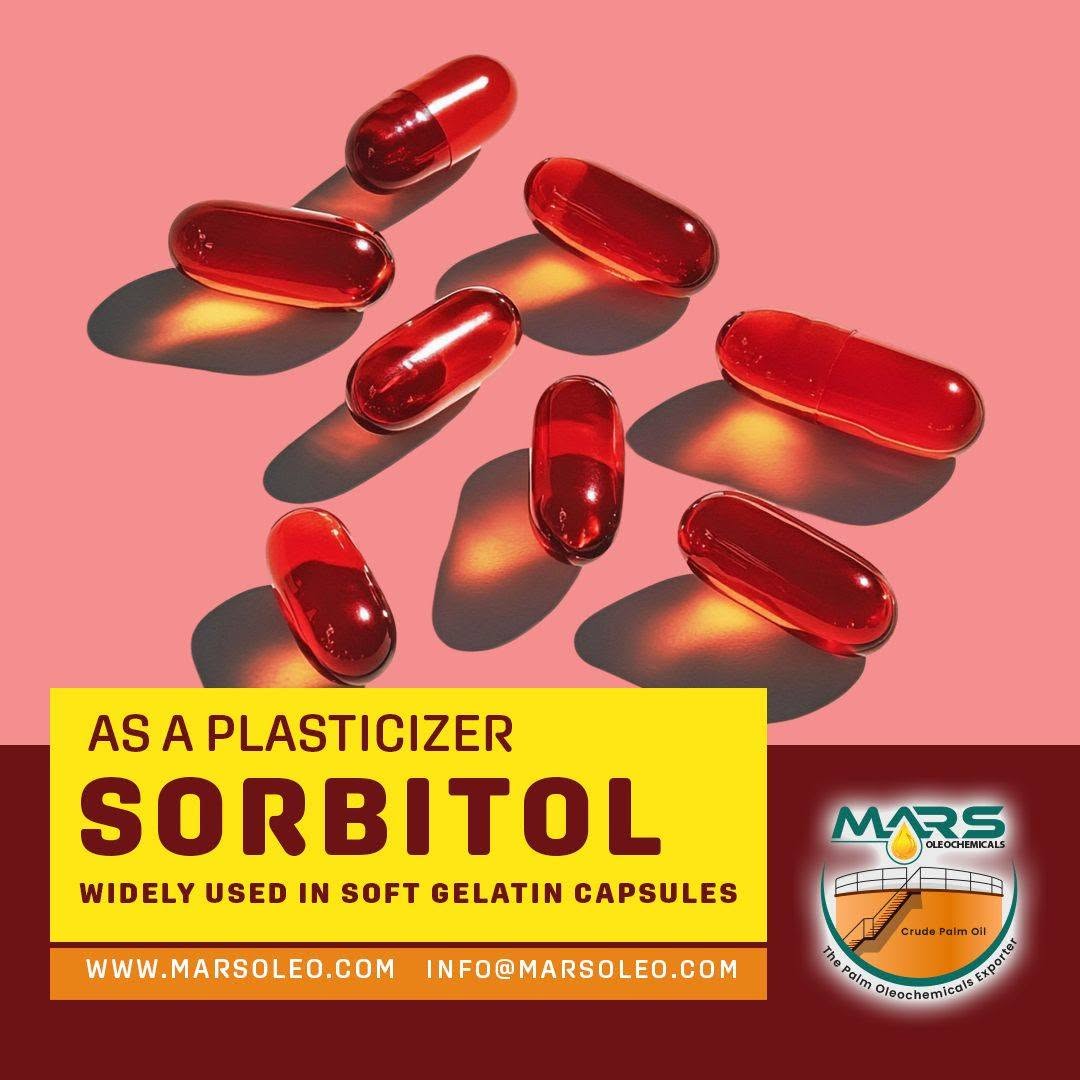
Soft gelatin capsules, commonly called softgels, are typically produced from gelatin together with one or more plasticizers and water. Sorbitol can be incorporated into suitable shell formulations as a plasticizing ingredient to help achieve the flexibility and mechanical properties required during manufacturing and storage.
The attached Mars Oleochemicals features red soft gelatin capsules and highlights Sorbitol “as a plasticizer widely used in soft gelatin capsules.” This is an appropriate technical application when clearly linked to suitable pharmaceutical-grade formulations.
Water balance is critical in soft gelatin capsule manufacturing. Plasticizers and gelatin interact with moisture throughout forming, drying and storage.
Sorbitol can influence moisture behavior because of its polyol and humectant characteristics. Manufacturers therefore optimize the ratio of gelatin, plasticizer and water according to the intended capsule formulation.
Too much or too little moisture can affect shell characteristics, so formulation and drying conditions must be carefully controlled.

Sorbitol acts as a plasticizer in soft gelatin capsules, supporting flexibility, moisture control, and performance.
Sorbitol is commonly supplied as an aqueous solution, often around 70% solids, for food, pharmaceutical, personal-care and industrial applications.
Mars Oleochemicals includes Sorbitol 70% for international commercial requirements. For pharmaceutical softgel applications, buyers should specify the required pharmacopeial or technical standard rather than relying on concentration alone.
Softgel manufacturers may use glycerine, sorbitol or combinations of plasticizers depending on the desired shell properties and capsule contents.
Different plasticizer systems can influence : Shell hardness, Flexibility, Moisture migration, Drying behavior, Elasticity, Capsule appearance, Storage stability and Compatibility with the fill material. Shell hardness, Flexibility, Moisture migration, Drying behavior, Elasticity, Capsule appearance, Storage stability and Compatibility with the fill material.
What is Sorbitol? Sorbitol is a sugar alcohol, or polyol, used in pharmaceutical, food, personal-care and industrial formulations for several functional purposes.
Is Sorbitol used in soft gelatin capsules? Yes. Sorbitol is used in suitable soft gelatin capsule shell formulations as a plasticizer.
Why is Sorbitol used as a plasticizer? It helps reduce gelatin rigidity and supports flexible, less brittle capsule shells.
What does a plasticizer do in softgel capsules? A plasticizer modifies the gelatin matrix so the shell can remain flexible and suitable for forming, sealing and handling.
Is Sorbitol the only plasticizer used in softgels? No. Glycerine and other suitable plasticizer systems may also be used, either alone or in combination with Sorbitol.
Can Sorbitol and glycerine be used together? Yes. Some formulations use combinations of plasticizers to achieve particular shell properties.
Does Sorbitol affect softgel moisture? Yes. Sorbitol's humectant properties can influence moisture behavior, so the full gelatin-plasticizer-water system must be optimized.
What is Sorbitol 70? Sorbitol 70 generally refers to an aqueous Sorbitol solution containing approximately 70% solids, subject to the supplier's specification.
Is Sorbitol 70 automatically pharmaceutical grade? No. Pharmaceutical suitability depends on the complete specification, purity, impurity limits, documentation and applicable pharmacopeial requirements.
Is Sorbitol used in pharmaceutical products other than softgels? Yes. Suitable Sorbitol grades may also be used in oral liquids, syrups and other pharmaceutical formulations.
Does Mars Oleochemicals supply Sorbitol 70? Yes. Mars Oleochemicals supplies Sorbitol 70% for international commercial requirements, subject to the requested specification.
How can buyers request Sorbitol? Buyers can provide the required concentration, grade, specification, quantity, packaging, intended application and destination to info@marsoleo.com.








Home :: Products :: Enquiry :: Contact Us :: Site Map
Copyright All Rights Reserved © 2025. Mars Oleochemicals :: Disclaimer :: Privacy Policy