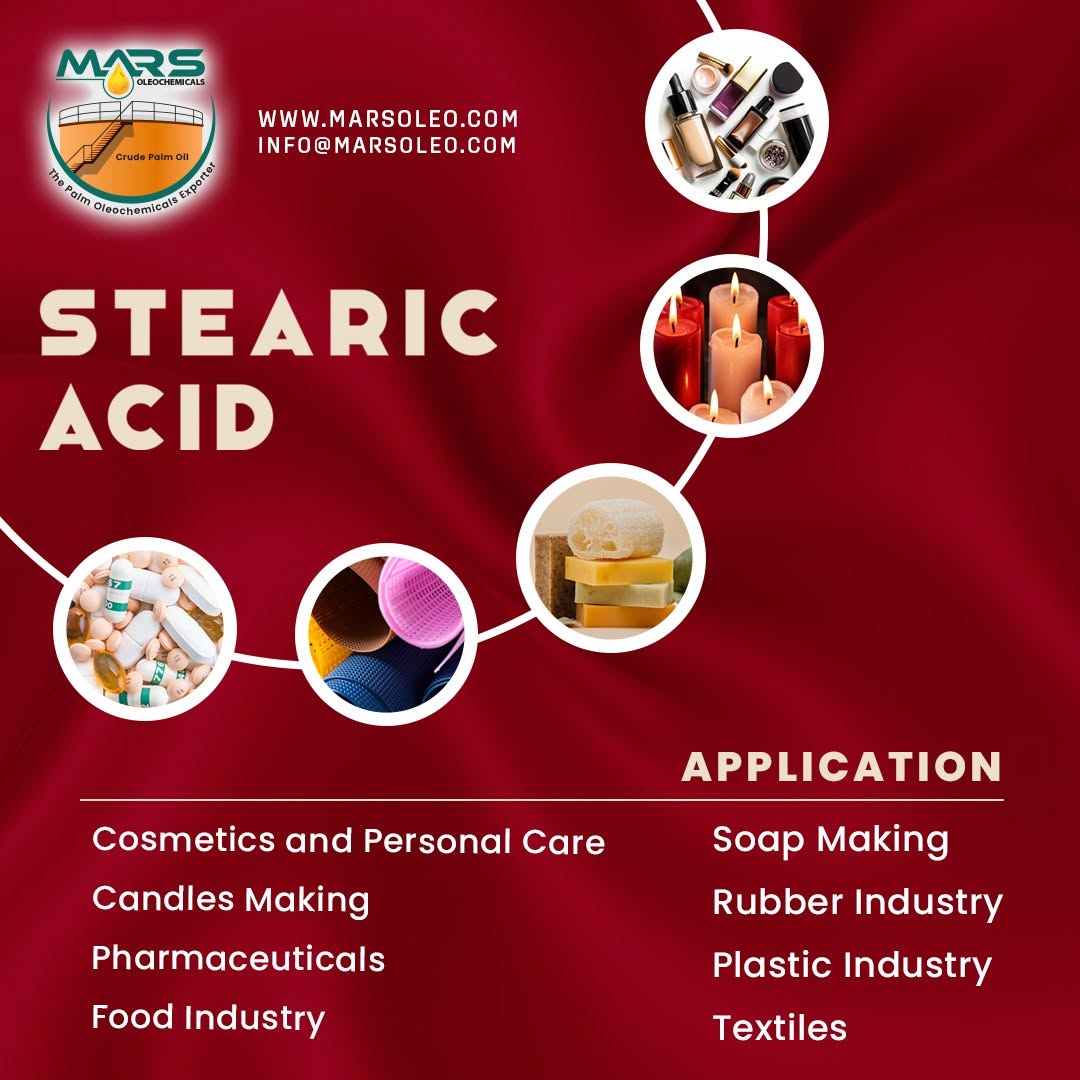
Stearic Acid, also known as Octadecanoic Acid, is an important saturated C18 fatty acid widely used in the global cosmetic, personal care, soap, candle, rubber, plastics, pharmaceutical, food and textile industries. This versatile oleochemical ingredient can be manufactured from vegetable-derived feedstocks, including palm oil and palm stearin. Its physical and chemical characteristics make it useful as a thickening agent, emulsion stabilizer, processing aid and intermediate for manufacturing other chemical products. Mars Oleochemicals Sdn. Bhd., Malaysia, supplies palm-based oleochemical products to manufacturers seeking suitable raw materials for diverse industrial applications.
Cosmetics and personal care industry, Stearic Acid contributes to the texture, consistency and stability of creams, lotions, cleansing products and selected hair care formulations. It can function as an emulsion-stabilizing and viscosity-controlling ingredient, while its neutralized derivatives serve as important soap and surfactant components. In soap manufacturing, stearic acid and its sodium or potassium salts are valuable for creating cleansing bars with desirable hardness, structure and lather characteristics. In candle manufacturing, Stearic Acid is frequently incorporated into wax blends to improve hardness, shape retention and other physical properties, depending on the formulation.

Palm-based Stearic Acid, its properties, industrial benefits and uses in cosmetics, soaps, candles and rubber.
Stearic Acid Applications extend to rubber processing, plastics manufacturing, pharmaceuticals, food-related production and textile chemicals. In the rubber industry, it is commonly used with zinc oxide in vulcanization systems. In the plastics industry, stearic acid and its derivatives can function as processing aids, lubricants and components of stabilizer systems. Appropriate pharmaceutical grades are used in selected drug formulations, while food-compliant grades and derivatives have specialized food industry applications. Stearic acid-derived materials are also used in textile treatment formulations, lubricants, polishes, coatings and specialty chemical manufacturing, demonstrating the broad industrial value of this fatty acid.
Mars Oleochemicals Malaysia supports international buyers through a diversified range of Stearic Acid, Palmitic Acid, Oleic Acid, Fatty Alcohols, Refined Glycerine, Soap Noodles, Surfactants, Esters and other Palm-Based Oleochemicals. Our commercial focus includes suitable grade selection, specification-based sourcing, export documentation and international shipment coordination. By connecting manufacturers with Malaysian oleochemical raw materials, Mars Oleochemicals supports applications across personal care, household products and industrial manufacturing. Product selection should consider fatty acid composition, purity, intended use, destination-market requirements and any applicable sourcing certifications.
Visit our website at www.marsoleo.com For product requirements, technical documentation, commercial information and international export inquiries, please email us at info@marsoleo.com.
What are the main advantages of Stearic Acid in industrial manufacturing? Stearic Acid offers versatile chemical properties and applications in cosmetics, soaps, candles, rubber, plastics and specialty chemical manufacturing. It is valued for thickening, structuring, lubrication and its ability to form useful derivatives such as metallic stearates.
How does Stearic Acid benefit cosmetics and personal care formulations? Stearic Acid contributes to the texture, viscosity and stability of creams, lotions and cosmetic emulsions. In suitable formulations, it can support emulsion stability and help produce smooth, consistent finished products.
Why is Stearic Acid used in soap and candle manufacturing? In soap manufacturing, Stearic Acid is used to produce stearate soaps that contribute hardness, structure and cleansing properties. In candle manufacturing, it can be incorporated into wax blends to modify hardness, opacity and shape retention.
What are the applications of Stearic Acid in rubber and plastics? In the rubber industry, Stearic Acid is commonly used with zinc oxide in vulcanization systems. In plastics manufacturing, Stearic Acid and its derivatives are used as lubricants, processing aids and components of selected stabilizer systems.
Can Stearic Acid be used in pharmaceutical, food and textile applications? Yes. Stearic Acid and its derivatives have applications in pharmaceutical formulations, permitted food-related uses and textile processing. The appropriate grade, product specification and regulatory compliance must be confirmed before use.







Home :: Products :: Enquiry :: Contact Us :: Site Map
Copyright All Rights Reserved © 2025. Mars Oleochemicals :: Disclaimer :: Privacy Policy