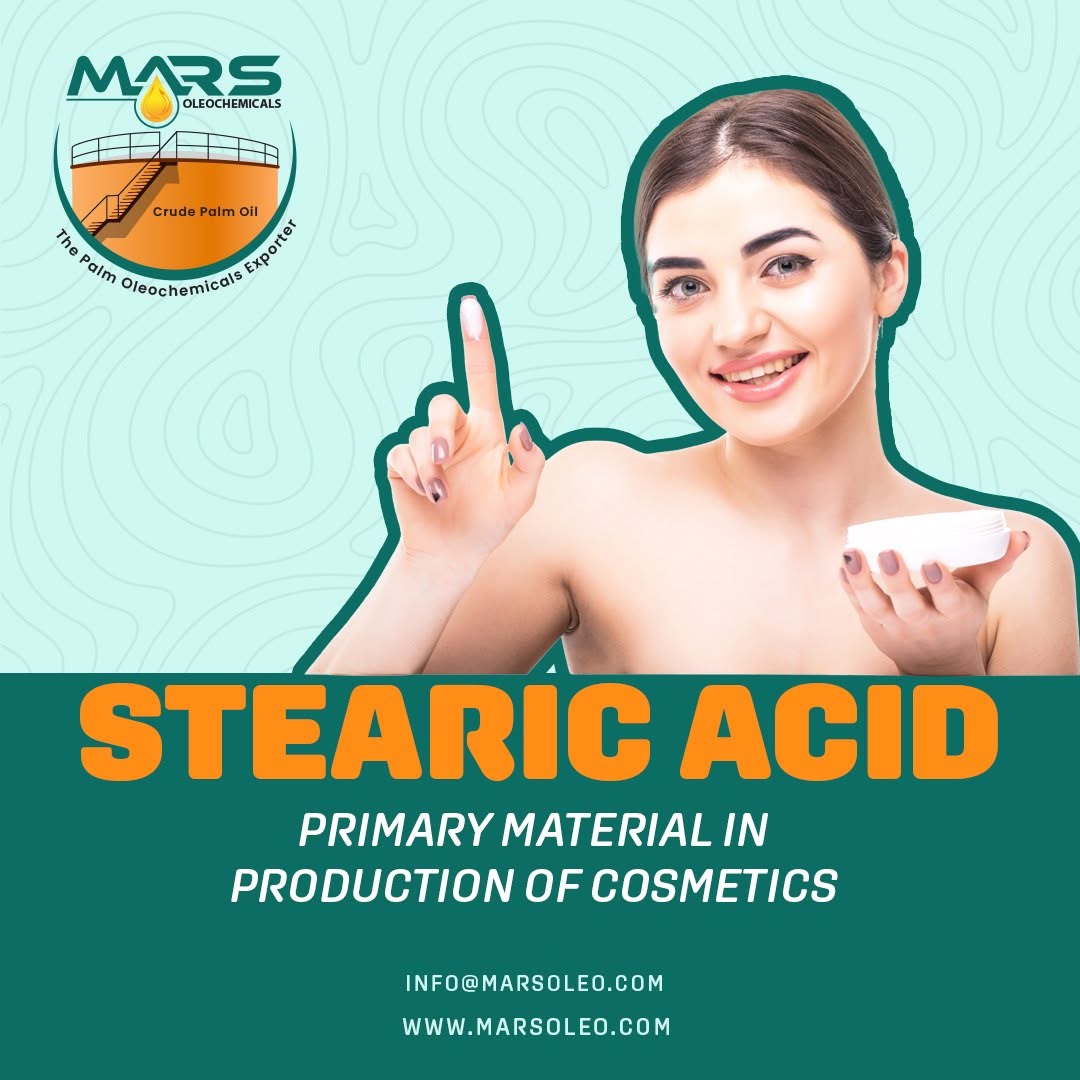
Stearic Acid is an important fatty acid widely used in the global cosmetics, skincare and personal care industries. Known for its thickening, consistency-enhancing and emulsion-stabilizing properties, it plays an important role in manufacturing creams, lotions, soaps and other cosmetic formulations.
At Mars Oleochemicals Sdn. Bhd., Malaysia, we supply palm-based oleochemical products, including Stearic Acid, for manufacturers seeking reliable vegetable-origin raw materials.
Derived from suitable palm-based feedstocks, commercial Stearic Acid is valued for its functionality, versatility and compatibility with numerous cosmetic formulations. From moisturizing creams and body lotions to facial cleansers and soaps, Stearic Acid contributes to the texture, structure and performance of finished personal care products.
Stearic Acid, chemically known as Octadecanoic Acid, is a saturated long-chain fatty acid containing 18 carbon atoms.
It occurs naturally in vegetable oils and animal fats. Commercial Stearic Acid can be produced using palm oil, palm stearin and other fatty acid feedstocks.
In the palm oleochemical industry, Stearic Acid is commonly obtained through fat processing, fatty acid separation and purification.
Commercial cosmetic grades may contain mixtures of stearic acid and other fatty acids, particularly palmitic acid, depending on the product specification.
Stearic Acid is typically available as white flakes, beads, pastilles or granular material.
Palm-based Stearic Acid can be manufactured from vegetable oil feedstocks through fatty acid processing.
Palm oil or palm stearin is processed to obtain fatty acids, which are subsequently separated and purified according to the desired product grade.
The resulting material may be supplied in flake, bead or granular form for convenient handling in industrial production.
Different grades are available to serve applications in cosmetics, soaps, candles, rubber processing and other industries.
Stearic Acid is widely valued as a multifunctional cosmetic ingredient.
It can act as a consistency agent, helping increase the thickness and structure of creams and lotions. In suitable emulsions, it also contributes to product stability and provides a smooth, uniform texture.
When combined with appropriate neutralizing agents, Stearic Acid can form stearate soaps that function as emulsifying or cleansing ingredients.
The final functionality depends on formulation composition, concentration, pH and processing conditions.

Stearic Acid as an important raw material for cosmetics and skincare, thickening, texture and emulsion stability.
Stearic Acid supports various cosmetic manufacturing requirements through its ability to modify consistency, texture and product structure.
It can be incorporated into formulations to obtain desired viscosity and provide a richer product feel.
Vegetable-origin grades offer manufacturers a plant-derived raw material option.
Its availability in different commercial grades also enables formulators to select suitable materials for particular cosmetic and industrial applications.
Stearic Acid supports the physical performance of cosmetic products.
It helps provide body and structure to creams and lotions while contributing to a smooth application experience. As a fatty acid ingredient, it can also provide emollient characteristics in suitable formulations.
Its main advantages relate to formulation texture, consistency, processing and emulsion performance rather than acting as an independent skincare treatment.
One of the primary functions of Stearic Acid in cosmetics is to improve consistency.
It helps manufacturers control the thickness and structure of certain creams, lotions and cleansing preparations.
In properly designed systems, Stearic Acid can also help stabilize emulsions, particularly through its interactions with other emulsifiers and formulation components.
This versatility makes it a useful material for cosmetic chemists and personal care manufacturers.
Palm-based Stearic Acid offers manufacturers a vegetable-origin option for formulating cosmetics and personal care products.
Its established functionality, commercial availability and compatibility with a broad range of formulation systems make it a widely used oleochemical ingredient.
For products requiring particular cosmetic grades, fatty acid composition, certification or sourcing criteria, supporting technical documentation should be reviewed.
Mars Oleochemicals Sdn. Bhd. is an MPOB-licensed Malaysian exporter supplying palm-based oleochemical products to international markets.
We support manufacturers and buyers seeking Stearic Acid and other fatty acid derivatives for cosmetics, personal care, soap manufacturing and industrial applications.
Visit our website at www.marsoleo.com For product requirements, technical documentation, commercial information and international export inquiries, please email us at info@marsoleo.com.
What is Stearic Acid and why is it used in cosmetics? Stearic Acid is a saturated fatty acid used in cosmetics as a thickening, consistency-enhancing and emulsion-stabilizing ingredient. It helps improve texture and structure in creams, lotions and personal care formulations.
What are the main benefits of Stearic Acid in skincare products? Stearic Acid supports product texture, consistency and smooth application. It can contribute emollient properties and help stabilize appropriately formulated cosmetic emulsions.
Is palm-based Stearic Acid suitable for cosmetic manufacturing? Yes. Palm-derived Stearic Acid is commonly used in cosmetic manufacturing when the selected grade meets formulation specifications, quality criteria and applicable regulatory requirements.
Is Stearic Acid an emulsifier or a thickening agent? Stearic Acid primarily functions as a consistency agent, thickener and structuring ingredient. When appropriately neutralized to form stearate salts, it can also contribute emulsifying and cleansing functionality.










Home :: Products :: Enquiry :: Contact Us :: Site Map
Copyright All Rights Reserved © 2025. Mars Oleochemicals :: Disclaimer :: Privacy Policy