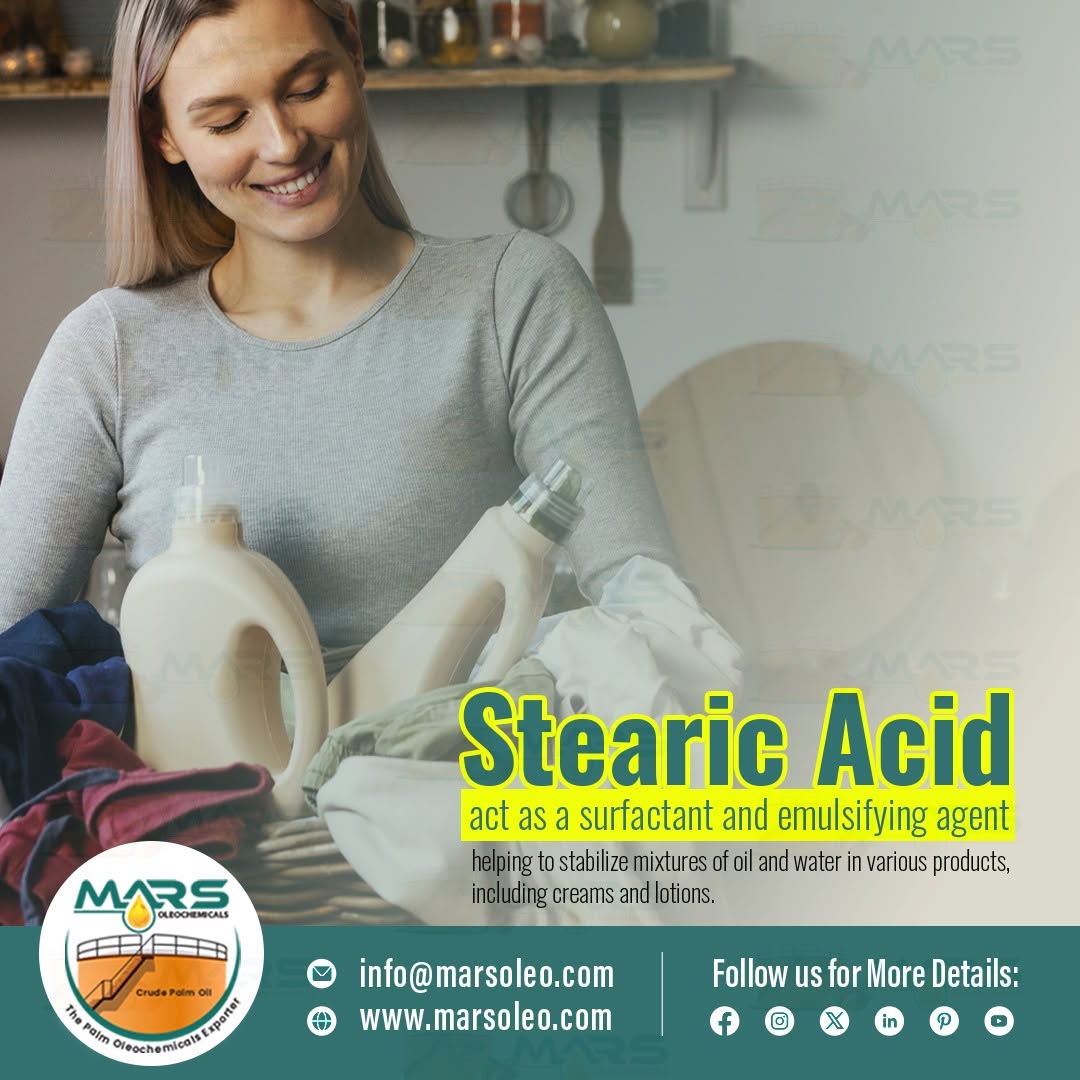
Stearic Acid is a widely used fatty acid in the cosmetics, personal care, soap and chemical industries. It plays an important role in formulation structure, viscosity control and emulsion stability.
Palm-based Stearic Acid is particularly valuable as a vegetable-origin raw material for manufacturers developing creams, lotions, cleansing products and specialty formulations.
At Mars Oleochemicals Sdn. Bhd., Malaysia, we supply palm-based fatty acids and oleochemical derivatives to support international industrial manufacturing requirements.
Stearic Acid is frequently associated with surfactant and emulsifying systems, its functionality depends on formulation chemistry. Its neutralized derivatives, known as stearate salts, are particularly important for providing surfactant and emulsifying properties.
Stearic Acid, also called Octadecanoic Acid, is a saturated C18 fatty acid naturally present in vegetable oils and animal fats.
Commercial vegetable-origin Stearic Acid may be produced using palm oil, palm stearin and related fatty acid feedstocks.
Its physical and chemical properties make it suitable for a wide range of personal care and industrial applications.
An emulsion is a mixture of two normally immiscible liquids, such as oil and water.
Cosmetic creams, body lotions and several cleansing formulations are common examples of emulsion-based products.
Stearic Acid helps influence the structure, consistency and rheological properties of appropriate emulsions.
Its long fatty acid chain contributes to interactions within the oil phase and other formulation components. When Stearic Acid is appropriately neutralized with an alkaline ingredient, stearate salts can form.
The resulting emulsion stability depends on the complete formulation, including emulsifier concentration, pH, temperature, processing conditions and other ingredients.
Stearic Acid and its neutralized salts are chemically related but perform different functions in formulations.
Stearic Acid is commonly used as a consistency agent, structuring ingredient and co-emulsifier in selected cosmetic systems.
Sodium Stearate is a soap-type anionic surfactant widely associated with cleansing and soap formulations.
Potassium Stearate is another soap-type surfactant that can contribute to emulsification and foaming in suitable systems.
This distinction is important when selecting ingredients for cosmetics, detergents and other products.

Palm-based Stearic Acid in emulsifying systems, creams, lotions, soaps and selected detergent formulations.
Stearic Acid can support emulsion stability by contributing to formulation structure and controlling consistency.
It helps create the desired physical characteristics in selected cream and lotion formulations. When combined with appropriate emulsifiers or neutralizing agents, it can form part of a functional oil-water emulsion system.
However, Stearic Acid alone should not be assumed to emulsify every oil-water mixture.
Manufacturers must evaluate the full formulation to achieve suitable stability, texture and performance.
Stearic Acid offers useful versatility as a raw material for cosmetic and industrial formulations.
Its vegetable-origin options make it suitable for manufacturers seeking plant-derived ingredients. It also provides structuring and consistency modification properties that help formulators control product viscosity and texture.
When used in an appropriately designed neutralized system, stearate formation provides additional surfactant functionality.
Stearic Acid and its derivatives can support a variety of formulation requirements.
They contribute to product consistency, cleansing performance, cream structure and selected emulsion systems.
Stearate-based surfactants can also provide foaming and cleansing properties in suitable applications.
The performance of each ingredient depends on the product grade, concentration and overall chemical formulation.
Palm-based Stearic Acid is an established vegetable-origin oleochemical raw material.
It can be used to manufacture personal care products, soap ingredients and specialty chemical derivatives.
Its versatility makes it useful to manufacturers developing different formulations for cosmetic and industrial markets.
Selecting the appropriate grade requires attention to fatty acid composition, appearance, acid value, iodine value and other relevant specifications.
Mars Oleochemicals Sdn. Bhd. is an MPOB-licensed Malaysian exporter supplying palm-based oleochemicals and fatty acid derivatives.
We support international manufacturers seeking Stearic Acid and related products for cosmetics, personal care, soap manufacturing and industrial applications.
Visit our website at www.marsoleo.com For product requirements, technical documentation, commercial information and international export inquiries, please email us at info@marsoleo.com.
How does Stearic Acid work as an emulsifying agent? Stearic Acid contributes to the structure and stability of cosmetic emulsions. When appropriately neutralized, it forms stearate salts that provide emulsifying functionality, helping oil and water phases remain dispersed in creams and lotions.
What are the benefits of Stearic Acid in surfactant formulations? Stearic Acid supports viscosity, consistency and formulation stability. Its derivatives, including sodium stearate and potassium stearate, provide surfactant properties useful in selected soap, cleansing and emulsifying systems.
Can Stearic Acid stabilize oil and water mixtures? Yes. In properly formulated emulsions, Stearic Acid can help stabilize oil-water mixtures by contributing to product structure. With suitable emulsifiers or neutralizing agents, it can support stable cosmetic emulsions.
What are the main applications of Stearic Acid in cosmetics and detergents? Stearic Acid is used in moisturizing creams, lotions, facial cleansing products, shaving creams, soaps and selected detergent formulations. Its function varies according to the formulation.






Home :: Products :: Enquiry :: Contact Us :: Site Map
Copyright All Rights Reserved © 2025. Mars Oleochemicals :: Disclaimer :: Privacy Policy