


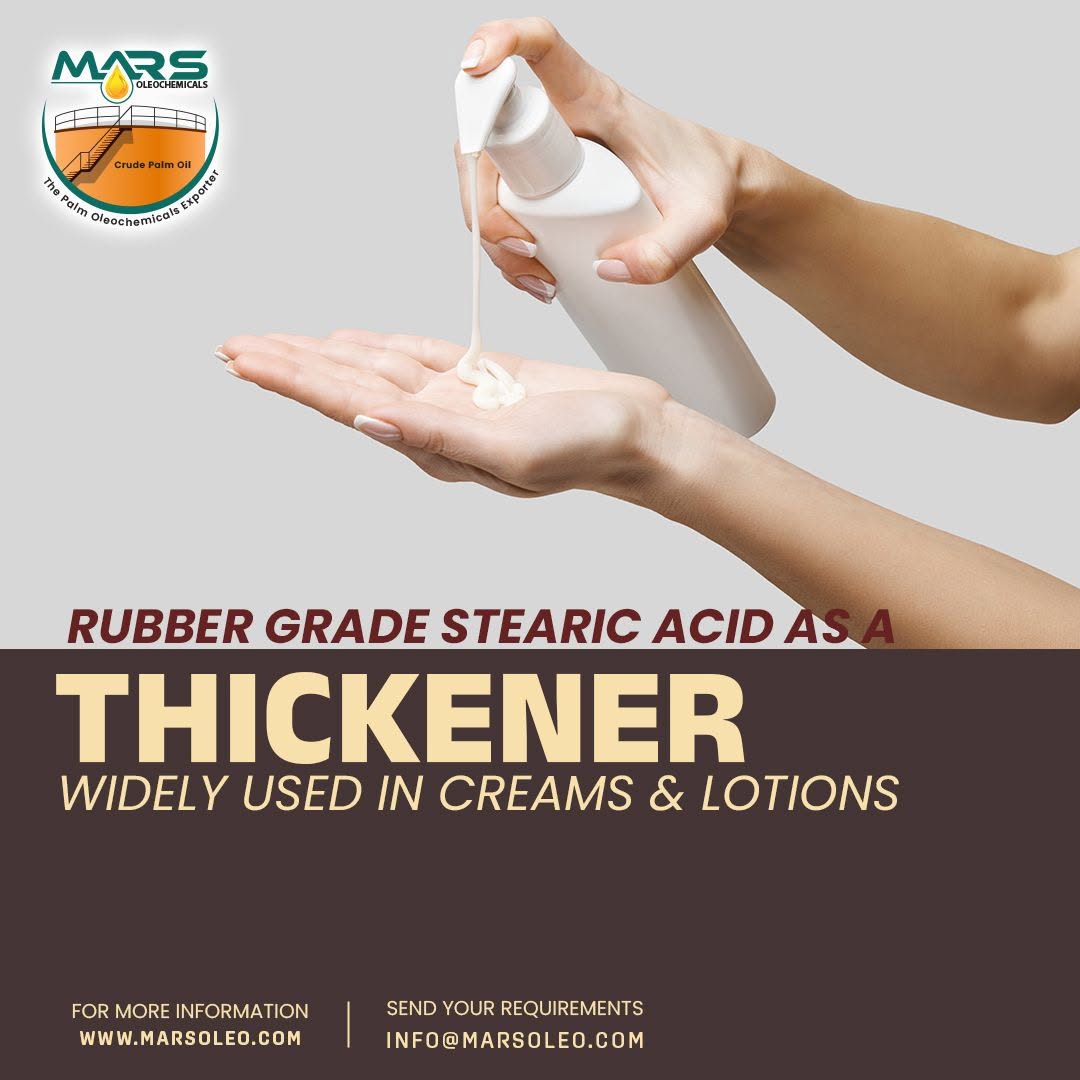
Stearic Acid, chemically known as Octadecanoic Acid, is a saturated long-chain fatty acid widely used in rubber manufacturing, cosmetics, personal care, soaps, detergents and industrial oleochemical applications. Stearic acid can be manufactured from palm-based fatty acid feedstocks and is available in different commercial grades with varying fatty acid compositions and purity characteristics. Its functionality depends on product specifications, processing requirements and intended industrial applications. Rubber-grade stearic acid is primarily used in rubber compounding, while suitable cosmetic-grade stearic acid can contribute to emulsion stability, viscosity and the texture of creams and lotions.
Rubber Grade Stearic Acid is an important auxiliary ingredient in rubber compounding and sulfur vulcanization systems. It is commonly used with zinc oxide to support the activation of vulcanization chemistry, helping manufacturers achieve the intended processing and curing performance. The material is relevant to manufacturing applications such as automotive tyres, industrial rubber goods, seals, hoses and molded rubber components. Product selection should consider acid value, iodine value, fatty acid composition, moisture, colour and other quality specifications. Rubber-grade stearic acid must not automatically be considered suitable for skin-contact cosmetic products.

Stearic acid rubber processing while suitable cosmetic grades enhance cream texture and formulation stability.
Stearic Acid in cosmetic formulations performs different functions when an appropriate cosmetic-grade material is selected. It can contribute to the structure and consistency of creams, lotions and other emulsions, helping formulators achieve a rich texture and desired product body. Stearic acid can also support emulsion stability and may be neutralized with suitable alkalis to form stearate soaps that contribute to emulsification. Its performance depends on concentration, formulation pH, processing temperature and compatibility with other cosmetic ingredients. Stearic acid itself is not always a complete emulsifier system, so formulation testing remains important.
Palm-Based Stearic Acid is derived from suitable palm oil or palm-derived fatty acid feedstocks and supports a broad range of industrial manufacturing activities. Commercial products may be offered with different C16 and C18 fatty acid compositions and purity levels. Manufacturers evaluating these materials should confirm their intended-use requirements, appropriate technical specifications, material origin and relevant regulatory documentation. Claims concerning sustainability, cosmetic-grade quality or pharmaceutical suitability should be supported by product-specific certificates and quality records.
Mars Oleochemicals Sdn. Bhd., Malaysia, international sourcing and export inquiries for palm-based stearic acid, fatty acids and related oleochemical products. Manufacturers, importers, distributors and industrial buyers can contact Mars Oleochemicals to discuss suitable grades, technical specifications, fatty acid composition, packing, quality documentation and shipment requirements. Visit our website at www.marsoleo.com For product requirements, technical documentation, commercial information and international export inquiries, please email us at info@marsoleo.com.
What is Rubber Grade Stearic Acid used for? Rubber Grade Stearic Acid is primarily used as a vulcanization co-activator in rubber compounding. It works with zinc oxide in sulfur vulcanization systems and is used in tyres, seals, hoses and industrial rubber products.
Can Rubber Grade Stearic Acid be used in creams and lotions? Rubber-grade stearic acid should not automatically be used in cosmetic products. Creams and lotions require appropriately specified cosmetic-grade material that meets relevant quality and safety requirements.
How does Stearic Acid work as a thickener in cosmetics? Suitable cosmetic-grade stearic acid contributes to consistency and emulsion stability in creams and lotions. It may also be neutralized to form stearate soaps that support emulsification.
Is Stearic Acid derived from palm oil? Stearic acid can be produced from palm-based fatty acids, other vegetable oils or animal fats. Feedstock origin must be confirmed through supplier documentation.
Where can manufacturers source Stearic Acid from Malaysia? Mars Oleochemicals Sdn. Bhd. supports international sourcing and export inquiries for palm-based stearic acid and related fatty acids.










Home :: Products :: Enquiry :: Contact Us :: Site Map
Copyright All Rights Reserved © 2025. Mars Oleochemicals :: Disclaimer :: Privacy Policy


