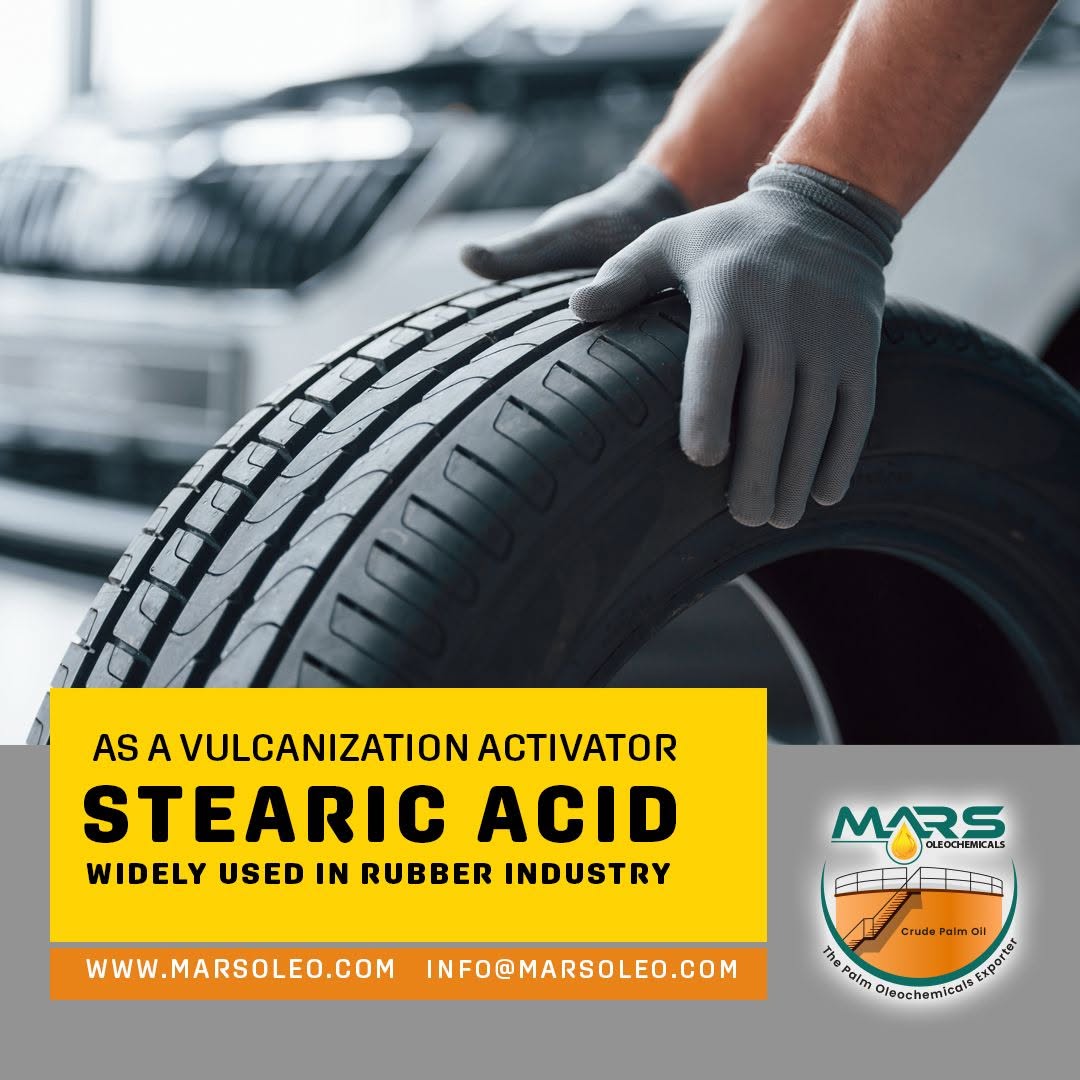
Stearic Acid is a saturated long-chain fatty acid commonly used as an additive in rubber compounding. The attached Mars Oleochemicals visual dated highlights its use as a vulcanization activator in the rubber industry.
Stearic Acid is generally considered part of the activator system, particularly in sulfur vulcanization where it commonly works alongside zinc oxide and other cure-system ingredients.
In many sulfur-cured rubber compounds, Stearic Acid and zinc oxide are used together to create an effective activator system.
Stearic Acid can interact with zinc oxide to form zinc-containing species that participate in the cure chemistry. This helps support efficient accelerator and sulfur systems during vulcanization.
The exact mechanism and optimum concentration vary according to rubber type, accelerator system, sulfur level and compound design.

Stearic acid rubber vulcanization by activating cure systems, improving processing, dispersion and compound performance.
Vulcanization transforms a rubber compound from a relatively soft and thermoplastic material into a crosslinked elastomer with useful mechanical and thermal properties.
A properly designed cure system can influence : Tensile properties, Elastic recovery, Hardness, Heat resistance, Abrasion behavior, Compression characteristics, Aging performance and Dimensional stability. Stearic Acid the cure system, but these final properties depend on the complete rubber formulation, not Stearic Acid alone.
Tire compounds contain numerous ingredients, including elastomers, carbon black or silica, sulfur systems, accelerators, activators, antioxidants, oils and other additives.
Stearic Acid may be incorporated into suitable tire formulations as part of the vulcanization activator system and to support processing.
What is Stearic Acid? Stearic Acid is a saturated long-chain fatty acid widely used in rubber, soap, cosmetics, candles, lubricants and other industrial formulations.
Is Stearic Acid used in rubber manufacturing? Yes. Stearic Acid is widely used in natural and synthetic rubber compounding.
Is Stearic Acid a vulcanization activator? Stearic Acid forms part of the vulcanization activator system in many rubber formulations, commonly working together with zinc oxide.
Why are Stearic Acid and zinc oxide used together? They form an activator system that supports accelerator and sulfur cure chemistry in many vulcanized rubber compounds.
Is Stearic Acid used in tire manufacturing? Yes. Stearic Acid is commonly incorporated into tire compounds as part of cure and processing systems.
Does Stearic Acid improve rubber elasticity? Stearic Acid supports the vulcanization system, but final elasticity depends on the rubber polymer, crosslink density, fillers, cure package and complete formulation.
Does Stearic Acid increase rubber durability? It can contribute indirectly through proper cure and processing chemistry, but durability depends on the complete compound and service conditions.
Is Stearic Acid used as a processing aid? Yes. In suitable formulations it can support processing, lubrication and ingredient dispersion.
Can Stearic Acid be used with natural rubber? Yes. Stearic Acid is widely used in natural-rubber vulcanization and compounding systems.
Can Stearic Acid be used with synthetic rubber? Yes. It is also used with multiple synthetic elastomers depending on formulation requirements.
Does Mars Oleochemicals supply rubber-grade Stearic Acid? Mars Oleochemicals supplies Stearic Acid grades for rubber and other industrial applications according to required specifications.
How can rubber manufacturers request a quotation? Buyers can provide the required grade, composition, technical specification, quantity, packaging and destination to info@marsoleo.com.










Home :: Products :: Enquiry :: Contact Us :: Site Map
Copyright All Rights Reserved © 2025. Mars Oleochemicals :: Disclaimer :: Privacy Policy