Surfactants, short for surface-active agents, are compounds designed to modify surface and interfacial behaviour. Their molecular structure generally contains a water-attracting hydrophilic region and an oil-compatible hydrophobic region. This dual character enables surfactants to position themselves between water, oil, dirt and surfaces, helping formulations perform functions including cleaning, wetting, emulsification, foaming and dispersion.
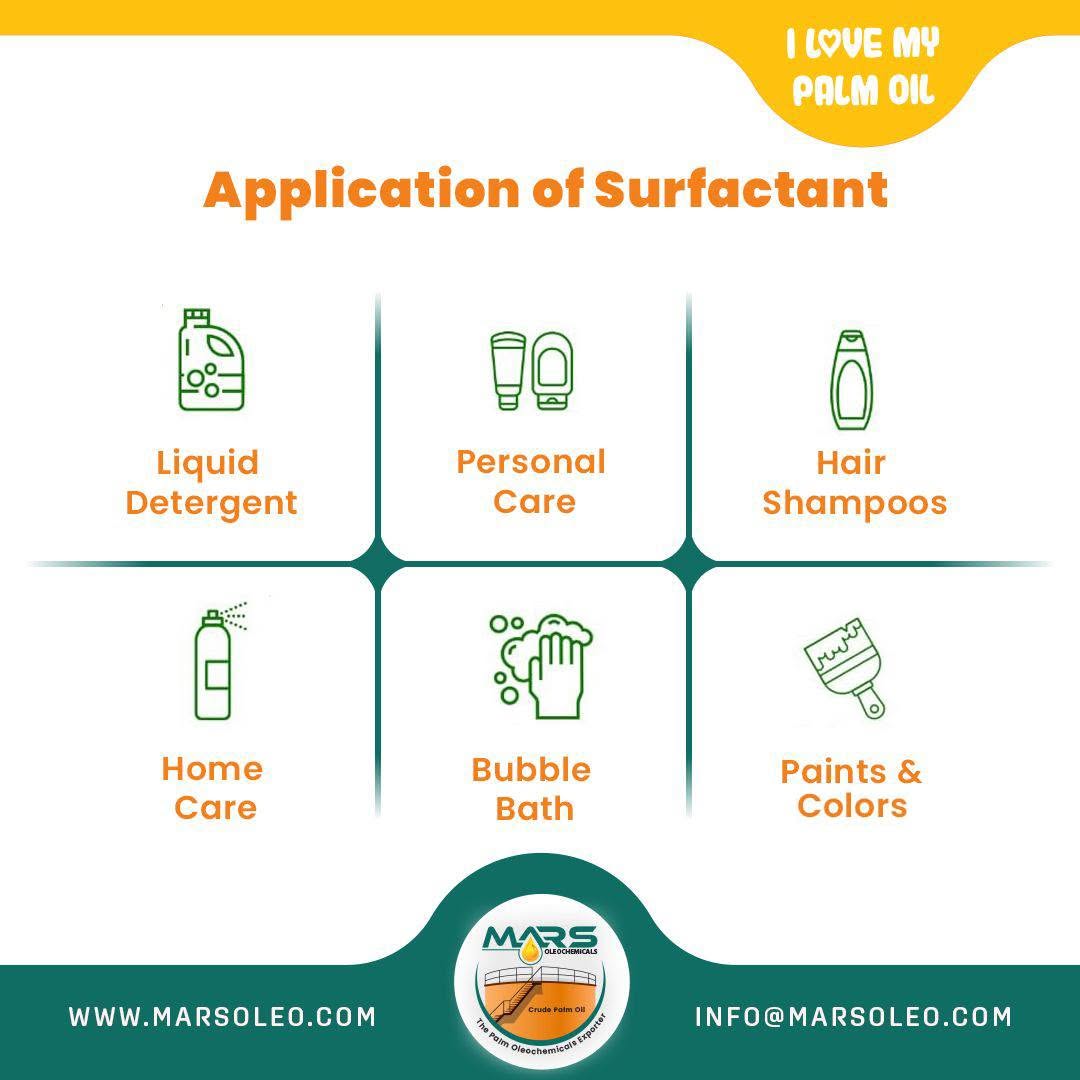
Surfactants in laundry detergents, dishwashing liquids and household cleaners, surfactants help loosen oily soils and dirt and enable them to be dispersed into the wash solution for easier removal. Different surfactant combinations are selected according to required detergency, foam level, viscosity, water compatibility and cleaning performance. Mars lists SLES, SLS, MES, CAPB and CDEA among its commercial surfactant categories for cleaning and formulation applications.

Surfactants reduce surface tension, wetting, emulsifying, dispersing and formulation performance across industries.
Personal-care formulations use surfactants for cleansing, foaming, emulsification and formulation stability. Shampoos, body washes, hand washes, liquid soaps and bubble baths often contain combinations of primary and secondary surfactants selected to obtain the required cleansing strength, foam characteristics, viscosity and sensory properties. For example, Mars describes SLES N70 as an anionic surfactant widely used in shampoos, body washes, hand washes and detergents, while Cocamide DEA can function as a foam booster and viscosity enhancer in compatible formulations.
Beyond cleaning and personal care, surfactants serve as wetting agents, emulsifiers, dispersants and processing aids in paints, coatings, agriculture, petroleum processing, lubricants, textiles and other industrial formulations. Their exact function depends on surfactant chemistry, concentration and the complete formulation. This broad range of surface and interfacial functions is what makes surfactants important across both consumer and industrial manufacturing.
What is a surfactant? A surfactant is a surface-active substance that changes interactions at interfaces such as water and oil. Surfactants can provide cleansing, wetting, foaming, emulsification, solubilisation and dispersion depending on their chemistry and formulation.
What are surfactants used for? Surfactants are widely used in detergents, household cleaners, shampoos, body washes, cosmetics, paints, coatings, agriculture, petroleum processing, lubricants and industrial formulations.
How do surfactants help detergents clean? Surfactants help water wet surfaces and interact with oily soils, allowing dirt and grease to become dispersed or suspended in the wash solution for easier removal.
Which surfactants are commonly used in shampoo? Depending on the formulation, shampoo systems may use surfactants such as SLES, SLS and CAPB, together with supporting ingredients used for foam, viscosity and conditioning requirements. Mars currently supplies several of these grades.
What is SLES N70 used for? SLES N70 is a concentrated anionic surfactant commonly used in shampoos, body washes, hand washes, liquid soaps, detergents and other cleaning formulations.
What is CAPB used for? Cocamidopropyl Betaine is commonly used in liquid soaps, shampoos, cosmetics, toiletries and detergent formulations, often as part of blended surfactant systems.
What is Cocamide DEA CDEA-85 used for? Cocamide DEA CDEA-85 is commonly used as a supporting surfactant, foam booster, foam stabiliser and viscosity enhancer in shampoos, bubble baths, liquid soaps, detergents and compatible cleaning formulations.
Are surfactants used in paints and coatings? Yes. Suitable surfactants can be used for wetting, emulsification and dispersion in paints, coatings and other formulated industrial systems.
Are all surfactants the same? No. Surfactants include anionic, cationic, non-ionic and amphoteric classes, and their performance varies substantially according to molecular structure, concentration and formulation requirements.








Home :: Products :: Enquiry :: Contact Us :: Site Map
Copyright All Rights Reserved © 2025. Mars Oleochemicals :: Disclaimer :: Privacy Policy