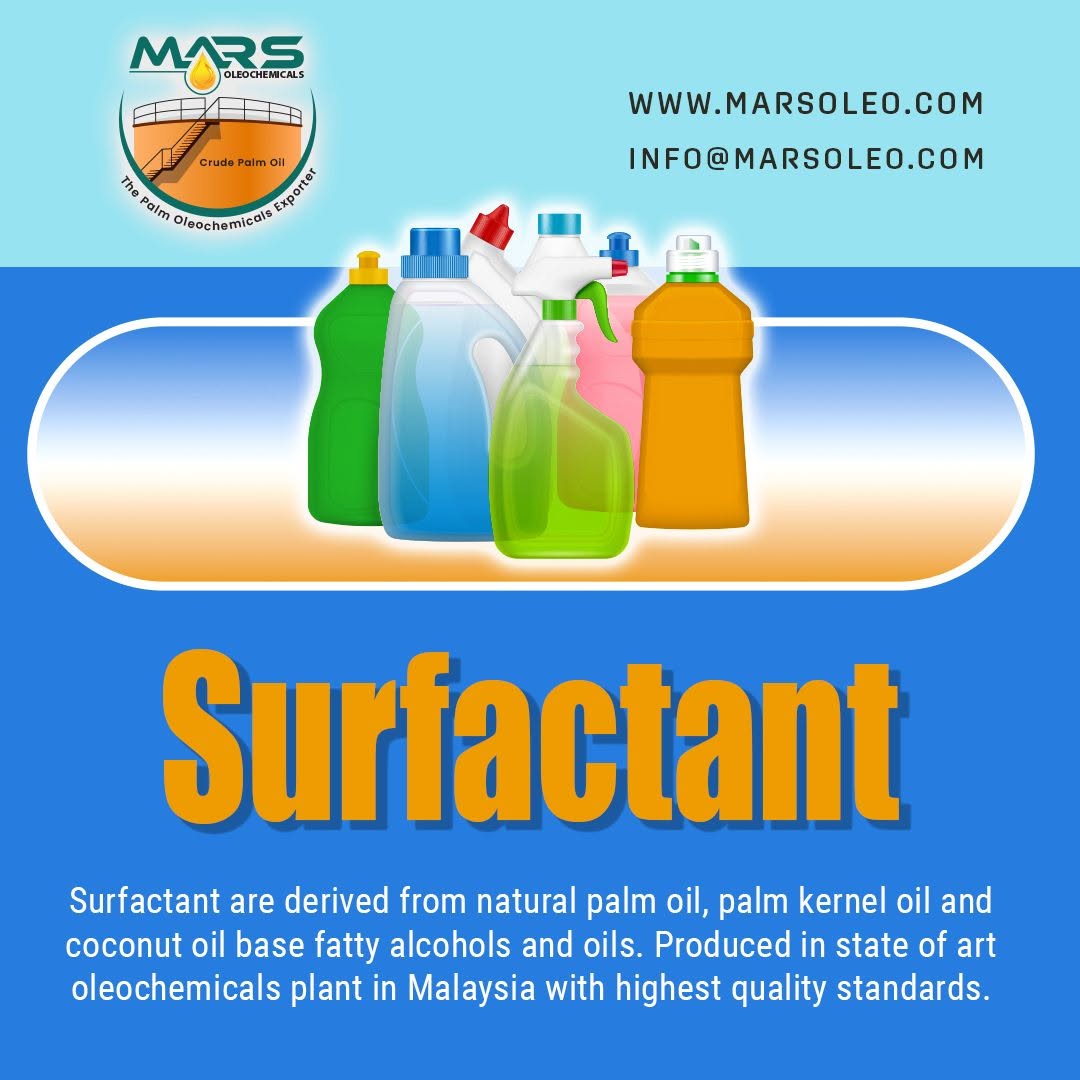
Surfactants are surface-active ingredients used to improve cleansing, wetting, foaming, emulsification and dispersion. Different surfactant chemistries provide different performance characteristics, making grade selection important for personal care, detergents, home care and industrial formulations.
Surfactant systems may include anionic products such as SLES and SLS, amphoteric surfactants such as CAPB and nonionic co-surfactants such as CDEA. Each has a different role, active-matter level and technical specification, so they should not be treated as interchangeable products.

Surfactants reduce surface tension, enabling effective cleansing, foaming, emulsification and dispersion across formulations worldwide.
Many surfactant manufacturing chains can begin with renewable oleochemical feedstocks such as palm-kernel or coconut-derived fatty materials. Natural Fatty Alcohols can serve as important intermediates for alcohol ethoxylates, sulfates and ether sulfates used across detergent and personal-care industries.
Buyers should specify the required surfactant chemistry, active matter, technical specification, quantity, packaging, application and destination. Reviewing the applicable COA, TDS and SDS helps ensure the selected product matches technical, regulatory and commercial requirements.
What is a surfactant? A surfactant is a surface-active ingredient that reduces surface or interfacial tension and can support cleansing, wetting, foaming, emulsification and dispersion.
What are surfactants used for? Surfactants are widely used in shampoos, body washes, hand washes, detergents, household cleaners and industrial cleaning formulations.
What is SLES 70? SLES 70 is a concentrated Sodium Laureth Sulfate grade commonly used as an anionic cleansing and foaming surfactant.
Is SLES N70 the same as SLES 70? N70 is a commonly used commercial designation for approximately 70% active Sodium Laureth Sulfate, although the actual supplier specification should always be checked.
What is SLS 95? SLS 95 is a high-active Sodium Lauryl Sulfate grade used in detergent, cleansing and selected personal-care applications.
What is CAPB? CAPB stands for Cocamidopropyl Betaine, an amphoteric surfactant widely used in personal-care and cleansing formulations.
What is the difference between CAPB 30 and CAPB 45? They are different commercial concentration or grade levels, so the actual active matter and specification should be compared before use.
What is CDEA 85? CDEA 85 is a Cocamide DEA co-surfactant grade traditionally used for foam and viscosity support in cleansing formulations, subject to applicable market regulations.
Is SLES the same as SLS? No. Both are anionic surfactants, but their chemical structures and formulation characteristics differ.
Can SLES and CAPB be used together? They are commonly used in compatible surfactant systems, but the final ratio depends on formulation requirements.
Are surfactants made from palm oil? Some oleochemical surfactants can use fatty-acid or Fatty Alcohol intermediates derived from palm-kernel, coconut or other renewable oil feedstocks, but not all surfactants have the same origin.
What surfactants does Mars Oleochemicals handle? The portfolio includes SLES 70 / N70, SLS 95, CAPB 30 / 45 and CDEA 85.
What determines surfactant quality? Important parameters vary by product and may include active matter, pH, color, viscosity, salts, moisture and other chemistry-specific analytical values.
What documents should buyers request? Buyers may request the applicable COA, TDS and SDS for technical and commercial evaluation.
What information is required for a quotation? Provide the product name, required active matter, specification, quantity, packaging, intended application and destination.
How can buyers contact Mars Oleochemicals? Commercial requirements can be sent to info@marsoleo.com.






Home :: Products :: Enquiry :: Contact Us :: Site Map
Copyright All Rights Reserved © 2025. Mars Oleochemicals :: Disclaimer :: Privacy Policy