


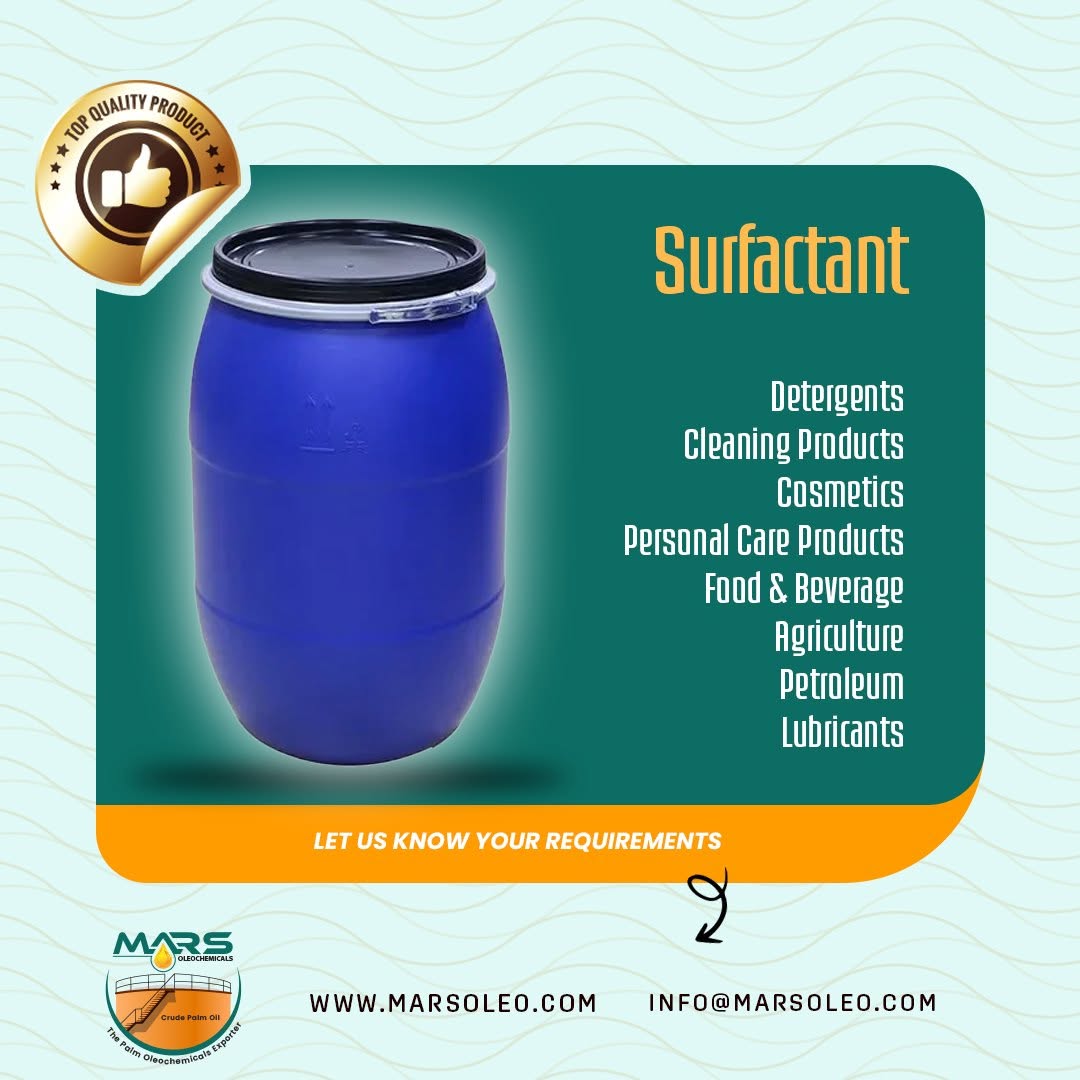
Surfactants are essential ingredients used to reduce surface and interfacial tension, enabling cleaning, wetting, foaming, emulsification and dispersion. Their unique molecular structure allows interaction with both water and oily materials, making surfactants highly valuable across consumer and industrial formulations.
Detergent manufacturers rely on surfactants to loosen soil, disperse oily material and improve cleaning performance. Different combinations of anionic, nonionic and amphoteric surfactants can be used in laundry detergents, dishwashing liquids, household cleaners and industrial cleaning formulations.

Surfactants reduce surface tension and support cleaning, foaming, emulsifying, wetting, dispersing and formulation performance worldwide.
Personal-care manufacturers use surfactants in shampoos, body washes, facial cleansers and liquid soaps. Products such as SLES and CAPB can provide cleansing, foam, viscosity and formulation functionality, while surfactant selection must account for mildness, compatibility and the desired sensory profile.
Beyond household and personal care, specialized surfactants are used in agriculture, petroleum, lubricants, textile processing and other industrial sectors. Selecting the correct surfactant requires consideration of active matter, ionic character, pH, formulation compatibility and the intended technical function.
What is a surfactant? A surfactant is a surface-active ingredient that reduces surface or interfacial tension and can provide cleaning, wetting, emulsifying, foaming or dispersing functionality.
What are surfactants used for? Surfactants are used in detergents, cleaning products, shampoos, cosmetics, personal care, agriculture, petroleum, lubricants and numerous industrial formulations.
What are the four main types of surfactants? The four major classes are anionic, amphoteric, nonionic and cationic surfactants.
Why are surfactants used in detergents? Surfactants help wet surfaces, loosen oily soil, suspend dirt and improve overall cleaning performance.
Are surfactants used in shampoo? Yes. Surfactants provide cleansing and often contribute to foam and formulation characteristics in shampoo.
What is SLES? SLES, or Sodium Laureth Sulfate, is an anionic surfactant widely used in personal-care and cleaning formulations.
What is CAPB? CAPB, or Cocamidopropyl Betaine, is an amphoteric surfactant widely used in shampoos, body washes and mild cleansing formulations.
Are surfactants used in agriculture? Yes. Suitable agricultural surfactants can function as wetting agents, spreading agents, emulsifiers, dispersants and formulation aids.
Can surfactants be used in food? Only specific food-grade surfactants or emulsifiers approved for the intended food application should be used.
What should buyers check when sourcing surfactants? Buyers should review surfactant type, active matter, pH, appearance, viscosity, ionic character, concentration and application-specific specifications.











Home :: Products :: Enquiry :: Contact Us :: Site Map
Copyright All Rights Reserved © 2025. Mars Oleochemicals :: Disclaimer :: Privacy Policy


